
Prosper in the Land
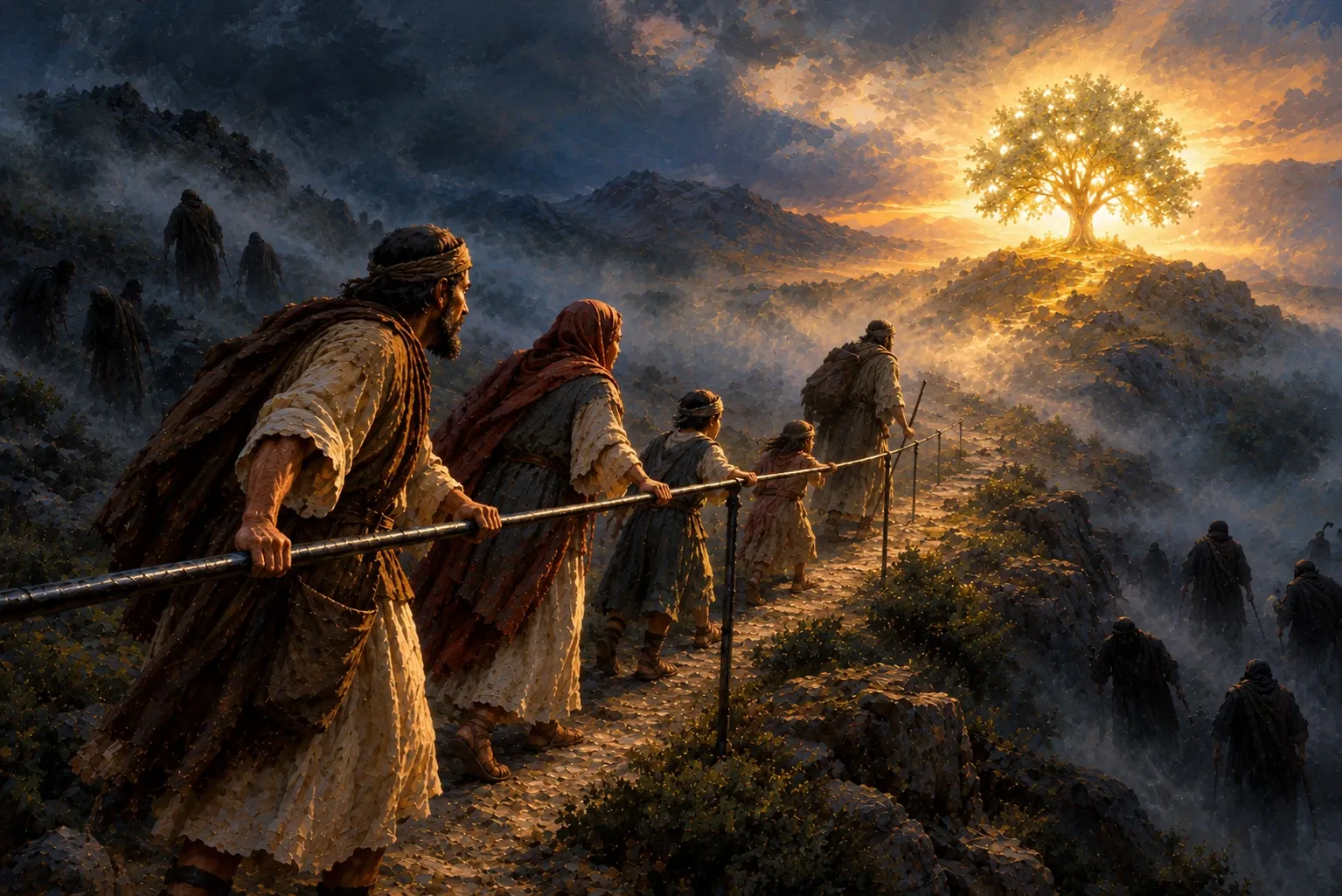
Keep the Commandments
"Keep the commandments," we use this phrase all the time, but are we using it the same way the Nephite authors used it? What did Nephi and Lehi consider to be commandments? What commandments were given?
We tend to think of the Ten Commandments when this phrase is used, and quite often this is the meaning. We know Lehi and his family kept the law of Moses, "And we did observe to keep the judgments, and the statutes, and the commandments of the Lord in all things, according to the law of Moses."1 The Ten Commandments are only a small part of the law, and there are more "commandments" as they are often called, and these are the "judgments, and the statutes" Nephi mentions. Here is a list of the 613 Mitzvot (Commandments) that include all of the statutes and judgments.
However, Nephi doesn't always seem to refer to the law of Moses when he says they "kept the commandments." After retrieving the Plates of Brass, Lehi prophesies about the destiny of the plates, and Nephi states, "And it came to pass that thus far I and my father had kept the commandments wherewith the Lord had commanded us."2 Nephi is referring to the personal revelation given to both Lehi, and himself.
If we look back we can see what these commandments were. The Lord told Lehi he had been "faithful and declared unto this people the things which I commanded thee."3 Next, "the Lord commanded my father, even in a dream, that he should take his family and depart into the wilderness."4 Nephi records, "And it came to pass that he was obedient unto the word of the Lord, wherefore he did as the Lord commanded him."5 Notice he says they were "obedient unto the word of the Lord" which tells me they read the scriptures and believed the Lord when he said, "...man doth not live by bread only, but by every word that proceedeth out of the mouth of the Lord doth man live."6
The next commandment comes via dream, "...Behold I have dreamed a dream, in the which the Lord hath commanded me that thou and thy brethren shall return to Jerusalem."7 After getting the plates, "it came to pass that the Lord spake unto him again, saying that it was not meet for him, Lehi, that he should take his family into the wilderness alone; but that his sons should take daughters to wife, that they might raise up seed unto the Lord in the land of promise. And it came to pass that the Lord commanded him that I, Nephi, and my brethren, should again return unto the land of Jerusalem, and bring down Ishmael and his family into the wilderness."8
After returning with the daughters of Ishmael, Nephi records, "And thus my father had fulfilled all the commandments of the Lord which had been given unto him. And also, I, Nephi, had been blessed of the Lord exceedingly."9 Lehi and Nephi arrived at a point where God was speaking to them in visions and dreams.10 Nephi's journey didn't start here as his heart had to be softened by the Lord11
So when Lehi and Nephi say they kept the commandments, they mean the ones the Lord gave them, and one of those was that his sons take daughters to wife, one each, to raise up seed.
Commandments on the Land
Now that the Lord has separated them and set them apart as a branch of Joseph, they are given new commandments for the land of their inheritance. As we saw in Covenant Land, the land came with conditions:
Wherefore, this land is consecrated unto him whom he shall bring. And if it so be that they shall serve him according to the commandments which he hath given, it shall be a land of liberty unto them; wherefore, they shall never be brought down into captivity;12
The land is consecrated, or set apart to all those who the Lord brings here, as long as they "serve him according to the commandments which he hath given." We should ask ourselves if the commandment, of one wife, given to Lehi would qualify as one of those commandments? If the promises of Lehi's covenant haven't all been fulfilled, then should we expect the stipulations of the covenant to be in force today? Why wouldn't they be? Isn't that one of the reasons for the Book of Mormon?13
wherefore, they shall never be brought down into captivity; if so, it shall be because of iniquity; for if iniquity shall abound cursed shall be the land for their sakes, but unto the righteous it shall be blessed forever.14
Why iniquity? Is that the same thing as sin? If so, why do we read of sins & iniquities?15 When did iniquity enter the picture for the Nephites? "But the word of God burdens me because of your grosser crimes. For behold, thus saith the Lord: This people begin to wax in iniquity;"16 If they were beginning to grow in iniquity, then shouldn't we find warnings about a cursed land and being brought into captivity? Wouldn't God send a prophet to warn them of destruction if they did not repent? Is that what Jacob did? Or was he only telling them their timing was off by 2,500 years?17
Prosper in the Land
As part of the promises made to Lehi one of the most commonly quoted statements in the Book of Mormon is, "inasmuch as ye shall keep my commandments ye shall prosper in the land; but inasmuch as ye will not keep my commandments ye shall be cut off from my presence."18 The Lord first gave this promise to Nephi, as we'll see below. Lehi's wording, "cut off from my presence," may come from a revelation of his own, which I would guess is in Lehi's record like so many other things we know are missing.
It may seem simple enough to take a traditional definition of prosper, meaning to be successful or to succeed. Another alternate definition is "to make gain."19 There are absolutely verses that tend to suggest this is the case. However, I was very curious as to why the word "prosper" is put in opposition to "ye shall be cut off from my presence." Does this suggest that keeping the commandments will put us in God's presence?
I began looking at some of the Hebrew words that could have been used in the original writing. The first one I found was tsâlach. It can have many meanings, including: to push forward, to break out, to come, to go over, to be good, to be meet, to be profitable, and so on.20 The first one really caught my attention, "to push forward." It reminds me of Nephi's statement,
"Wherefore, ye must press forward with a steadfastness in Christ, having a perfect brightness of hope, and a love of God and of all men. Wherefore, if ye shall press forward, feasting upon the word of Christ, and endure to the end, behold, thus saith the Father: Ye shall have eternal life."21
Perhaps Nephi is telling us to prosper by "pressing forward?" What if the message is that by keeping God's commandments, holding fast to the rod, or feasting upon the word of Christ, we will press forward toward the promised land, or the tree? These symbols appear to represent a place that has something to do with God's presence.22
It's shortly after this that he tells us "Wherefore, I said unto you, feast upon the words of Christ; for behold, the words of Christ will tell you all things what ye should do."23 I believe he's trying to help us understand how to hear the Lord's voice in our lives, and receive an endowment of light. This is our journey, and it's our fault if we won't push forward and knock. "Wherefore, now after I have spoken these words, if ye cannot understand them it will be because ye ask not, neither do ye knock; wherefore, ye are not brought into the light, but must perish in the dark."24
The Book of Abraham tells us why the earth was made in the first place: "we will make an earth whereon these may dwell; and we will prove them herewith, to see if they will do all things whatsoever the Lord their God shall command them."25 Keeping the commandments was never only a list to follow. We came here to see whether we would do what God commands us, and that means hearing his voice.
Toward the Promised Land
By reviewing each of the statements throughout the Book of Mormon, we can gain some insights as to what the true meaning might be. Let's start with a promise to Nephi that uses similar language as the others, and see if the new definition sheds light on the meaning.
And it came to pass that the Lord spake unto me, saying: Blessed art thou, Nephi, because of thy faith, for thou hast sought me diligently, with lowliness of heart.
And inasmuch as ye shall keep my commandments, ye shall prosper, and shall be led to a land of promise; yea, even a land which I have prepared for you; yea, a land which is choice above all other lands.
And inasmuch as thy brethren shall rebel against thee, they shall be cut off from the presence of the Lord.
And inasmuch as thou shalt keep my commandments, thou shalt be made a ruler and a teacher over thy brethren.
For behold, in that day that they shall rebel against me, I will curse them even with a sore curse, and they shall have no power over thy seed except they shall rebel against me also.
And if it so be that they rebel against me, they shall be a scourge unto thy seed, to stir them up in the ways of remembrance.26
Here the Lord uses prosper as a means to being "...led to a land of promise; yea, even a land which I have prepared for you; yea, a land which is choice above all other lands."
It sounds like what Jesus told his disciples:
"In my Father’s house are many mansions: if it were not so, I would have told you. I go to prepare a place for you.
And if I go and prepare a place for you, I will come again, and receive you unto myself; that where I am, there ye may be also."27
Lehi repeats the promise to his sons Laman and Lemuel, this time in the Lord’s voice:
"And he hath said that: Inasmuch as ye shall keep my commandments ye shall prosper in the land; but inasmuch as ye will not keep my commandments ye shall be cut off from my presence." 28
The entire context of the chapter is worth studying. The tone and message to Laman and Lemuel is much different than the following messages in chapters 2 & 3 directed at Jacob and Joseph respectively.
Before he dies, he says it once more, this time to Laman’s children: "For the Lord God hath said that: Inasmuch as ye shall keep my commandments ye shall prosper in the land; and inasmuch as ye will not keep my commandments ye shall be cut off from my presence."29
Once Nephi breaks from his brothers, he notes their prosperity, "And the Lord was with us; and we did prosper exceedingly; for we did sow seed, and we did reap again in abundance. And we began to raise flocks, and herds, and animals of every kind."30 It’s the same thing that was said of their father Joseph in Egypt: "And the LORD was with Joseph, and he was a prosperous man… and the LORD made all that he did to prosper in his hand."31
Jesus used the same image of sowing and reaping:
"But he that received seed into the good ground is he that heareth the word, and understandeth it; which also beareth fruit, and bringeth forth, some an hundredfold, some sixty, some thirty."32
While Nephi may be talking about actual planting and sowing, it could also be that he's using those symbols as metaphors for what is really happening as they progress toward God and being received by the Lord, being redeemed from the fall.
Prosper as Understanding
Tsâlach isn't the only Hebrew word translated "prosper." Another is sakal, which means to look at, to consider, to ponder, to be prudent, to wisely understand, and also to prosper.33
The Lord told Joshua, "This book of the law shall not depart out of thy mouth; but thou shalt meditate therein day and night, that thou mayest observe to do according to all that is written therein: for then thou shalt make thy way prosperous, and then thou shalt have good success."34 Both words are in that verse: "make thy way prosperous" is tsâlach, and "have good success" is sakal. The way to prosper was to keep the law, meditate on it, and understand it.
David told Solomon the same thing: "keep the charge of the LORD thy God, to walk in his ways, to keep his statutes, and his commandments… that thou mayest prosper in all that thou doest."35 That is sakal again. Solomon didn't keep the law of the king, and his kingdom was torn apart.
Isaiah's servant is described with the same word: "Behold, my servant shall deal prudently."36 Margaret Barker notes that some English translations render this verb "prosper," but that it "can also mean to understand and to have understanding, to know," and that the old Greek translation, the Septuagint, reads "my servant shall understand."37
If prosper means to understand, Jesus's words fit: the good ground is the one who "heareth the word, and understandeth it." To keep the commandments and prosper in the land may mean to hear the Lord's word, understand it, and be led by it toward his presence.
So when the Lord promised Lehi's family that they would prosper in the land if they kept his commandments, he may have meant more than crops and flocks. The commandments were the ones he gave them, one wife among them, and prospering meant pressing forward, hearing and understanding his word, toward the land he prepared and toward his presence. Keep them and they would prosper; break them and they would be cut off.
You can search the Book of Mormon for all of the references and study them out, I won't take away that opportunity from you. But notice where it leads. One of the meanings of tsâlach is simply "to come," and the Book of Mormon never stops inviting us to come unto Christ. The Lord "inviteth them all to come unto him and partake of his goodness,"38 and "he commandeth none that they shall not partake of his salvation."39 Jacob said he labored "that we might persuade them to come unto Christ."40 If keeping his commandments is how we press forward and come unto him, could his commandments be how he raises up seed? "For if I will, saith the Lord of Hosts, raise up seed unto me, I will command my people." The seed he raises up may be the people who hear him and come.
Lehi taught Jacob why it works that way: men "are free to choose liberty and eternal life, through the great Mediator of all men, or to choose captivity and death."41 That is where we go next.
Sources for Further Study
Notes
- 2 Nephi 5:10 ↩
- 1 Nephi 5:20 ↩
- 1 Nephi 2:1 ↩
- 1 Nephi 2:2 ↩
- 1 Nephi 2:3 ↩
- Deuteronomy 8:3 ↩
- 1 Nephi 3:2 ↩
- 1 Nephi 7:1-2 ↩
- 1 Nephi 16:8 ↩
- "And he said, Hear now my words: If there be a prophet among you, I the Lord will make myself known unto him in a vision, and will speak unto him in a dream." Numbers 12:6 ↩
- "And it came to pass that I, Nephi, being exceedingly young, nevertheless being large in stature, and also having great desires to know of the mysteries of God, wherefore, I did cry unto the Lord; and behold he did visit me, and did soften my heart that I did believe all the words which had been spoken by my father; wherefore, I did not rebel against him like unto my brothers." 1 Nephi 2:16 ↩
- 2 Nephi 1:7 ↩
- "Which is to show unto the remnant of the house of Israel what great things the Lord hath done for their fathers; and that they may know the covenants of the Lord, that they are not cast off forever" - Title Page of the Book of Mormon "And awake, and arise from the dust, O Jerusalem; yea, and put on thy beautiful garments, O daughter of Zion; and strengthen thy stakes and enlarge thy borders forever, that thou mayest no more be confounded, that the covenants of the Eternal Father which he hath made unto thee, O house of Israel, may be fulfilled." Moroni 10:31 ↩
- 2 Nephi 1:7 ↩
- Sins & Iniquities ↩
- Jacob 2:23 ↩
- For those who may be curious about the ramifications on the early saints, Ryan Fisher's talk "The Missing Piece" is an excellent piece of research. I introduce it in Covenant Land. ↩
- 2 Nephi 1:20 ↩
- Prosper ↩
- Strong's #6743: tsâlach (pronounced tsaw-lakh') ↩
- 2 Nephi 31:20 ↩
- Notice the similarities between these verses: "But, to be short in writing, behold, he saw other multitudes pressing forward; and they came and caught hold of the end of the rod of iron; and they did press their way forward, continually holding fast to the rod of iron, until they came forth and fell down and partook of the fruit of the tree." 1 Nephi 8:30 "And after he had said these words, he said unto me: Look! And I looked, and I beheld the Son of God going forth among the children of men; and I saw many fall down at his feet and worship him." - 1 Nephi 11:24 "Hosanna! Blessed be the name of the Most High God! And they did fall down at the feet of Jesus, and did worship him." - 3 Nephi 11:17 "And they did land upon the shore of the promised land. And when they had set their feet upon the shores of the promised land they bowed themselves down upon the face of the land, and did humble themselves before the Lord, and did shed tears of joy before the Lord, because of the multitude of his tender mercies over them." - Ether 6:12 "And now behold, I say unto you that the right way is to believe in Christ, and deny him not; and Christ is the Holy One of Israel; wherefore ye must bow down before him, and worship him with all your might, mind, and strength, and your whole soul; and if ye do this ye shall in nowise be cast out." 2 Nephi 25:29 ↩
- 2 Nephi 32:3 ↩
- 2 Nephi 32:4 ↩
- Abraham 3:24–25 ↩
- 1 Nephi 2:19–24 ↩
- John 14:2-3 ↩
- 2 Nephi 1:20 ↩
- 2 Nephi 4:4 ↩
- 2 Nephi 5:11 ↩
- Genesis 39:2–3 ↩
- Matthew 13:23 ↩
- Strong's #7919: sakal ↩
- Joshua 1:8; the Hebrew words are on BibleHub's interlinear page. ↩
- 1 Kings 2:3; interlinear ↩
- Isaiah 52:13; Jesus quotes it in 3 Nephi 20:43. ↩
- Margaret Barker, What Is Temple Mysticism? (video, from about 10:40) ↩
- 2 Nephi 26:33 ↩
- 2 Nephi 26:24 ↩
- Jacob 1:7 ↩
- 2 Nephi 2:27 ↩
Comments