
The Law of the King
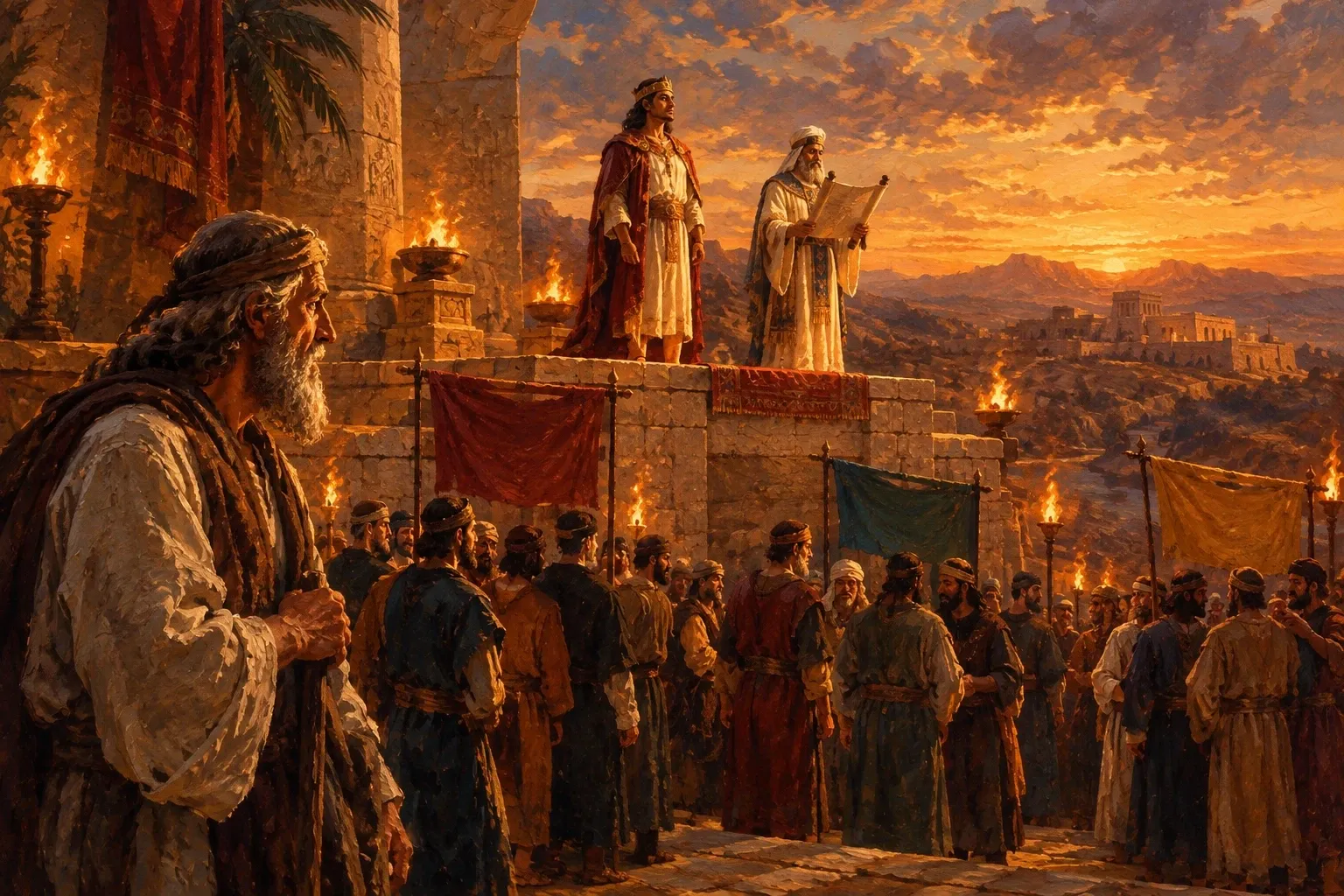
A question that hasn’t been pondered enough is this: How can the Lord condemn David and Solomon’s actions as abominable if there was no law they violated? There must be more that we don’t understand, something missing from the biblical narrative.
“…where there is no law given there is no punishment; and where there is no punishment there is no condemnation…”1
“How could a man repent except he should sin? How could he sin if there was no law? How could there be a law save there was a punishment?”2
Yet the Lord declares, “Behold, David and Solomon truly had many wives and concubines, which thing was abominable before me, saith the Lord.”3
It seems that an abomination, in this sense, refers to something that has been twisted or corrupted. Often, an abomination arises when religious justification is used to excuse wrongdoing. The Lord’s labeling of their actions as an abomination strongly suggests condemnation, especially since Jacob informs the Nephites that they’ve come under condemnation for following David and Solomon’s practice: “I the Lord God will not suffer that this people shall do like unto them of old…”4 and, “ye have come unto great condemnation; for ye have done these things which ye ought not to have done.”5
The argument that David and Solomon didn’t have the commandment given to Lehi is a fair counterpoint, but it assumes that Jacob 2:27 (“For there shall not any man among you have save it be one wife;”) introduces a new law rather than reinforcing an older, existing one.
I believe the law was already there, and Jacob points us to it in the first chapter of his book.
The Law of the King
Jacob appears to allude to Deuteronomy 17 when he mentions “the second king,” “many wives,” and “much gold and silver” in Jacob 1:15–16. Notably, these two verses were not separated until Orson Pratt’s 1879 edition, so they should be read together.6
| Jacob 1:15–16 | Deuteronomy 17:15, 17 |
|---|---|
| And now it came to pass that the people of Nephi, under the reign of the second king, began to grow hard in their hearts, and indulge themselves somewhat in wicked practices, such as like unto David of old desiring many wives and concubines, and also Solomon, his son. Yea, and they also began to search much gold and silver, and began to be lifted up somewhat in pride. | Thou shalt in any wise set him king over thee, whom the Lord thy God shall choose: one from among thy brethren shalt thou set king over thee: … Neither shall he multiply wives to himself, that his heart turn not away: neither shall he greatly multiply to himself silver and gold. |
The iniquity the Nephites began to indulge in seems directly tied to their misunderstanding of previous kings, David and Solomon. They failed to interpret the scriptures correctly regarding kingship.7 This same error crept into the early restoration, as Hyrum Smith later warned: “There were many that had a great deal to say about the ancient order of things, as Solomon and David having many wives and concubines—but it’s an abomination in the sight of God.”8
David and Solomon are often remembered for their high points (their victories, wisdom, and accomplishments), but a closer reading of their full narratives reveals that their reigns were marred by sin, pride, and devastating consequences for Israel.
David’s downfall is one of the slowest, saddest train wrecks in scripture. 2 Samuel 11–20 records the unraveling of his life after his sin with Bathsheba, leading to betrayal, murder, the death of his child, and an unending cycle of family tragedy. The latter part of his reign is defined by strife, rebellion, and death, most notably with the uprising of Absalom.
Then later, in 1 Kings 11, Solomon’s direct violation of God’s command regarding multiple wives leads to the division of the kingdom. His heart turns away from the Lord, and because of his choices, the once-united monarchy fractures, leading to centuries of conflict between Israel and Judah.
These kings were not models of righteousness to be emulated. They serve as warnings. Their failures highlight the dangers of power, unchecked desire, and the justification of sin under the guise of divine approval.
Joseph Smith didn’t treat David as a model either. When he revised the Bible, he changed the verses that praise him. In the King James Version, Nathan tells David, “The Lord also hath put away thy sin; thou shalt not die.” Joseph’s revision reads, “The Lord also hath not put away thy sin, that thou shalt not die.” Where Solomon is told to walk “as thy father David did walk,” Joseph’s reads, “thou shalt not walk in unrighteousness as did thy father David.” And where Solomon’s heart “was not perfect… as was the heart of David his father,” Joseph’s says it “became as the heart of David his father.”9
In his sermons he went further. He taught that David “sought repentance at the hand of God carefully with tears but he could ownly get it through Hell,” and that “although David was a king he never did obtain the spirit & power of Elijah & the fulness of the Priesthood, & the priesthood that he received & the throne & kingdom of David is to be taken from him & given to another by the name of David in the last days.”10 Earlier he had noted that when many of the saints arose at Christ’s resurrection, “it seems that David did not. Why? because he had been a murderer.”11
Some will say David only sinned in the matter of Uriah. But the Book of Mormon doesn’t condemn him and Solomon for the murder. It condemns them for their many wives and concubines: “David and Solomon truly had many wives and concubines, which thing was abominable before me, saith the Lord.”12 It’s tackling a specific thing.
The Temple Scroll: A Lost Tradition?
When Jacob in the Book of Mormon condemns the Nephites for following David and Solomon’s example, he appears to reference Deuteronomy 17, assuming we, as his audience, will understand the connection. However, we don’t know everything he said in his sermon. Jacob himself acknowledges this: “And now I, Jacob, spake many more things unto the people of Nephi, warning them against fornication and lasciviousness, and every kind of sin, telling them the awful consequences of them.”13
This leaves open the strong possibility that he directly cited Deuteronomy 17, including the command that the king was to have only one wife, a principle we will explore further below. The big question is: Does Deuteronomy 17 in Jacob’s time match our version found in the KJV, which comes from the Masoretic Text?
Two documents among the Dead Sea Scrolls may shed light on an older tradition of Deuteronomy 17, The Damascus Document, and The Temple Scroll.14 Both are associated with the Essene community, a sect known for preserving ancient traditions and challenging mainstream Jewish interpretations.
One of the most striking findings in the Temple Scroll is its radically different interpretation of Deuteronomy 17’s restrictions on kingship. As Yigael Yadin, who published the scroll, notes:
“In the Statutes of the King, the Temple Scroll considers restrictions on the king’s marriages. Rabbinic Judaism interpreted Deuteronomy 17:11 to restrict the king to 18 wives. This was based in part on the fact that King David had 18 wives.”
In contrast, the Temple Scroll provides:
“[The King] shall not take another wife, for she [his first wife] alone shall be with him all the days of her life. But should she die, he may take unto himself another wife.”
Here we have a clear-cut ruling against bigamy and divorce, the earliest such ruling in any extant Jewish writing. This may well have been a forerunner of Christian doctrine on these subjects.”15
Here is the Temple Scroll’s version of the law of the king. It is written as if God is speaking, and the first part follows Deuteronomy 17:15–18 closely: a king the Lord chooses, from among your brothers, who does not multiply horses, wives, or silver and gold. Deuteronomy stops there. It says the king is to write “a copy of this law” and read it all his life, but it never says what “this law” contains. The scroll does. Its next section opens, “This is the law,” and spells it out: how the people are to gather when they proclaim him king, the men who guard him from sin, the council he must rely on, and one wife for all the days of her life. The parts from Deuteronomy are highlighted.
(11Q19 LVII–LVIII)
“You shall set over yourself a king whom I shall choose. From among your brothers, you shall set over yourself a king; you shall not set a foreign man who is not your brother over yourself. But he is not to increase the cavalry or make the people go back to Egypt on account of war in order to increase the cavalry, or the silver and gold. Blank I told you, ‘You shall not go back again on this path.’ He is not to have many wives or let his heart go astray after them. He is not to have much silver and gold; not much. Blank When he sits upon the throne of his kingdom, they shall write for him this law according to the book which is in front of the priests.”
“This is the law […]: the priests. On the day when they proclaim him king, the children of Israel [shall assemble?], from those more than twenty years old up to those of sixty years, according to their banners. And he shall appoint {they shall appoint} at their head chiefs of a thousand, chiefs of a hundred, chiefs of fifty, and chiefs of ten in all their cities. From them he shall select a thousand, a thousand from each tribe, to be with him: twelve thousand men of war who will not leave him on his own, so that he will not be seized by the hands of the nations. All those selected, which he selects, shall be men of truth, venerating God, enemies of bribery, skilled men in war; and they shall always be with him day and night and they shall guard him from every act of sin and from the foreign nations so that he does not fall into their hands. He will have twelve princes of his people with him and twelve priests and twelve Levites who shall sit next to him for judgment and for the law. He shall not divert his heart from them or do anything in all his councils without relying on them. Blank He shall not take a wife from among all the daughters of the nations, but instead take for himself a wife from his father’s house, from his father’s family. He shall take no other wife apart from her because only she will be with him all the days of her life. If she dies, he shall take for himself another from his father’s house, from his family. He shall not pervert justice, or accept a bribe to pervert correct judgment. He shall not crave the field, the vineyard, the wealth, the house, or any valuable thing in Israel or purloin.”16
This raises an important question: Did the Temple Scroll reflect an older Mosaic tradition that had been lost? Or was it a polemic against the Hasmonean rulers, who were known for violating Deuteronomic laws on kingship? If an older monogamous tradition existed, this would make David and Solomon’s actions even more egregious, providing further justification for the Lord’s words in Jacob 2:24: “Behold, David and Solomon truly had many wives and concubines, which thing was abominable before me, saith the Lord.”
Some might argue that David and Solomon cannot be held accountable if the law was unknown to them, since the “book of the law” was not rediscovered until Josiah’s reign (2 Kings 22–23). However, the text describes the law as something lost, not newly created, and earlier scriptures suggest that covenant principles were already known. Moreover, Solomon’s condemnation in 1 Kings 11 shows that the Lord held him accountable for violating known commandments. Whether through written law or divine instruction, David and Solomon departed from the standards God had revealed, and the existence of older traditions, like those reflected in the Temple Scroll, only strengthens the case that monogamy was always the expectation.
The Nephite law on marriage, given to Lehi and his descendants, appears to align much more closely with the Temple Scroll than with Rabbinic interpretations of Deuteronomy 17: “For there shall not any man among you have save it be one wife;”17
This suggests that the Book of Mormon’s stance may represent an older, original Deuteronomic law, one that was later corrupted or reinterpreted by Rabbinic Judaism to justify polygamy.
The Temple Scroll is about 1,000 years older than the oldest complete manuscripts of the Masoretic Text. If we are weighing textual evidence, we must consider: Which tradition is older? Which is more faithful to the original law of Moses? Why would the Temple Scroll introduce a monogamy requirement unless it had a strong basis in tradition?
The Book of Mormon’s condemnation of polygamy, combined with the Temple Scroll’s clear ruling against it, may suggest that monogamy, not polygamy, was the original divine standard for kings and common people alike. When the Lord declares that David and Solomon’s “many wives and concubines” were an abomination, we should be clear about what is being condemned. It was not merely David’s adultery or Solomon’s foreign wives. It was specifically their practice of multiplying wives and concubines.
Ultimately, while historical texts offer valuable context, the Book of Mormon remains the one record we can trust with full confidence. Through it, we learn that the Lord viewed David and Solomon’s actions as abominable, and it stands to reason that He has never looked with favor upon any king or people who practiced plural marriage.
According to Their Banners
Notice how on the day when they proclaim the king, they are to assemble the men “according to their banners,” these are to “be men of truth,” and are to “always be with him day and night and they shall guard him from every act of sin.” It seems the Nephites may have done that very thing immediately after Nephi dies:
And it came to pass that Nephi died. Now the people which were not Lamanites were Nephites; nevertheless, they were called Nephites, Jacobites, Josephites, Zoramites, Lamanites, Lemuelites, and Ishmaelites. But I, Jacob, shall not hereafter distinguish them by these names, but I shall call them Lamanites that seek to destroy the people of Nephi, and those who are friendly to Nephi I shall call Nephites, or the people of Nephi, according to the reigns of the kings.18
Perhaps Jacob mentions this because they were gathered together to proclaim their new king and they had assembled themselves “according to their banners,” and the Nephites, Jacobites, Josephites, Zoramites, and Ishmaelites were “friendly to Nephi.” Remember the name Nephi in this instance is referring to the current king, “And whoso should reign in his stead were called by the people, second Nephi, third Nephi, and so forth, according to the reigns of the kings…”19
The Law of the King Was to Be Read to Him
A crucial aspect of Deuteronomy 17 is that the law, including the restriction on multiple wives, was meant to be read by the king: “…he shall write him a copy of this law in a book… and he shall read therein all the days of his life: that he may learn to fear the LORD his God, to keep all the words of this law…”20
When Israel crowned its first king, Samuel “told the people the manner of the kingdom, and wrote it in a book, and laid it up before the LORD.”21 The Bible never tells us what that book said. The Temple Scroll claims to.
In the Temple Scroll, “this is the law” to be read includes the statement of one wife. That is significant. It suggests that the king was always supposed to be reminded of this standard, yet later interpretations shifted away from this requirement. If Jacob used Deuteronomy 17 as part of his sermon, he would have included the portion that makes clear the king is to have one wife, further reinforcing the Nephite prohibition of polygamy. It would also fit the way the Lord establishes his word. Nephi, speaking of Jacob as one of his witnesses, wrote, “by the words of three, God hath said, I will establish my word.”22 The law of the king in Deuteronomy and the commandment given to Lehi would be two witnesses to the same rule: one wife.
The New King
Why don’t we learn this second king’s name? Why does Jacob leave him unnamed? He had to be Nephi’s son or grandson, since “the kingdom had been conferred upon none but those who were descendants of Nephi.”23 Could it be that Jacob deliberately omitted his name to emphasize the pattern rather than the person?
Jacob may have deliberately chosen not to name the second king because he wanted to highlight the broader issue, how kingship can lead to corruption, rather than focusing on a single individual. It is a recurring pattern in history: rulers justifying wickedness by appealing to precedent (David and Solomon), accumulating wives and wealth, and leading their people into pride and iniquity. It also mirrors Deuteronomy 17, which was a general warning about the dangers of kingship rather than a rebuke of any single ruler.
Alternatively, the omission of the king’s name might also suggest that the Nephites already knew exactly who Jacob was referring to, making it unnecessary to state outright.
While we can’t say with certainty that the second king introduced the error, it is clear that the mischief entered after Nephi’s death and that the Nephites’ misunderstanding of scripture was directly tied to their cultural view of kingship.
Jacob’s wording strongly suggests that this corruption developed under royal influence: “…the people of Nephi, under the reign of the second king, began to grow hard in their hearts, and indulge themselves somewhat in wicked practices…” The reference to David and Solomon implies that they were using past kings as justification for accumulating wives and wealth, mirroring the very behaviors condemned in Deuteronomy 17.
Lehi left Jerusalem during the reign of the last king of the Kingdom of Judah.24 At that time, Zedekiah was on the throne, and according to Jeremiah, he too was a polygamist: “So they shall bring out all thy wives and thy children to the Chaldeans: and thou shalt not escape out of their hand, but shalt be taken by the hand of the king of Babylon: and thou shalt cause this city to be burned with fire.”25
Ishmael and Lehi’s families had only ever known one system of governance: the rule of kings. It’s no surprise, then, that upon arriving in the promised land, they sought to establish a familiar structure: “And it came to pass that they would that I should be their king.”26 Yet Nephi was reluctant: “But I, Nephi, was desirous that they should have no king; nevertheless, I did for them according to that which was in my power.”27
Historically, kingship in Judah was directly tied to the Davidic line. After Solomon’s death, the ten northern tribes rejected Davidic rule, refusing to accept Solomon’s son, Rehoboam, as their king. Instead, they appointed Jeroboam, establishing the northern Kingdom of Israel.
Meanwhile, the southern tribes of Judah and Benjamin remained loyal to the House of David, and their kingdom, Judah, continued under Davidic kings. With the exception of Athaliah, every monarch of Judah is believed to have been a direct descendant of David.
It would be an interesting study to examine what cultural influences Lehi’s ancestors may have brought from the Northern Kingdom while living in the Southern Kingdom for the 120 or so years prior to their departure. We know they preserved writings from Northern prophets like Zenos and Zenock, figures who may have also descended from Joseph of Egypt.28 As Nephi taught, “Yea, the prophet Zenos did testify of these things, and also Zenock spake concerning these things, because they testified particularly concerning us, who are the remnant of their seed.”29
When Lehi obtained the plates of brass, he confirmed his ancestry, tracing it back to Joseph of Egypt: “And it came to pass that my father, Lehi, also found upon the plates of brass a genealogy of his fathers; wherefore he knew that he was a descendant of Joseph; yea, even that Joseph who was the son of Jacob, who was sold into Egypt…”30
It is possible that Lehi’s ancestors had lost their written record of this lineage when they fled the Assyrian invasion (circa 722 BC) and sought refuge in the Southern Kingdom. While Lehi may have already been aware of his descent from Joseph through family oral tradition, the plates of brass provided official confirmation.
The desire for a king started in Nephi’s day: “they would that I should be their king.”31 It seems they wanted a king like the ones they had known in Jerusalem, and a generation later, under the second king, it appears they wanted their king to have many wives like those kings did. That generation had never seen Jerusalem. Nephi had deliberately kept its ways from them: “I, Nephi, have not taught them many things concerning the manner of the Jews; for their works were works of darkness, and their doings were doings of abominations.”32 So where did they learn it? Jacob tells us: “because of the things which were written concerning David, and Solomon his son.”33
Given to the Fathers?
Recently, a great deal of attention has been given to the 1830 edition of the Book of Mormon and Jacob 3:5. The first printing used the phrase: “…for they have not forgotten the commandment of the Lord, which was given unto our fathers, that they should have, save it were one wife; and concubines they should have none; and there should not be whoredoms committed among them.”
This suggests that the commandment was originally given to the fathers, not just to our father Lehi. The term fathers could refer to the patriarchs Abraham, Isaac, and Jacob, or it could extend further back to the earliest patriarchs, including Adam, Noah, down to Melchizedek.
However, I am not yet persuaded that this is the case, as it refers to a commandment for which we have no direct record, at least not yet. Another challenge is that the Printer’s Manuscript, the copy the typesetter worked from, uses the singular father instead of fathers.34 This raises the question: how did the change occur?
We know that Joseph Smith made textual clarifications throughout his lifetime, but it remains unclear whether he personally made this change or if he even noticed it before his death. A recent podcast shed light on this issue by reviewing Joseph’s personal 1830 copy of the Book of Mormon. On the page containing this verse, Joseph had written a brief but pointed note: “One Wife.” This indicates that he specifically grasped the principle of monogamy from this passage, even in the version that used fathers.
If a commandment had been given by the fathers, then David and Solomon would have been violating a commandment that originated much earlier than Moses, perhaps one that had been in place from the beginning. However, at this time, we lack substantial biblical evidence to confirm this viewpoint. Yet with Joseph’s own personal note in his personal copy of the Book of Mormon, it leaves the possibility that this is the case.
Either way, the original law regarding kingship may have explicitly restricted rulers to one wife, a principle preserved in the Temple Scroll and possibly reflected in Jacob’s teachings in the Book of Mormon.35
So there was a law. The king was not to multiply wives to himself, and the law he was to read all the days of his life may have said one wife. When the Nephites crowned a new king and began desiring many wives and concubines, and gold and silver, they repeated the very things that law forbade, and they excused themselves with the kings who broke it first.
But Lehi’s family didn’t come from David’s line. Lehi found on the plates of brass that he was a descendant of Joseph, and the Lord had led his family out for a purpose of his own: “that I might raise up unto me a righteous branch from the fruit of the loins of Joseph.”36
Notes
- 2 Nephi 9:25 ↩
- Alma 42:17 ↩
- Jacob 2:24 ↩
- Jacob 2:26 ↩
- Jacob 2:34 ↩
- See the chapter, verse, and punctuation changes that have been made to Jacob 2 in the Book of Mormon: Chapter and Verse ↩
- I’ve written about that here: Wresting the Scriptures ↩
- I’ve written about Hyrum’s statement here: Alternate Universe ↩
- JST 2 Samuel 12:13; 1 Kings 3:14; 1 Kings 11:4; see also 1 Kings 3:1; 11:6; 14:8; 15:3. Gwendolyn Stevens Wyne sets these changes side by side in “Polygamy’s Genesis: Examining Claims of an Early 1830s Polygamy Revelation,” Journal of Mormon Polygamy 2, no. 2 (2026), 98–103. ↩
- Discourse, 10 March 1844, as Reported by Wilford Woodruff, p. 210, The Joseph Smith Papers. ↩
- Discourse, 16 May 1841, as Published in Times and Seasons, p. 430, The Joseph Smith Papers. ↩
- Jacob 2:24 ↩
- Jacob 3:12 ↩
- “…they are caught in two: fornication, by taking two wives in their lifetimes although the principle of creation is male and female He created them (Gen 1:27) and those who went into the ark went into the ark two by two (Gen 7:9). Concerning the Leader it is written he shall not multiply wives to himself (Deut 17:17); but David had not read the sealed book of the Law in the Ark; for it was not opened in Israel from the day of the death of Eleazar and Joshua and the elders…” (CD 4:20–5:4, trans. Edward Cook, in Michael Wise, Martin Abegg Jr., and Edward Cook, The Dead Sea Scrolls: A New Translation) The Damascus Document is one of the Dead Sea Scrolls, written for a sectarian community often associated with the Essenes. It outlines the group’s covenant obligations, rules for daily living, and expectations for purity. The document was intended to guide a righteous remnant who believed they were living in the last days and had been called out from a corrupt Israel. ↩
- The Temple Scroll—The Longest and Most Recently Discovered Dead Sea Scroll Yigael Yadin, Biblical Archaeology Review, September/October 1984. Yadin cites Deuteronomy 17:11; the rule on wives is in 17:17. ↩
- Martínez, Florentino García. The Dead Sea Scrolls Translated: The Qumran Texts in English. Leiden: E.J. Brill, 1994, pp. 173–174. ↩
- Jacob 2:27 ↩
- Jacob 1:12–14 ↩
- Jacob 1:11 ↩
- Deuteronomy 17:18–19 ↩
- 1 Samuel 10:25 ↩
- 2 Nephi 11:3; see also Deuteronomy 19:15. ↩
- Mosiah 25:13 ↩
- 1 Nephi 1:4 ↩
- Jeremiah 38:23 ↩
- 2 Nephi 5:18 ↩
- 2 Nephi 5:18 ↩
- “In the Book of Mormon, Zenos is generally referred to as “the prophet.” When we think of “the prophet,” we think of Moses, or we think of Isaiah. When the Book of Mormon is referring to “the prophet”—as an unidentified “the prophet”—it’s Zenos. The Book of Mormon preserves something over 3000 words—(I cut and pasted, one time, all the words that you could attribute to Zenos into one MS Word document; my recollection is about 3400 words. I don’t know what happened to the document. I don’t have it anymore)—but 3400 words of Zenos makes him one of the most quoted authorities in the entire Old Testament record. Lehi’s party departed from Jerusalem before the Babylonian captivity, in possession of a brass-plates-version of the Old Testament, in which you find Zenos talking plainly, openly, and blatantly about the coming of a Messiah.” – Third Root ↩
- 3 Nephi 10:16 ↩
- 1 Nephi 5:14 ↩
- 2 Nephi 5:18 ↩
- 2 Nephi 25:2. I’ve written more about this in A Branch of Joseph. ↩
- Jacob 2:23 ↩
- Printer’s Manuscript of the Book of Mormon, p.99 see also, Book of Mormon, 1830, p. 128 ↩
- see, Jacob 1:15–16 ↩
- Jacob 2:25 ↩
Comments