
Chapter and Verse

The Book of Mormon has gone through several changes and editions to arrive at our modern edition. The chapters, verses, headings, footnotes, and most of the punctuation weren’t on the plates; men added them later. That matters for Jacob 2:30, because the man who divided Jacob’s sermon into chapters and verses and wrote its first footnotes was Orson Pratt, the same man who first published the conventional reading in 1853. I found it useful to look at how the Book of Mormon was organized in the first printing, and how we got to the chapters and verses we use today.
1830 Printing
In the original 1830 printing the chapters were fewer and therefore contained much more content. This chart is a useful study tool: Comparison of Chapter Divisions: 1830 and 1981 Editions.1
Our modern version of Jacob is divided into seven chapters; the original had only five. By viewing the 1830 edition, it’s clear that chapters two and three are meant to be read together, and the context of those chapters makes more sense when studied as a whole.
Jacob Chapter 2 Paragraphs
| Original Chapter & Paragraph | Modern Chapter & Verse |
|---|---|
| Jacob 2:¶1, pp. 124-125 | Jacob 2:1–8, pp. 119-120 |
| Jacob 2:¶2, p. 125 | Jacob 2:9–10, p. 120 |
| Jacob 2:¶3, p. 125 | Jacob 2:11, p. 120 |
| Jacob 2:¶4, pp. 125-126 | Jacob 2:12–13, p. 120 |
| Jacob 2:¶5, p. 126 | Jacob 2:14–19, pp. 120-121 |
| Jacob 2:¶6, pp. 126-127 | Jacob 2:20–33, pp. 121-122 |
| Jacob 2:¶7, p. 127 | Jacob 2:34–35, p. 122 |
| Jacob 2:¶8, pp. 127-128 | Jacob 3:1, p. 122 |
| Jacob 2:¶9, p. 128 | Jacob 3:2–7, pp. 122-123 |
| Jacob 2:¶10, p. 128 | Jacob 3:8–10, p. 123 |
| Jacob 2:¶11, pp. 128-129 | Jacob 3:11–14, p. 123 |
1879 Edition Changes
“The first edition of the Book of Mormon had consisted of large, unnumbered chapters, which made citing a particular passage difficult. In subsequent editions, some of these large paragraphs were divided and verse numbers were assigned to the paragraphs, but the paragraphs were still generally long. In 1879, Elder Orson Pratt divided the Book of Mormon into small chapters and verses for easier reference. His numbering system became the standard for all later Latter-day Saint editions.”2
We still use Pratt’s chapters and verses today. That means Pratt is the one who divided Jacob’s single sermon into chapters 2 and 3. There were no chapter headings yet; those came in 1921. The only headings in the early editions are the ones original to the plates.
1921 Edition
“The 1920 edition of the Book of Mormon (actually printed in 1921) was produced by a committee of Apostles, including Elders George F. Richards, Anthony W. Ivins, Joseph Fielding Smith, James E. Talmage, and Melvin J. Ballard. They made grammatical adjustments, standardized the titles of the books of Nephi to remove ambiguity, and put the text in a double-column format to match the presentation of the Bible. They also created chapter summaries for every chapter, included a guide for pronouncing names in the Book of Mormon, added a table of contents, and revised the footnotes and the index.”3
That same year, the committee also removed the Lectures on Faith from the Doctrine and Covenants. Many Saints don’t realize that the Lectures represented the “Doctrine” portion of the “Doctrine & Covenants.” So yes, you’re missing the first portion of the D&C. There are many articles and papers telling you why it was justified, but I disagree with them. They were voted on and sustained by the church as scripture in 1835, and in 1921 they were removed without a vote by the church, therefore I consider them canon and carry a set with my scriptures (yes I still pack a set of scriptures to church).4
I agree with Bruce R. McConkie who said, “In my judgment, it is the most comprehensive, inspired utterance that now exists in the English language—that exists in one place defining, interpreting, expounding, announcing, and testifying what kind of being God is. It was written by the power of the Holy Ghost, by the spirit of inspiration. It is, in effect, eternal scripture; it is true.”5
I believe Elder James E. Talmage wrote the headings in this edition, and Jacob chapters 2 and 3 get their first headings in this new edition.6 I think this heading describes chapter 2 better than the ones that came after it: “Plurality of wives forbidden because of iniquity.”
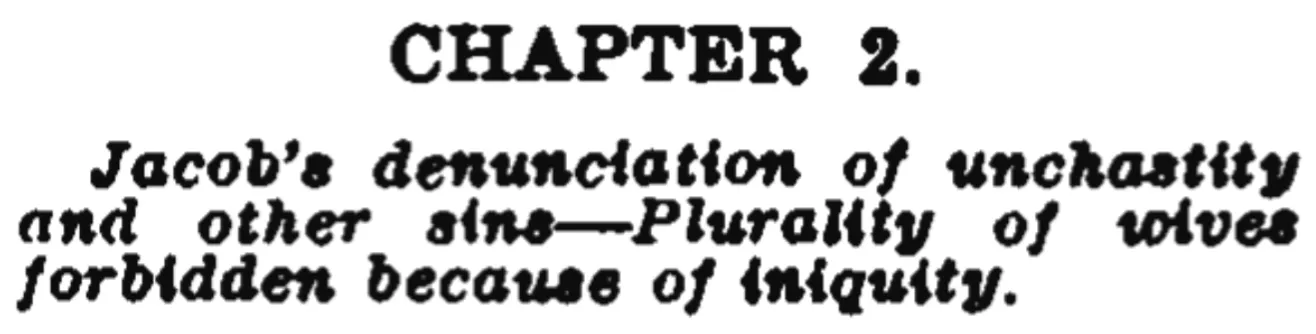 | 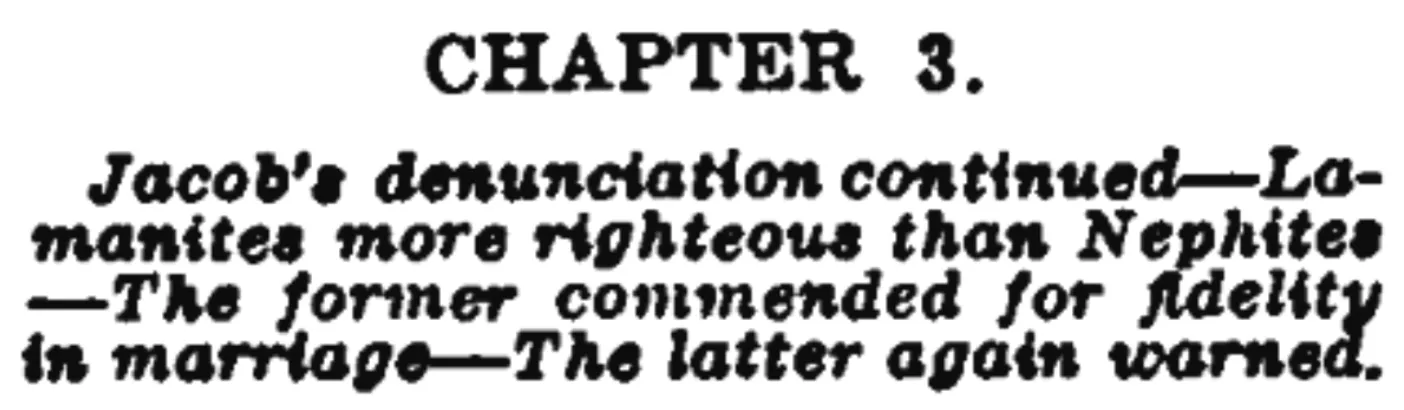 |
|---|---|
| Chapter 2 Jacob’s denunciation of unchastity and other sins-Plurality of wives forbidden because of iniquity. | Chapter 3 Jacob’s denunciation continued-Lamanites more righteous than Nephites-The former commended for fidelity in marriage-The latter again warned. |
1981 Edition
“In 1981, part two of the Church’s historic English scriptures project came to fruition with new editions of the Book of Mormon, Doctrine and Covenants, and Pearl of Great Price. Some textual corrections were made to the Book of Mormon based on close comparisons with early manuscripts… As part of this effort, all four standard works received new or expanded chapter summaries, expanded footnotes cross-referencing all the Church’s standard works… and select passages from Joseph Smith’s translation of the Bible.”7
From what I understand, Elder Bruce R. McConkie rewrote the chapter headings for the 1981 edition.8 Elders Thomas S. Monson and Boyd K. Packer were also part of this project. The 1981 edition, Jacob chapter 2 starts on page 128 of the facsimile.
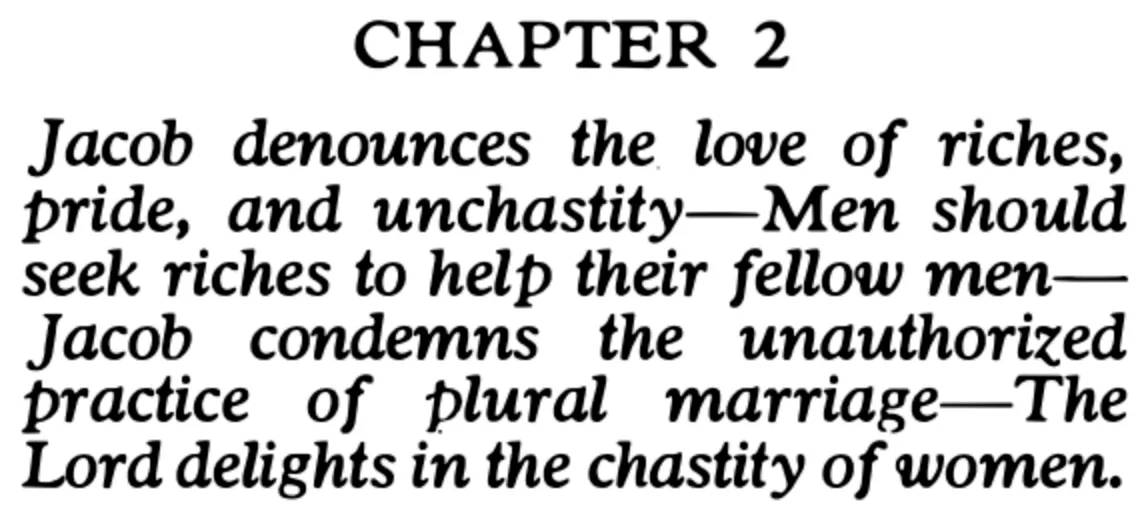 | 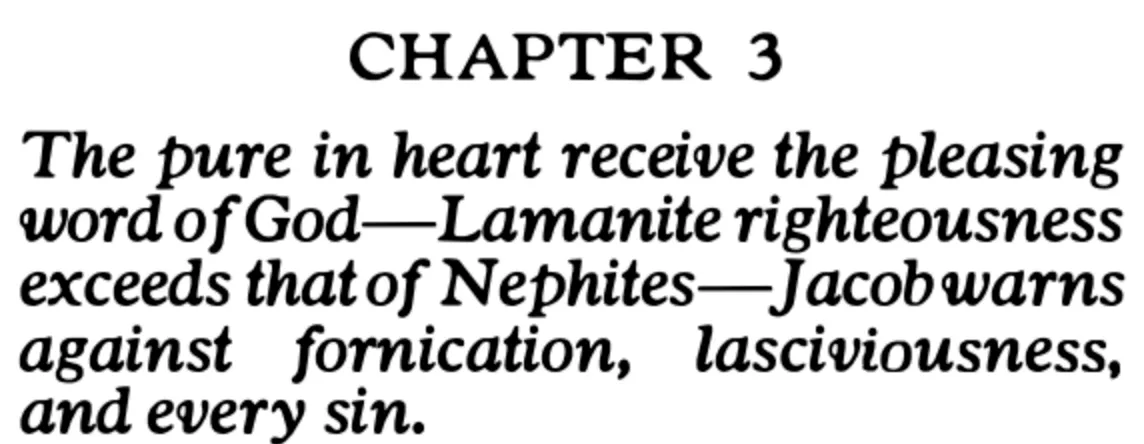 |
|---|---|
| Chapter 2 Jacob denounces the love of riches, pride, and unchastity-Men should seek riches to help their fellow men-Jacob condemns the unauthorized practice of plural marriage-The Lord delights in the chastity of women. | Chapter 3 The pure in heart receive the pleasing word of God-Lamanite righteousness exceeds that of Nephites-Jacob warns against fornication, lasciviousness, and every sin. |
2013 Edition
“Compared to most new editions, the revisions in the 2013 edition are minor. In the text of the scriptures, spelling and punctuation errors were corrected, and some word spellings were updated to more current standards.”9
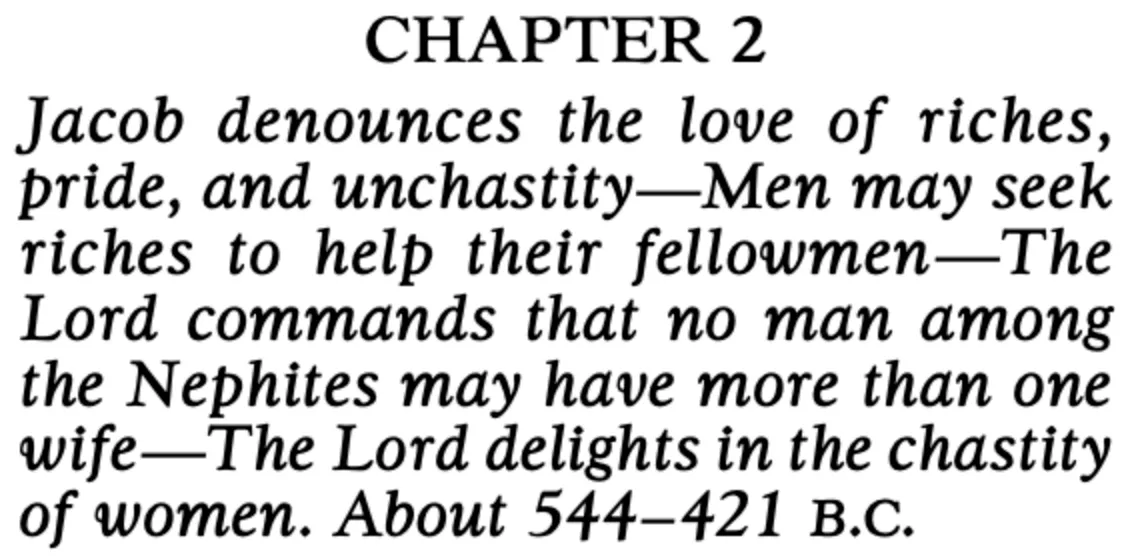 | 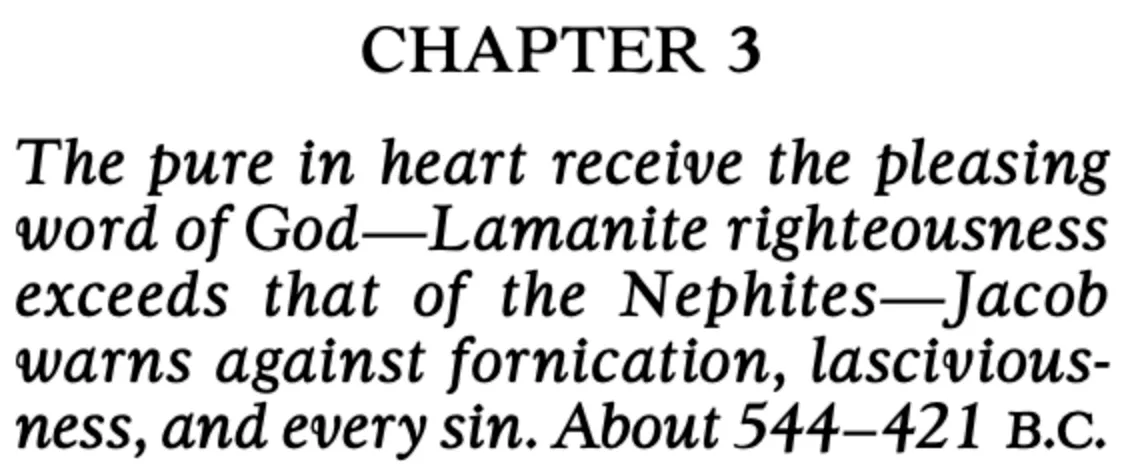 |
|---|---|
| Chapter 2 Jacob denounces the love of riches, pride, and unchastity-Men may seek riches to help their fellowmen-The Lord commands that no man among the Nephites may have more than one wife-The Lord delights in the chastity of women. About 544-421 B.C. | Chapter 3 The pure in heart receive the pleasing word of God-Lamanite righteousness exceeds that of the Nephites-Jacob warns against fornication, lasciviousness, and every sin. About 544-421 B.C. |
While there may have been a few minor changes, the chapter heading in Jacob chapter 2 is interesting to me. The church moved from “Jacob condemns the unauthorized practice of plural marriage” to “The Lord commands that no man among the Nephites may have more than one wife.” The 1981 wording is the authorized vs. unauthorized reasoning we traced to Pratt in Part 1.3; the 2013 wording just restates the command. I suppose many readers were confused by the Lord’s strong condemnation in this chapter, but I’m still not sure the new heading clears things up.10
How would you rewrite the heading if you were going to give a summary of Jacob’s sermon?
Book of Mormon Punctuation
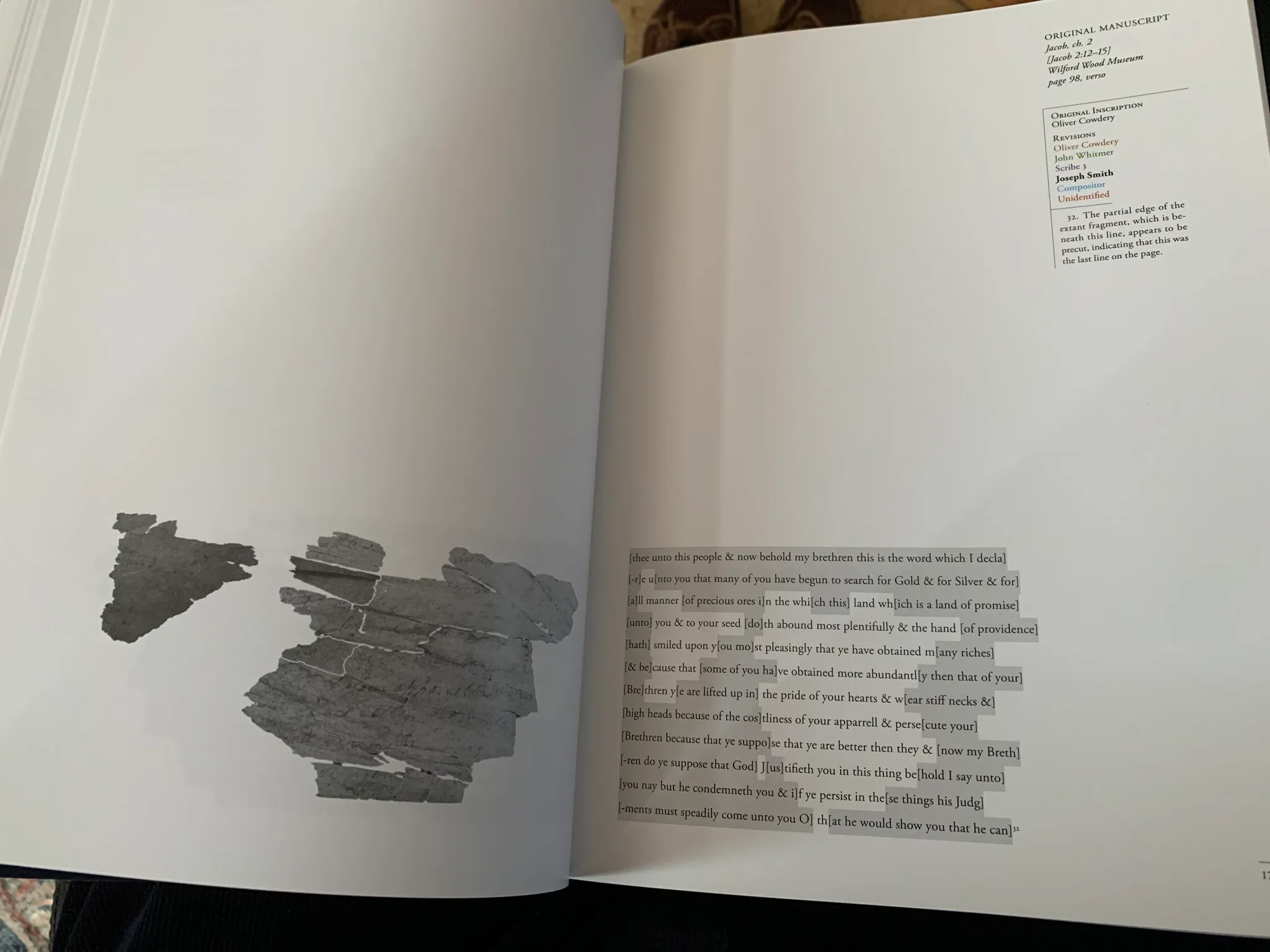
The original manuscript of the Book of Mormon has almost no punctuation; it reads like one long sentence from beginning to end. Ancient Hebrew was written the same way. The printer’s manuscript has some punctuation, most of it likely added by the typesetter, John H. Gilbert. We only have about 28% of the original manuscript,11 and we have 100% of the printer’s manuscript.12 Joseph Smith put the original manuscript into the cornerstone of the Nauvoo House and over time water seeped into the cavity and destroyed the greater portion of that document. Below is a picture of a fragment from Jacob chapter 2.13
Major, John H. Gilbert
Gilbert was born April 13, 1802 in Richmond, NY. In 1824 he moved to Palmyra, NY to work for the Wayne Sentinel, published by Egbert Grandin. He was married in the Zion Episcopal Church, in Palmyra, New York in 1827.14 Here is a statement of belief from an Episcopal Church,
“As Episcopalians, we follow Jesus Christ as our Lord and Savior. We believe in the Father, Son and Holy Spirit as the one Trinity of God. We are a branch of the one Holy, Catholic and Apostolic Church. We believe God is active in our everyday lives through the power of the Holy Spirit.”
Some want to criticize Joseph’s ever changing theology, evolving from the supposed trinitarian view in 1830, to two separate personages with bodies of flesh and bone by the 1840s. Did it really evolve over time or is there more to the story? There hasn’t been much written about the punctuation of the Book of Mormon. I like this talk by Denver Snuffer as he addresses the punctuation issues from Gilbert:
It was E.B. Grandin who printed the first copies of the Book of Mormon. He had an employee named John H. Gilbert the young man who did the typesetting for the Book Mormon.15
You can see a picture of him in the Joseph Smith Papers, Documents Vol. 1: July 1828-June 1831, p. 87. The picture was taken in 1890, over six decades later. John Gilbert took the handwritten printer’s manuscript of the Book of Mormon and, as he set the type, he was forced to punctuated it. Today we still look at his punctuation. The commas in the text are primarily the creation of this man. Therefore I do not believe the punctuation was or is necessarily inspired. I’m going to suggest another way to read a few verses. I want to lift out his commas, and throw them on the floor. I’m not going to use them anymore. I’m going to read you a description of Christ in 2 Nephi 25:12. I will give two different ways to read the passage. First Gilbert’s then mine.
Gilbert’s:
“The Only Begotten of the Father, yea, even the Father of heaven and of earth.”
Now mine:
“The Only Begotten of the Father yea even the Father of heaven and of earth.”
Gilbert’s suggests Christ is the Only Begotten of the Father and that Christ is the Father of heaven and of earth.
Mine suggests Christ is the Only Begotten of the Father. The Father is both Christ’s and also heaven and earth’s Father.16
He continues,
Left to his own, John Gilbert would undoubtedly have drawn on his own background at the time. He, like anyone then or now who considered themself Christian, would believe in a Trinitarian God. Therefore the punctuation would follow a Trinitarian format. As a result, we should expect “Trinitarian commas”17 in the Book of Mormon.
If you throw out the commas and replace them with another alternative way to punctuate that removes Trinitarian fingerprints, the result undermines the arguments of those who want to claim Mormon theology was originally Trinitarian.
Throw out the commas. Then 2 Nephi 25:12 tells us Christ is the Only Begotten of the Father. He was and is the Only Begotten of the Father. His Father is the Father of heaven and of the earth.
We can do the same with Mosiah 3:8. “And he shall be called Jesus Christ, the Son of God, the Father of heaven and earth, the Creator of all things from the beginning; and his mother shall be called Mary.”
These commas suggest Christ is both the Son of the Father and Christ is also the Father of heaven and earth.
But if we move the commas around we can instead say: “And he shall be called Jesus Christ, the Son of God the Father of heaven and earth the Creator of all things from the beginning; and his mother shall be called Mary.”
This suggests Christ is the Son of God the Father. And God the Father is the Father of heaven and earth, and the creator of all things from the beginning.
In the first layout, we are forced to view the content of these verses as essentially Trinitarian, because Christ is both the Father and the Son. In the second, instead we have two personages, one of whom was the Father of heaven and earth and the other who is His Son. This is consistent with the Lectures on Faith, which defines the Godhead as “the Father, Son and Holy Spirit.”18 The Father is a personage of “spirit, glory, and power.” The Son is “a personage of tabernacle made or fashioned like unto man.” The Holy Spirit, the third member of “the Godhead” being “the mind of the Father and Son.”19 Therefore it is clear there are two: both the Father and another who was “called the Son” as we saw in D&C 93: 14.20
While the discussion on Joseph’s theology and the nature of the Godhead is very interesting, it’s not the point of this project. However, I believe we should all re-examine the Lectures on Faith, and try to understand what Joseph was attempting to teach the Saints.21
Punctuation and Footnote Changes to Jacob 2:30
I believe it’s worth studying this to understand that verse 30 lives inside the context of the surrounding verses. The changes in the headers, footnotes, paragraphs, and punctuation are interesting to ponder as we study the history of this verse. From the images below we can see only a couple of small punctuation changes have occurred since the 1830 edition. I will revisit this later in Part 2.
| 1830 Edition |
|---|
 |
| 1830 Edition: “…cursed be the land for their sakes. For if I will, saith the Lord of Hosts, raise up seed unto me, I will command my people: otherwise, they shall hearken unto these things. For…” |
| 1871 Edition |
 |
| 1871 Edition: “…cursed be the land for their sakes. For if I will, saith the Lord of Hosts, raise up seed unto me, I will command my people; otherwise they shall hearken unto these things. For…”22 |
| 1879 Edition |
  |
| 1879 Edition: “30. For if I will, saith the Lord of Hosts, raise up seed unto me, I will command my people; otherwise they shall hearken unto these things.”23 q, See Rev. on marriage, given in 1843. Doc. & Cov. 132. r, the law given to Lehi. See vers. 27, 34. Jacob 3:5. |
| 1921 Edition |
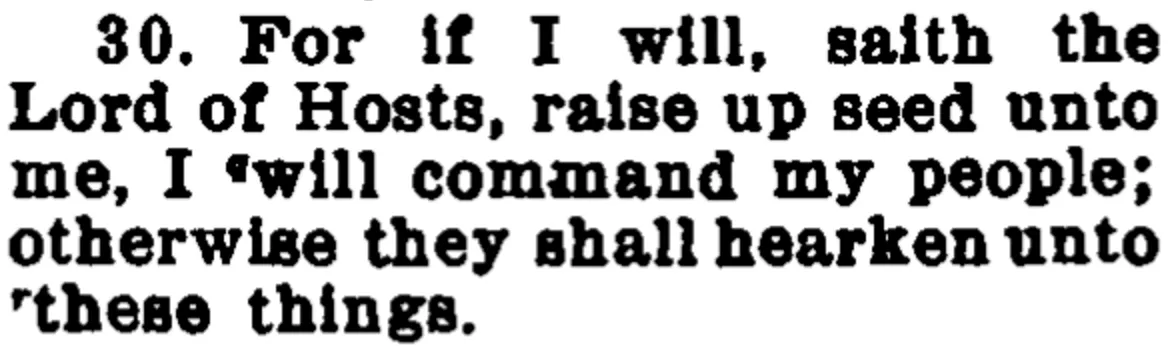  |
| 1921 Edition: “30. For if I will, saith the Lord of Hosts, raise up seed unto me, I will command my people; otherwise they shall hearken unto these things.” q, D&C 132. r, vers. 27, 34. Jacob 3:5. |
| 1981 Edition |
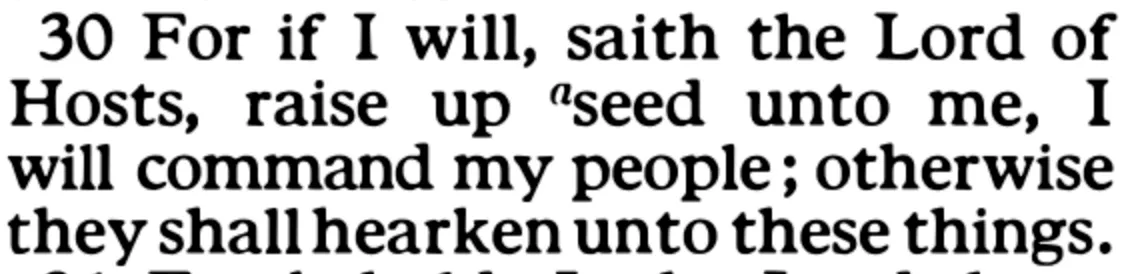 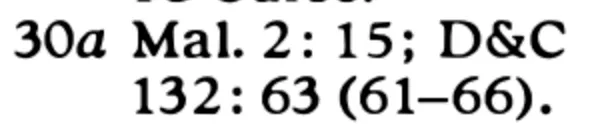 |
| 1981 Edition: “30. For if I will, saith the Lord of Hosts, raise up seed unto me, I will command my people; otherwise they shall hearken unto these things.” 30a Mal. 2:15; D&C 132:63 (61-66). |
| 2013 Edition |
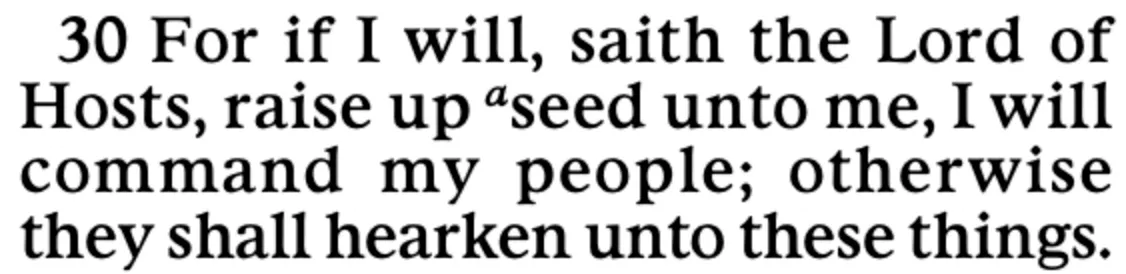  |
| 2013 Edition: “30. For if I will, saith the Lord of Hosts, raise up seed unto me, I will command my people; otherwise they shall hearken unto these things.” 30a Mal. 2:15; D&C 132:63 (61-66). |
In 1879 Pratt gave verse 30 two footnotes. The q on “will command” sends the reader to the revelation on plural marriage, D&C 132. The r on “these things” calls them “the law given to Lehi,” meaning the one-wife rule was for Lehi’s family, not for us. That is the reading Pratt first published in The Seer in 1853, twenty-six years earlier, now printed under the verse itself. It shouldn’t be surprising to find it here. The 1921 edition kept the D&C 132 note. In 1981 the note narrowed to D&C 132:63, where plural wives are given “to multiply and replenish the earth,” the same “more children” reason we looked at in Part 1.2, and added Malachi 2:15.
Book of Mormon Versions
I have several copies of the Book of Mormon and I like to read and review a variety of printings and versions. Some of my favorites are listed below. I recommend reading different versions as new things will stand out to you as you read each. Here are some of the copies I like to read alongside the standard LDS version:
- Restored Covenant Edition | This might be my favorite version of all. “The Restored Covenant Edition of the Book of Mormon was originally printed in 1999 by Zarahemla Research Foundation. The RCE is based on a meticulous word-for-word search comparison of the Original Manuscript, the Printer’s Manuscript and 11 editions of the Book of Mormon.”
- 1830 Replica Edition | “offers you a chance to read it just as Emma Smith or Brigham Young would have.”
- The Stick of Joseph | This is a unique version of the Book of Mormon; it uses Hebrew names and terms throughout. It’s a fascinating read to see and understand the Hebrew names and emphasis on connecting the religion of their fathers to the world of the Book of Mormon.
- Restoration Edition | “This volume of scripture is one of three that together constitute a unified effort to recover what the scriptures originally said and to prune away the uninspired alterations of man.”
- 1830 Penguin Edition | I keep a copy of this on my bed stand.
- The Book of Mormon: The Earliest Text | “The most accurate and readable edition of the Book of Mormon ever published, based on the earliest sources available… The product of over two decades of painstaking labor by Royal Skousen”
- Annotated Edition of the Book of Mormon | “Designed to be read by all Christians regardless of sect or denomination.”
- Voices From The Dust | “A Hebrew Roots adaptation of an ancient record written by a remnant of the House of Israel Showing unto the remnant of the House of Isra’el the great things YHVH has done for their fathers and that they may know the covenants of YHVH that they are not cast off forever.”
This should give us a better idea of these chapters, the verses, and how verse 30 fits inside the context of chapters 2 and 3. Jacob gave one sermon. A typesetter added the commas, Orson Pratt added the chapter break, the verse numbers, and the first footnotes, and later committees wrote the headings. The first note under verse 30 came from the same man who first published the conventional reading. When we study this verse, it’s worth reading Jacob 2 and 3 the way they were first printed, as one sermon, and letting the text speak before the notes do.
Notes
- “The differences in the chapter divisions between the first edition of the Book of Mormon and the 1981 edition are listed in this four-page chart. Chapters in the 1830 edition were longer, in part because the Book of Mormon was printed in narrative rather than verse form—what we would expect from a historical record. The text was first arranged into its present verses in the 1879 edition to facilitate the location of particular passages. Modern readers may be interested to see how the sections of the Book of Mormon were divided in the 1830 edition, which are divided along broad conceptual lines. For example, all of Jacob’s speech in Jacob 2–3 and all of Alma’s blessing to his son Corianton in Alma 39–42 were single chapters.” ↩
- History of the Scriptures ↩
- History of the Scriptures ↩
- General Assembly, 17 August 1835. This is where the Saints voted and sustained “the doctrine and covenants of their faith, by a unanimous vote.” ↩
- The Lord God of Joseph Smith, Bruce R. McConkie of the Seventy, January 4, 1972 “I suppose that the rising generation knows little about the Lectures on Faith. In my own judgment, these Lectures are of great value and should be studied. I consider them to be of extreme value in the study of the gospel of Jesus Christ.” – Joseph Fielding Smith, “Seek Ye Earnestly”. Salt Lake City: Deseret Book, 1970. ↩
- Chapter 2 starts on page 117 of the facsimile. ↩
- History of the Scriptures ↩
- Church removes racial references in Book of Mormon headings, Salt Lake Tribune ↩
- History of the Scriptures ↩
- Another significant change in this set of scriptures is at John 14:16. The footnote (a) was changed from “TG Jesus Christ, Second Comforter” to “TG Holy Ghost, Comforter.” Joseph Smith taught about the Second Comforter specifically using this verse. See “The Second Comforter,” Teachings of the Prophet Joseph Smith, pp. 150–151. ↩
- Full pages to fragments — see the original Book of Mormon manuscript in the new Joseph Smith Papers print volume, By Christine Rappleye, 25 Jan 2022 ↩
- “The LDS Church paid a record-setting $35 million Monday to buy the printer’s manuscript of the Book of Mormon from the Community of Christ.” – LDS Church buys printer’s manuscript of Book of Mormon for record $35 million, By Tad Walch, Sept 20, 2017 ↩
- Original Manuscript of the Book of Mormon, Jacob, Chapter 2 ↩
- Read more from him, “Memorandum, 1892 September 8“ ↩
- Snuffer’s note 78: John H. Gilbert was born April 13, 1802 and would have been twenty-six when he set the type for the Book of Mormon. He had five years experience in typesetting before working on the project. ↩
- Talk 7 Christ, Denver Snuffer, p.43-44 ↩
- Snuffer’s note 81: This is a term I have coined to try to make this problem apparent in a short-hand way. ↩
- Snuffer’s note 82: 5th Lecture ¶2. ↩
- Snuffer’s note 83: 5th Lecture ¶2. ↩
- Talk 7 Christ, Denver Snuffer, p.45-46 ↩
- If the nature of the Godhead discussion interests you, I highly recommend, The Words of Joseph Smith? by Rob Fotheringham ↩
- The colon after “my people” was replaced with a semicolon. The comma after “otherwise” was removed. ↩
- This is the first edition with Pratt’s modern verses, and the first with footnotes. Earlier editions had numbered paragraphs, as the 1879 quote above says. ↩
Comments