
One Interpretation, Officially
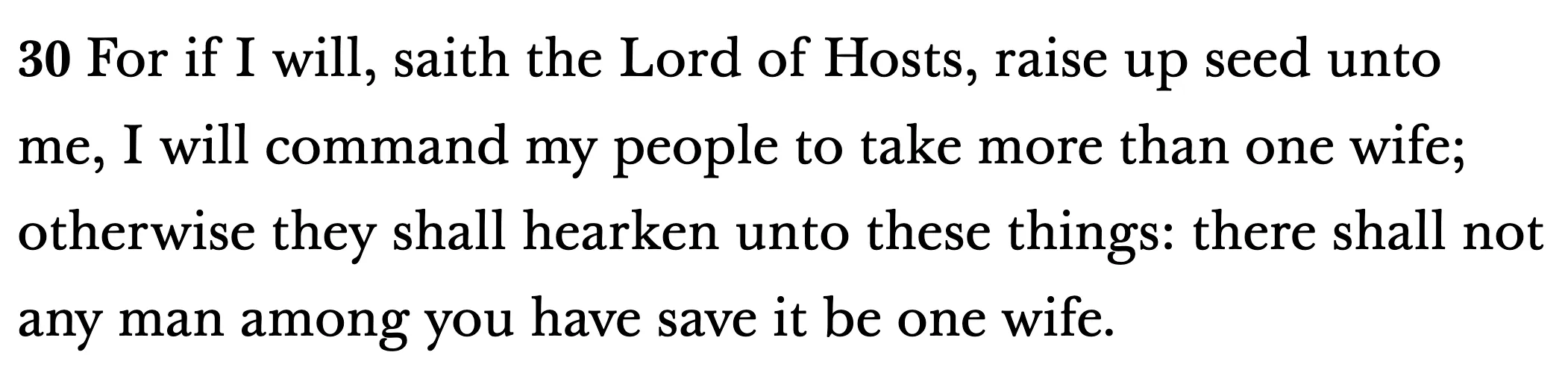
Jacob 2:30 is treated as an incomplete sentence, as if the words in italics were part of it: “For if I will, saith the Lord of Hosts, raise up seed unto me, I will command my people to take more than one wife; otherwise they shall hearken unto these things: there shall not any man among you have save it be one wife.”
Let’s look at official LDS church statements and teachings to demonstrate that this verse has only been interpreted this one way. We haven’t had any other suggestions, interpretations or explanations in official materials or from the leadership of the church. There’s really only one conventional interpretation offered and accepted by the church. It comes with one stated reason, to raise up more children, and as we’ll see, the birth records don’t appear to support it. Official church statements are few, but here is the current one:
The standard doctrine of the Church is monogamy, as it always has been, as indicated in the Book of Mormon (Jacob chapter 2): “Wherefore, my brethren, hear me, and hearken to the word of the Lord: For there shall not any man among you have save it be one wife; and concubines he shall have none. … For if I will, saith the Lord of Hosts, raise up seed unto me, I will command my people; otherwise they shall hearken unto these things.”
In other words, the standard of the Lord’s people is monogamy unless the Lord reveals otherwise. Latter-day Saints believe the season the Church practiced polygamy was one of these exceptions.1
“Official Declaration 1” has the same language in its heading, which was added in the 2013 edition of the scriptures:2
The Bible and the Book of Mormon teach that monogamy is God’s standard for marriage unless He declares otherwise (see 2 Samuel 12:7–8 and Jacob 2:27, 30).3
The last official church statement I was able to find is recorded in the main polygamy essay that was added to the church website on October 22, 2014.4 This essay makes clear the singular reason for the practice of polygamy.
The Book of Mormon identifies one reason for God to command it: to increase the number of children born in the gospel covenant in order to “raise up seed unto [the Lord].”5
It is only about having children in the gospel covenant. That’s it. According to current church statements there is no other interpretation or way to look at it.6
Church Manuals
Let’s look at how the correlation committee maintains the same conventional interpretation throughout the church manuals.7 There are many jumping-off points in all of these statements below, but I’m trying to focus on the ones regarding Jacob 2:30.
Let’s start with the 2024 manual, “Come, Follow Me” for the Book of Mormon. I have noticed that the church has slowly moved away from the topic of plural marriage. The hard lessons and the strong rebuke from Jacob’s sermon now only involve pride and chastity, and not polygamy.
In the April 1–78 lesson, Jacob 1-4, it doesn’t even mention marriage, let alone plural marriage. Not only that, the schedule just so happened to line up with general conference weekend. As I understand it, no Sunday School lesson was taught on Jacob 2 in any LDS ward in 2024. Are we avoiding the hard topics in this chapter?
Under the header, “God delights in chastity” we read:
As you read Jacob 2:22–35; 3:10–12, what do you find that helps you understand why chastity is so important to God?
Chastity, that’s it, hmm. I remember a lot more from this sermon. I also noticed the reenactment scene from the church production shows the woman covering up her shoulders,9 since uncovered shoulders are so offensive in the sight of God and this is what Jacob is railing against.10 In all seriousness, chastity is very important, but it’s not the focus of Jacob’s sermon.
I found several more recent manuals that reflect the same sentiment and mirror the official church statements:
2020 Jacob 1–4: “Be Reconciled unto God through the Atonement of Christ”, Come, Follow Me
Note that Jacob also addressed the practice of having more than one wife. What do you find in Jacob 2:23–30 that helps you understand why the Lord has, in limited situations, commanded His people to practice plural marriage? How does He feel about those who do so without His authorization?
2020 Lesson 20: Plural Marriage, Foundations of the Restoration Teacher Manual
Invite a student to read Jacob 2:27, 30 aloud. Emphasize the following principle: Marriage between one man and one woman is God’s standard unless He commands otherwise. Point out that these verses also include a reason given by the Lord for the practice of plural marriage—to “raise up seed unto [the Lord]” by increasing the number of children born to faithful parents (see also D&C 132:63).
2017 Lesson 44: Jacob 2:12–35, Book of Mormon Seminary Teacher Manual
Remind students that one way the Nephites were committing sexual sins was by entering into unauthorized plural marriages (see Jacob 1:15).
Ask a student to read Jacob 2:24–27 aloud. Invite the class to follow along, looking for what the Lord declared about marriage. You may need to explain that the word concubine refers to a woman in Old Testament times who was legally married to a man but had a lower social status than a wife. You may also want to explain that the Lord did not condemn David and Solomon for practicing plural marriage in general; rather, He condemned them for entering into specific plural marriages that He had not authorized (see D&C 132:37–39).
According to Jacob 2:27, what is the “word of the Lord” regarding having more than one wife? (Help students identify the following truth: Unless the Lord commands otherwise, He has ordained that marriage is to be between one man and one woman. Invite students to consider writing this truth in their scriptures.)
Ask a student to read Jacob 2:30 aloud. Invite the class to follow along, looking for when the Lord’s people are authorized to practice plural marriage.
According to Jacob 2:30, when are the Lord’s people authorized to practice plural marriage? (Help students identify the following truth: Plural marriage is authorized only when the Lord commands it. Invite students to consider writing this truth in their scriptures.)
Explain that if the Lord commands individuals to practice plural marriage, He will issue that command through His prophet—the President of the Church—and through no one else (see D&C 132:45–48).
According to Jacob 2:30, what is one reason the Lord has commanded some of His children to practice plural marriage? (To “raise up seed unto [the Lord],” or increase the number of children born in the gospel covenant.)
2014 Lesson 153: Official Declaration 1 and the Continued Development of Temple Work, Doctrine and Covenants and Church History Seminary Teacher Manual
Based on what you have learned, how would you respond if someone asked you if Latter-day Saints practice plural marriage? (Help students understand that Church members practiced plural marriage for a time in obedience to the Lord’s command, but that practice ended long ago, also according to the Lord’s command. Marriage between one man and one woman is God’s standard for marriage unless He declares otherwise [see Jacob 2:27, 30].)
These are from some of the most recent church manuals. It seems that the correlation committee has been tasked to emphasize a difference between “authorized” and “unauthorized” plural marriages. Our journey is to explore whether God actually authorized it at all, and if Jacob 2:30 is allowing for the future revelation that is known as D&C 132.
Raise Up Seed
There have been studies done to determine if Latter-day Saint polygamists were more productive than Latter-day Saint monogamists of their time. The church essay claims that, “Plural marriage did result in the birth of large numbers of children within faithful Latter-day Saint homes.”11 This is only a partial truth, however, because monogamist marriages also produced “large numbers of children within faithful Latter-day Saint homes.” In fact, most of the data shows monogamist LDS women had more children than polygamist LDS women. Regardless of which study you look at, the difference is negligible. Polygamy didn’t create any more of a baby boom than monogamy; in fact, it may have resulted in slightly fewer children per wife.12
The church’s own essay admits this in a footnote: “monogamous women bore more children per wife than did polygamous wives except the first.” It argues that fertility was still higher “at the societal level… because of the near universality of marriage among women and the abundant opportunities for remarriage.”13 But that is a reason for marriage, not for plural marriage. If the extra children came from nearly every woman marrying, monogamy with the same rate of marriage would have done the same, and each wife would have had more children, not fewer.
I would highly recommend the book “Joseph Smith Revealed: A Faithful Telling” by Whitney Horning.14 She does an excellent job addressing other related myths about polygamy, such as “Pioneer Utah had an overabundance of women compared to men.”15
I find it very surprising that the conventional interpretation is the only one put forward by the church, especially when it appears monogamist Saints outpaced polygamist Saints in producing children. Because this has been troubling to me, I’m going to explore Jacob 2 in depth as I don’t want to suffer from any curses that might be upon me because of the sins of my ancestors,16 nor do I want to labor any longer under condemnation.17
To recap the official position of the church I would say it this way: God’s standard is monogamy unless he commands otherwise, and when he does it’s only for the singular purpose of increasing the number of children born in the gospel covenant. I am excited to see where this takes me, and if I can clearly see that this is indeed the single interpretation that stands out among the others.
I’m left to ponder over a few things. I’ve felt all along that there is more to this verse than we’ve been taught, what do you think? Where did this conventional interpretation come from? Did Joseph or Hyrum use this verse when speaking about polygamy? What did the early Saints think when they read these verses while practicing plural marriage? Did they really have more children than monogamist Saints? Did Joseph father any children with his supposed wives? If he didn’t, then did we misunderstand him? The church offers one interpretation and one reason for it, and the reason doesn’t appear to hold up. That is reason enough to take a closer look, starting with where this interpretation came from.
Notes
- Polygamy: Latter-day Saints and the Practice of Plural Marriage, Official Newsroom of the Church of Jesus Christ of Latter-day Saints ↩
- Summary of Approved Adjustments for the 2013 Edition of the Scriptures, p. 11 ↩
- Official Declaration 1 ↩
- This essay was indexed on this day. The church sent a letter to all leaders on September 9, 2014: “The purpose of the Gospel Topics section is to provide accurate and transparent information on Church history and doctrine within the framework of faith…when Church members have questions regarding Church history and doctrine, possibly arising when detractors spread misinformation and doubt, you may want to direct their attention to these resources.” This letter was in response to several other essays that were quietly added to the church website in 2013 and early 2014. Original Index: Plural Marriage in The Church of Jesus Christ of Latter-day Saints ↩
- Gospel Topics Essay: Plural Marriage in The Church of Jesus Christ of Latter-day Saints ↩
- There are common myths used to justify our ancestors’ reasons for the need for polygamy, such as: Protecting widows, women could not own property, not enough righteous men, or that there was an overabundance of women in Utah, among others. These arguments are counter to the church’s current official statements, as they now claim there was, “one reason for God to command it.” ↩
- Many are unfamiliar with the Correlation Committee “Within The Church of Jesus Christ of Latter-day Saints, the Correlation Department is responsible for ensuring that all work aligns with the doctrine of Jesus Christ and inspired policies of the Church. This department grew out of a 20th-century reform movement in the Church, led by President Joseph F. Smith, that focused on simplifying and centralizing work across Church organizations.” I’ve wondered if it has been a good thing: Death by (Correlation) Committee ↩
- It’s worth noting that the 2020 lesson was scheduled on March 9–15, 2020. That week should be memorable for most of us. April 8, 2024 will also be a memorable one. ↩
- Jacob Teaches about Pride and Chastity | Jacob 2–3 ↩
- “O that he would show you that he can pierce you, and with one glance of his eye he can smite you to the dust!” Jacob 2:15 ↩
- Gospel Topics Essay: Plural Marriage in The Church of Jesus Christ of Latter-day Saints ↩
- “Mormons contend that one of the prime reasons for polygamy was to produce more children (Pace 1982). Based on this premise, it should be no surprise that Mormon families are quite large. Smith and Kunz (1976) found that women in polygamous marriages had only slightly lower fertility rates than those in monogamous marriages (7.46 vs. 7.82 births respectively). However, the number of children produced by the first wife in a two-wife marriage was larger than that found in monogamous marriages (9.20 births). Whereas, additional wives in two and three-wife marriages had lower birth rates In comparison to monogamous females.” Mormon Polygamy in the Nineteenth Century, p. 7 (44) A 2011 study of the Utah Population Database found the same pattern: the more wives a man had, the fewer children each wife bore, “suggesting a fitness cost of polygamy to females.” The authors add that earlier studies of the same population found “a similar pattern of reduced fertility in females involved with plural marriages” (Bean and Mineau, 1986; Anderton and Emigh, 1989). – Moorad, Promislow, Smith, and Wade, “Mating system change reduces the strength of sexual selection in an American frontier population of the 19th century,” Evolution and Human Behavior 32 (2011): 147–155 ↩
- Plural Marriage and Families in Early Utah, Gospel Topics Essays, note 6 ↩
- This is not an affiliate link, just fyi. Joseph Smith Revealed: A Faithful Telling ↩
- Joseph Smith Revealed: A Faithful Telling, p. 101 ↩
- I often ponder the warning from Jacob to the Nephites, “Wherefore, ye shall remember your children, how that ye have grieved their hearts because of the example that ye have set before them; and also, remember that ye may, because of your filthiness, bring your children unto destruction, and their sins be heaped upon your heads at the last day.” Jacob 3:10 ↩
- The previous post deals with condemnation, Wresting the Scriptures ↩
Even knowing what I have come to know, when I read footnote 14 I felt a wave of nausea. God is pleading with us in the strongest of terms to wake up, repent, shed these false beliefs or suffer destruction. It stings every time I read our church materials which refer to polygamy as a "practice." That is not what Jacob calls it.