
Alternate Universe
The Other Sermon at the Temple
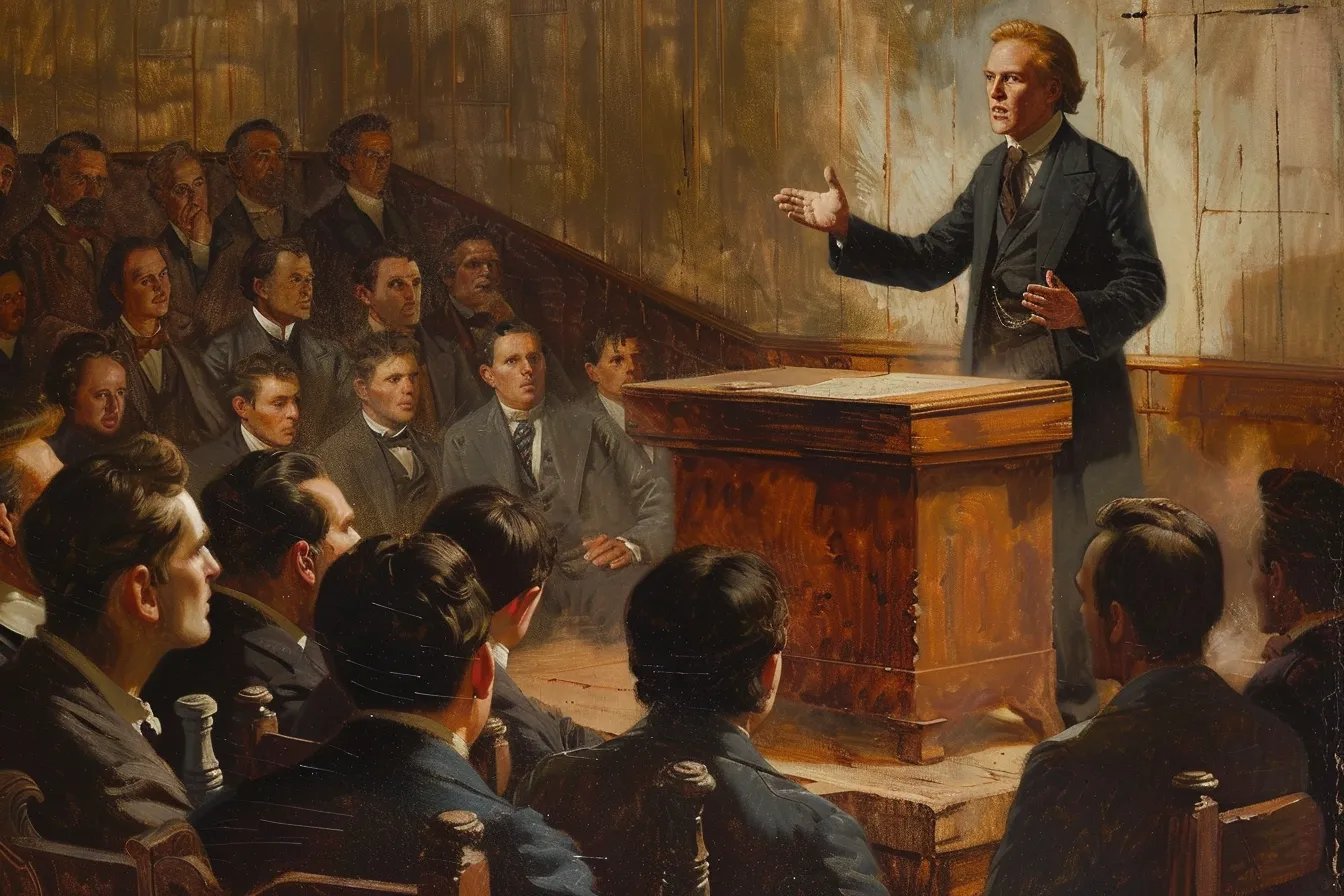
After concluding my search for the earliest mention of Jacob chapter 2, Whitney Horning1 helped uncover a quote from Hyrum Smith.2 It turns out Orson Pratt wasn’t the first to preach from Jacob 2. In Part 1.3 we traced the conventional reading to Pratt in 1853.3 Ten years earlier, in 1843, Hyrum Smith, co-president of the church, stood at the temple like Jacob and preached from the same chapter, and he read it the opposite way: having many wives and concubines was an abomination, and Jacob’s one-wife rule was “a perpetual principle.”
“May 14 [1843] attended [a] meeting at the temple a.m. Hyrum Smith addressed the people. Subjects from the book Mormon, 2d chap Jacob remarked that – the book Mormon was a mirror, a key to the Bible – spoke of persecution as being one of the means of salvation – when persecution ceased, apt to forget the first commandment – said there were many that had a great deal to say about the ancient order of things as Solomon and David having many wives and concubines — but it’s an abomination in the sight of god — if an angel from heaven should come and preach such doctrine would be sure to see his cloven foot & cloud of blackness over his head, —though his garments might shine as white as snow — a man might have one wife, — concubines he should have none — observed that, the idea was that this was given to Jacob for a perpetual principle — … I am a plain man to God I am responsible I deal in plainness … I feel myself ashamed of such conduct amongst us trifling with property & chastity of one another.”4
Just like in the time of Jacob, the same errors were creeping into the restoration as, “there were many that had a great deal to say about the ancient order of things as Solomon and David having many wives and concubines.” The Nephites were wresting the scriptures regarding David & Solomon, “for they seek to excuse themselves in committing whoredoms, because of the things which were written concerning David, and Solomon his son.” Hyrum confirms the Lord’s words from Jacob, “but it’s an abomination in the sight of god.”5
It’s almost as if God knows our hearts and that’s why he gives us patterns to discern what’s happening in our day. As Hyrum puts it, “the book Mormon was a mirror, a key to the Bible.” “And again, I will give unto you a pattern in all things, that ye may not be deceived; for Satan is abroad in the land, and he goeth forth deceiving the nations”6
If “this was given to Jacob for a perpetual principle” then what would that indicate? Perpetual as defined in the 1828 dictionary, “Never ceasing; continuing forever in future time; destined to be eternal; as a perpetual covenant; a perpetual statute.” and “Permanent; fixed; not temporary; as a perpetual law or edict.”7
If it is a perpetual principle, should that influence our thinking regarding Jacob’s sermon? The first definition says, “a perpetual covenant; a perpetual statute.” Did Hyrum know that this land belongs to Father Lehi as his land of inheritance?8 Did he understand that monogamy was the commandment that was given to Father Lehi?9 Did he know the importance of keeping the commandments of the covenant land?10
Where has this quote been?
From what I can tell, the first time this was published online was in 2019. The church and historians have had access for much longer. However, none of them published the full quote. It has existed as a photographed document, but not as a typed one. When I first wrote this in 2024, if you searched the internet for Hyrum’s full quote about Jacob chapter 2, you wouldn’t find it. Why would the church and church historians avoid publishing the full context of Hyrum’s words?
I spent some time trying to track down the earliest use of this quote, I believe it comes from Andrew Ehat’s Master’s thesis published in 1982.11
“The May 1843 Confrontation
In May 1843, when Hyrum, William Law and William Marks realized that their efforts had not ended the rumors of the private practice of to them aberrant marriage forms, they decided to bring the issue into the open. They were suspicious that their worst fears were true — Joseph was teaching plural marriage. So while Joseph was out of town, Hyrum spoke on 14 May to the Nauvoo populace taking as his text Jacob 2 in the Book of Mormon — quoting the verses that are a severe denunciation of polygamy.12 Almost echoing William Law’s sentiments, Hyrum said to the Saints, “If an angel from heaven should come and preach such doctrine, [you] would be sure to see his cloven foot and cloud of blackness over his head.”13 (Footnotes are from the original.)
From what I can tell, this was the first publication of the quote, but it’s only a partial quote. Here are all of the instances where I could find this journal quoted, however they are all partial quotes leaving out the most important statements.
1982 – Andrew Ehat – Online Text | Word Document
1989 – Richard S. Van Wagoner – Mormon Polygamy: A History, p. 54
1994 – Edward H. Ashment – The Temple: Historical Origins and Religious Value | Full PDF, p. 294
2011 – Terryl L. Givens, Matthew J. Grow – Parley P. Pratt: The Apostle Paul of Mormonism, p. 203
2012 – John G. Turner – Brigham Young: Pioneer Prophet, p. 97
2013 – Brian C. Hales – Joseph Smith’s Polygamy, Vol. 1, p. 195
2013 – Brian C. Hales – Encouraging Joseph Smith to Practice Plural Marriage: The Accounts of the Angel with a Drawn Sword (p. 5/59)
2013 – Merina Smith – Revelation, Resistance & Mormon Polygamy
2014 – Don Bradley and Brian C. Hales – Joseph Smith, an Angel with a Drawn Sword, and Plural Marriage, p. 6
2016 – Jeffrey M. Bradshaw – Now That We Have the Words of Joseph Smith, How Shall We Begin to Understand Them? Illustrations of Selected Challenges within the 21 May 1843 Discourse on 2 Peter 1 | The Interpreter Foundation
While none of these authors cite the entire quote, I would like to look closely at the work of Brian Hales and Don Bradley. From his website, “Brian C. Hales is the author of seven books dealing with Mormon polygamy—most notably the three-volume, Joseph Smith’s Polygamy: History and Theology (Greg Kofford Books, 2013).”14 I’m really grateful for the work Brian and Don have done to put together a large body of resources on polygamy. While Brian has given us a valuable resource, I’m often left scratching my head when I read his conclusions.
His research assistant, Don Bradley “is an author and independent historian specializing in the beginnings of the Latter-day Saint Restoration.”15 I really like Don, and I highly recommend his book, The Lost 116 Pages.16
It can’t be stressed enough how important these two men are in the world of Mormon polygamy apologetics; they’re the “go-to plyg gurus.” They are the unofficial authorities defending the church’s current narrative regarding Joseph Smith’s Polygamy. They show up on podcasts, in blog posts, news articles, conferences, radio & TV shows, and even in Church Essays.17
Here is how they’ve presented the quote in Encouraging Joseph Smith to Practice Plural Marriage: The Accounts of the Angel with a Drawn Sword (p. 5/59)18
I attended meeting at the temple in the afternoon. Hyrum Smith addressed the people . . . . He said there were many that had a great deal to say about the ancient order of things as Solomon and David having many wives and concubines, but it is an abomination in the sight of God. If an angel from heaven should come and preach such doctrine, some would be sure to see his cloven foot and cloud of darkness over head, though his garments might shine as white as snow. A man might have one wife but concubines he should have none.
Here is what is missing from the ellipses:
Subjects from the book Mormon, 2d chap Jacob remarked that – the book Mormon was a mirror, a key to the Bible – spoke of persecution as being one of the means of salvation – when persecution ceased, apt to forget the first commandment –
Here is what’s missing from the end of the quote:
A man might have one wife but concubines he should have none. observed that, the idea was that this was given to Jacob for a perpetual principle —
They also changed when it happened. Their version begins, “I attended meeting at the temple in the afternoon,” but the journal says “a.m.”
Why would they only give us portions of the temple sermon by Hyrum? In a review by BYU Studies, “In this three-volume set, author Brian Hales presents an exhaustive study of plural marriage as practiced and introduced by Joseph Smith.”19
If their research was “exhaustive,” shouldn’t we have the full quote given from Hyrum? If Latter-day Saints have never had full access to the quote by Hyrum Smith, does that affect how they weigh the matter? Are the church and its apologists withholding more quotes, journals, sermons, letters, or other evidence that Joseph and Hyrum fought against polygamy? Are they hedging up the way?20
Can we properly judge a matter without all of the evidence? If their position is so strong, why pick and choose portions of this important sermon about polygamy, delivered at the temple? Do the missing pieces weaken the traditional narrative?
Ol’ Two Toes
Another thing that caught my attention was an added word into the quote that slightly alters the meaning. Hales adds the word “some” to read:
“If an angel from heaven should come and preach such doctrine, some would be sure to see his cloven foot and cloud of darkness over head”21
“if an angel from heaven should come and preach such doctrine would be sure to see his cloven foot & cloud of blackness over his head”22

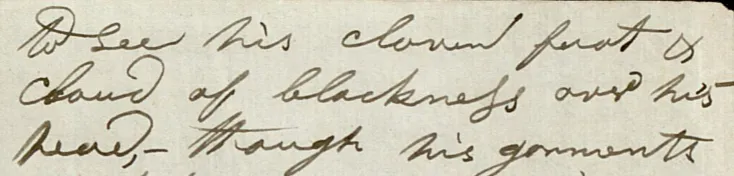
Would only “some” “see his cloven foot & cloud of blackness over his head” or would all? If only “some” see it are they deceived, or are those who miss the devil in those details deceived? There are many questions that should be asked of the church and of men like this who are promoting the traditional narrative. I suspect this document is available today mainly because Andrew Ehat quoted it in 1982. If he hadn’t, would anyone have made it known to the world?
Cloud of Blackness
I find it interesting that some of the quotes say “cloud of blackness,” which matches the original, and others say “cloud of darkness.” Does it matter? I’m not so sure, but again I ponder why we change things like this. In fact, the original Moses 1:1523 reads like this, “surely blessed be the name of my God for his Spirit hath not altogether withdrawn from me or else where is thy glory for it is blackness unto me.”24 The current version reads, “where is thy glory, for it is darkness unto me?”25
It’s also worth pondering that in the temple endowment, immediately after Adam and Eve partake of the fruit, they recognize Lucifer and see his “glory” and it is as Moses describes, “where is thy glory for it is blackness unto me.”26 We should be grateful for the keys of knowledge that Joseph & Hyrum left us to discern between light & dark, good & evil, truth & error.27
Even if this were an Angel from heaven, we should consider the words of Paul, “But though we, or an angel from heaven, preach any other gospel unto you than that which we have preached unto you, let him be accursed.”28 At one point Lucifer was also an angel who fell from heaven.29
Turning of Things Upside Down
If you read the theory by Don Bradley in either document, he surmises that the angel Hyrum is speaking of is “the angel with the drawn sword.”30 This is turning what Hyrum meant on its head. Hyrum was warning that those who teach such doctrine are deceiving you and they are a devil in disguise. “Bradley theorizes that this 1843 quotation may have been referring to the same sword-wielding angel, but without mentioning the sword.”31
For those who may be unaware, in Mormon tradition, Joseph Smith was visited by an unnamed angel with a drawn sword, who presented him with a divine command to practice polygamy.32 The angel with a drawn sword is a story that has been passed down from generation to generation. Could it be that this tradition of our fathers is untrue? If an angel commanded what Jacob calls an abomination, wouldn’t that be an angel of the devil? “O be wise; what can I say more?”33
As Joseph and Hyrum taught, “If any man writes to you, or preaches to you, doctrines contrary to the Bible, the Book of Mormon, or the book of Doctrine and Covenants, set him down as an imposter”34 This would also apply to a devil appearing as an angel of light whose words would be pleasing unto the carnal mind.35
Hyrum’s Conversion to Polygamy
The Church historians and apologists have used parts of Hyrum’s sermon at the temple to support the narrative that Brigham Young converted Hyrum to polygamy shortly after his May 14th, 1843 sermon at the temple.36 Here is the latest official retelling from “Saints, Volume 1,” Chapter 40: United in an Everlasting Covenant, pp. 491-492, from 2018.
On May 14, while Joseph was away at another conference, Hyrum preached in the temple against men having more than one wife. Referring to Jacob’s condemnation of unauthorized plural marriages in the Book of Mormon, Hyrum called the practice an abomination before God.37
After the sermon, Hyrum began to question his own certainty about what he taught. Discussions about plural marriage swirled around Nauvoo, and rumors that Joseph had several wives were also common.38
Hyrum wanted to believe this was not the case, but he wondered if Joseph was not telling him something. There had been times, after all, when Joseph had alluded to the practice, perhaps testing Hyrum to see how he would react. And Hyrum sensed there were some things that Joseph told the Twelve that he had not taught him.
One day soon after the sermon, Hyrum saw Brigham near his home and asked if they could talk. “I know there is something or other which I do not understand that is revealed to the Twelve,” he said. “Is this so?”
The men sat down on a pile of fence rails. “I do not know anything about what you know,” Brigham answered cautiously, “but I know what I know.”
“I have mistrusted for a long time that Joseph had received a revelation that a man should have more than one wife,” Hyrum said.
“I will tell you about this,” Brigham said, “if you will swear with an uplifted hand before God that you will never say another word against Joseph and his doings and the doctrines he is preaching.”
Hyrum stood up. “I will do it with all my heart,” he said. “I want to know the truth.”
As Brigham taught him about the Lord’s revelation to Joseph on plural marriage, Hyrum wept, convinced that Joseph acted under commandment.
This story is a mashup of one contemporary document and an anecdote from 1866.39 It seems this story has been retold over and over in the books of historians.40 In fact, Brigham’s story puts the event in 1842, but Hyrum’s sermon against the practice is from 1843. The year at the top of the journal was added later in a different handwriting, so I wondered whether it could have been 1844. The calendar points to 1843: May 14, 1843 was a Sunday, and May 14, 1844 was a Tuesday. So Brigham’s conversion story comes a year before the sermon it supposedly followed.
Did Hyrum convert to polygamy?
If Hyrum’s sermon at the temple is from 1843,41 then what did Hyrum say after his supposed conversion by Brigham? Once again we find a sermon of Hyrum’s that was hidden away, edited, and difficult to find. Hyrum “spoke an hour and a half” on the subject of having more wives than one.42 He would be dead just 80 days later.
Notice the sermons are consistent, from 1843: “a man might have one wife,” and from 1844: “I believe every good man should have one wife in this life.” Here are selected portions from the notes:
“One reason I speak to the Elders is, in consequence of the Ten thousand reports which come to me from abroad— almost every foolish man runs to me, to enquire if such and such things are true, and how many spiritual wives a man may have. I know nothing about it; what he might call a spiritual wife, I should not know anything about. In about half an hour after he has gone, another person begins to say: “the Elders tell such and such things all over the country.” I am authorized to tell you from henceforth, that any man who comes in and tells any such damn fool doctrine, to tell him to give up his license. None but a fool teaches such stuff; the devil himself is not such a fool, and every Elder who teaches such stuff ought to have his nose wrung; any one found guilty of such teaching will be published and his license will be taken from him.
I wish the Elders of Israel to understand it is lawful for a man to marry a wife, but it is unlawful to have more, and God has not commanded any of you to have more; and if any of you dare to presume to do any such things, it will spoil your fun, for you will never have the spirit to preach the Gospel. I despise a man who teaches a pack of stuff that will disgrace himself so; for a man to go into the world, and talk of this spiritual wife system he is as empty as an open sepulchre.
All the mysteries are to be taught in Nauvoo where they can be taught so as to be understood. No spiritual wife doctrine ever originated with me.
I believe every good man should have one wife in this life, and I know if I had two I should not know what to do with them; they might quarrel about me, and I might get a whipping. One is enough, and I warn all of you not to attempt it; if a man should begin to find you out, you would get into some cell in Alton.
Get the wife sealed to you that God and your country let you have, and if any brother hears any person preach such stuff wring his nose but look out or he may be stouter than you. No man would have more than one wife or they will join together and beat him. If I was a woman, and got so fooled I would hide my head. I give the sisters leave to wring his nose to teach such stuff; I’ll bear you out in it; give him justice.
We are in a different dispensation; it is the honest and pure in heart that will hearken to the everlasting covenant; they are those who are noble and good; they that give you food, and clothe you. We want the honest in heart— the virtuous— the noble; we want the good seed gathered here. Let all men repent, and the Elders gather out the good seed, and bring it to Nauvoo. We want you to understand that if you preach any thing wrong, you will be published. We don’t want bogus makers, counterfeiters, or preachers of the spiritual wife system.”
Would we live in an alternate universe if Hyrum’s sermons had been made public sooner? Clearly Hyrum was an alternative voice, whose sermons and teachings would today “disagree publicly with the official position of the church.”43
Conclusion
Hopefully this has given us enough background on the history of this verse and where we get our traditional interpretation. The official reading came from Orson Pratt in 1853. Ten years earlier, Hyrum Smith stood in the temple, took Jacob 2 as his text, and called many wives an abomination and Jacob’s rule “a perpetual principle.” A year later he told the elders again that it was “unlawful to have more.” The first known sermon on Jacob 2 in our day was against plural marriage, and the line about a perpetual principle is the part left out when historians quote it. Next, we’ll turn to Joseph himself and what he said about Jacob 2.
Notes
- Whitney recently published a book called, “Hyrum Smith A Prophet Unsung” “The world has long spoken both good and evil of Joseph Smith Jr., but few know his older brother, Hyrum. Few in this world have acknowledged or given any attentiveness to this man who, from his childhood, lived a life of honor, integrity, humility, and faith. During Joseph’s dispensation, there is record of only one other man who rose up out of the darkness of this world and into the Light, receiving Eternal life. On January 19, 1841, the Lord pronounced Hyrum a Patriarch, Prophet, Seer, and Revelator and recognized his place as first in His Priesthood. As one of God’s chosen servants, he was largely ignored and dismissed by the people in his day. Today, not one of the Churches that claim their foundation in Joseph’s Restoration Movement recognize Hyrum in their line of Prophet/president successors. Hyrum’s full value in the Restoration and in the Lord’s unfolding work today has yet to be fully understood, appreciated, or acknowledged.” ↩
- 94: Historical Malpractice Part 1 – A Conversation with Whitney Horning, starting at 20:52 ↩
- The Root of the Interpretation ↩
- Church History Catalog | Asset viewer | Volume 18, 1843 May 14-June 11 ↩
- “Behold, David and Solomon truly had many wives and concubines, which thing was abominable before me, saith the Lord.” – Jacob 2:24 ↩
- D&C 52:14 ↩
- Webster’s Dictionary 1828: Perpetual ↩
- “Yea, the Lord hath covenanted this land unto me…” 2 Nephi 1:5 ↩
- “For there shall not any man among you have save it be one wife; and concubines he shall have none;” Jacob 2:27 “ye know that these commandments were given to our father, Lehi;” Jacob 2:34 “…for they have not forgotten the commandment of the Lord, which was given unto our father—that they should have save it were one wife, and concubines they should have none, and there should not be whoredoms committed among them.” Jacob 3:5 ↩
- “And if it so be that they shall serve him according to the commandments which he hath given, it shall be a land of liberty unto them; wherefore, they shall never be brought down into captivity; if so, it shall be because of iniquity; for if iniquity shall abound cursed shall be the land for their sakes…” 2 Nephi 1:7 ↩
- Joseph Smith’s Introduction of Temple Ordinances and the 1844 Mormon Succession Question, by Andrew F. Ehat, December 1982 ↩
- 159 Levi Richards, Diary, 14 May 1843, Church Archives. William Law also used Jacob 2 in his campaign against the Prophet’s teachings on plural marriage (see Ehat, “The Nauvoo Journal of Joseph Fielding,” p. 154). George A. Smith observed that when Joseph Smith was confronted with this passage from the Book of Mormon, the Prophet would cite the passage in that chapter that said, “For if it will, saith the Lord of Hosts, raise up seed unto me, I will command my people……… (Jacob 2:30), and follow this by saying, “God has commanded us” (George A. Smith to Joseph Smith III, 9 October 1869, Historian’s Office Letterpress Copybooks, Church Archives). Editor’s note: the letter itself doesn’t mention verse 30. It says only, “When the passage in the book of Mormon enjoining Monogamy was referred to your father; he replied that ‘God has commanded us.’” See Joseph and Jacob 2. ↩
- 160 Levi Richards, Diary, 14 May 1843.” ↩
- About: Brian C. Hales ↩
- Don Bradley | Greg Kofford Books ↩
- The Lost 116 Pages: Reconstructing the Book of Mormon’s Missing Stories ↩
- In a review of one of his books from BYU Studies, Brian’s work is described this way: “Brian Hales’s influence in Church history circles is already seen in at least one official LDS Church publication, a thoughtful article entitled “Plural Marriage in Kirtland and Nauvoo” that is posted on the Church’s website, lds.org. Brian Hales is cited more times than any other single author in the footnotes for that piece.” – Joseph Smith’s Polygamy, BYU Studies ↩
- The book, Joseph Smith’s Polygamy, Vol. 1, p. 195 is missing the first part and reads, “He said there were many that had a great deal to say about the ancient order of things as Solomon and David having many wives and concubines, but it’s an abomination in the sight of God. If an angel from heaven should come and preach such doctrine, some would be sure to see his cloven foot and cloud of darkness over head, though his garments might shine as white as snow. A man might have one wife but concubines he should have none.” ↩
- “Hales’s volumes are ambitious by any measure and are impressive for their sheer scope, attention to detail, and thorough consideration of all available sources.” – Brian C. Hales. Joseph Smith’s Polygamy. | BYU Studies I wonder what the issue is with Hyrum’s statement that made Brian Hales hedge portions? Especially with his, “attention to detail, and thorough consideration of all available sources.” ↩
- I can’t help but ponder the Lord’s rebuke to the scribes & Pharisees, “Woe unto you, lawyers! for ye have taken away the key of knowledge: ye entered not in yourselves, and them that were entering in ye hindered.” – Luke 11:52 The JST reads this way, “Woe unto you lawyers, for you have taken away the key of knowledge, the fullness of the scriptures. You enter not in yourselves into the kingdom, and those who were entering in, you hindered.” – Luke 8:17 God will destroy the hedge however, “And now go to; I will tell you what I will do to my vineyard: I will take away the hedge thereof, and it shall be eaten up; and break down the wall thereof, and it shall be trodden down:” Isaiah 5:5 ↩
- Joseph Smith’s Polygamy, Vol. 1, p. 195 ↩
- Church History Catalog | Asset viewer | Volume 18, 1843 May 14-June 11 ↩
- Some may not realize that this should be Genesis 1, as the header of Moses 1 informs us, “An extract from the translation of the Bible as revealed to Joseph Smith the Prophet, June 1830–February 1831.” ↩
- Old Testament Revision 1, p.1. ↩
- Moses 1:15 ↩
- id. ↩
- These changes might contribute to our struggle to understand the “skin of blackness” in the Book of Mormon, 2 Nephi 5:21 But if we won’t ask God, then well… “Wherefore, now after I have spoken these words, if ye cannot understand them it will be because ye ask not, neither do ye knock; wherefore, ye are not brought into the light, but must perish in the dark.” 2 Nephi 32:4 ↩
- Galatians 1:8 ↩
- Isaiah 14:12 ↩
- 14: The Angel with the Drawn / Flaming Sword | 132 Problems: Revisiting Mormon Polygamy ↩
- Encouraging Joseph Smith to Practice Plural Marriage: The Accounts of the Angel with a Drawn Sword (p. 5/59) ↩
- The earliest account was likely written in 1853, nine years after the death of Joseph Smith. A non-Mormon’s secondhand version followed in 1854, and the rest date from 1869 on. “In all, twenty accounts from nine witnesses have been identified (see Appendix). All these individuals could have heard the statement from the Prophet; however, this may not be a safe assumption. The narratives themselves suggest that Benjamin F. Johnson and Eliza R. Snow may have repeated information gathered from other people… Unfortunately, with the exception of the Robinson account, all the reminiscences are recounted at least twenty to thirty years after the event. The identity of the angel is also not revealed.” – Encouraging Joseph Smith to Practice Plural Marriage: The Accounts of the Angel with a Drawn Sword (p. 5/59) ↩
- Jacob 6:12 | “here is some of the fruit of that tree. It will make you wise.” Who knew the King was singing about the Garden of Eden? 🎥 (You’re The) Devil in Disguise ↩
- Times & Seasons, Vol. 5, No. 7, pg 491 ↩
- “But behold, the devil hath deceived me; for he appeared unto me in the form of an angel, and said unto me: Go and reclaim this people, for they have all gone astray after an unknown God. And he said unto me: There is no God; yea, and he taught me that which I should say. And I have taught his words; and I taught them because they were pleasing unto the carnal mind; and I taught them, even until I had much success, insomuch that I verily believed that they were true; and for this cause I withstood the truth, even until I have brought this great curse upon me.” Alma 30:53 “And our spirits must have become like unto him, and we become devils, angels to a devil, to be shut out from the presence of our God, and to remain with the father of lies, in misery, like unto himself; yea, to that being who beguiled our first parents, who transformeth himself nigh unto an angel of light, and stirreth up the children of men unto secret combinations of murder and all manner of secret works of darkness.” 2 Nephi 9:9 ↩
- I find it fascinating that Jacob delivers his sermon at the temple and a few years later he’s visited by a man named Sherem who, “…preached many things which were flattering unto the people; and this he did that he might overthrow the doctrine of Christ.” Jacob 7:2 ↩
- Footnote 38: Hyrum Smith, Discourse, in Levi Richards, Journal, May 14, 1843; Jacob 2:23–30. Hyrum Smith, Discourse, in Levi Richards, Journal, May 14, 1843 ↩
- Footnote 39: Hyrum Smith, Discourse, in Levi Richards, Journal, May 14, 1843; Temple Lot Transcript, part 3, 373, 385, questions 532–34, 770. Hyrum Smith, Discourse, in Levi Richards, Journal, May 14, 1843 Temple Lot Transcript, part 3, 373, 385, questions 532–34, 770 ↩
- Photograph of the record by George D. Watt. Historian’s Office reports of speeches, 1845-1885 / Brigham Young, 1866 October 8 The only transcript that I could find online from the Brigham Young Center, “REMARKS“ ↩
- From Brian Hales, Joseph Smith’s Polygamy, Volume 2: History, pp. 45-46 Mormon Enigma: Emma Hale Smith, p.141, By Linda King Newell, Valeen Tippetts Avery ↩
- The full journal entry is quoted at the top of this post. ↩
- Here is the original talk: Hyrum Smith, April 8, 1844, discourse not published, Nauvoo, Illinois. This sermon nearly made it into our official “history of the church” but Brigham decided to remove it and crossed it out: History, 1838–1856, volume E-1 [1 July 1843–30 April 1844] Here is the transcript, you’ll need to search on page or scroll to near the end, it’s been crossed out: Full Transcript This sermon was edited ever so slightly to turn Hyrum into an eternal polygamist. I’ve posted the full sermon with notes on the changes: Hyrum Smith Discourse on Polygamy ↩
- I heard Brian Hales state on the 132 Problems podcast that, “when we start to disagree publicly with the official position of the church, that’s the problem.”– 49: Do I need to be “Excommunicated”?! — w/ Brian Hales | 132 Problems: Revisiting Mormon Polygamy, starting at 13:53 and, “alternative voices are good when we’re able to sustain what the church’s official teachings are, but the problem comes when we want to publicly disagree.” – 49: Do I need to be “Excommunicated”?! — w/ Brian Hales | 132 Problems: Revisiting Mormon Polygamy, starting at 15:52 ↩
Comments