
Jacob’s Prophecy
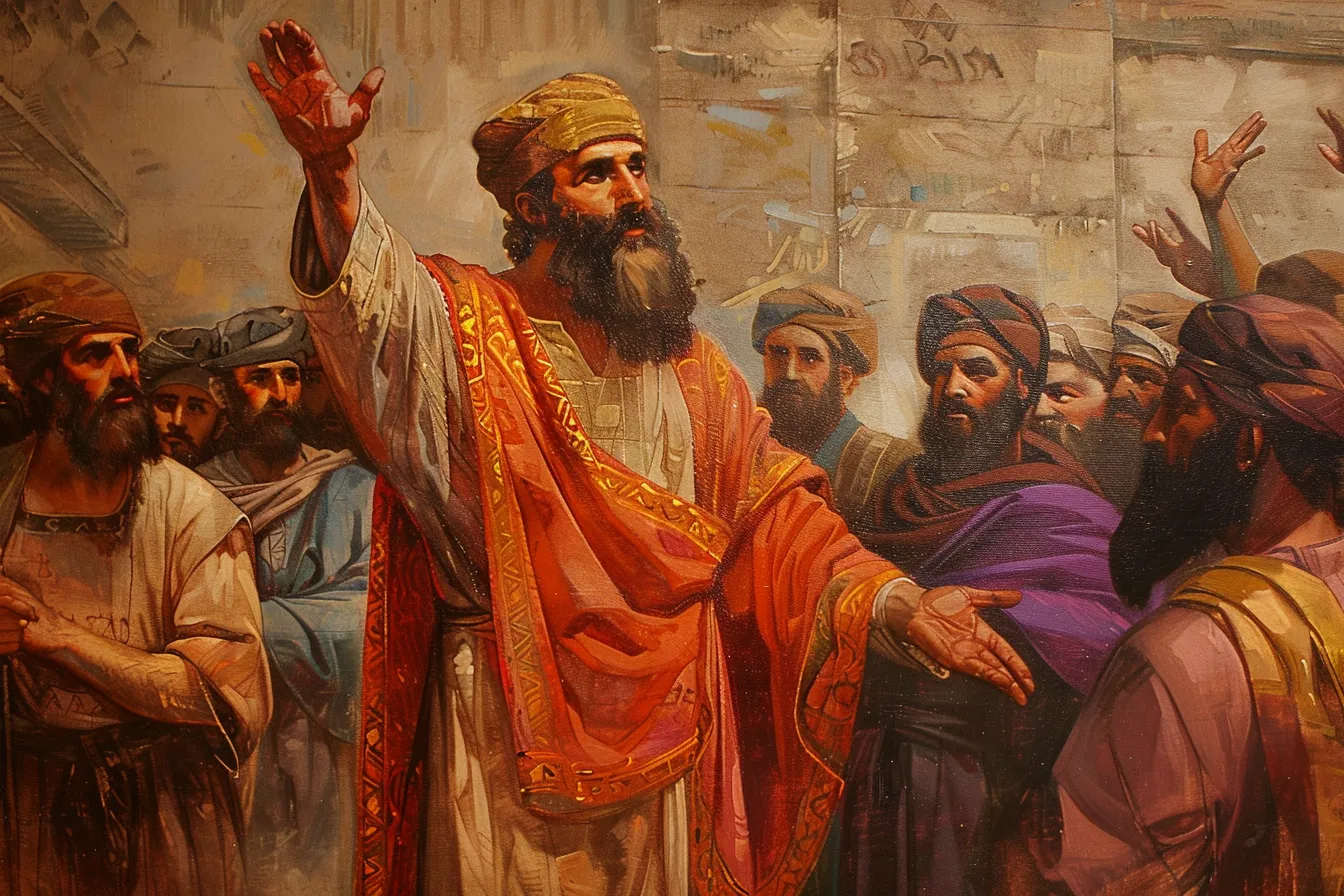
After Jacob recounts the commandments from his father’s record, he laments at what the Nephites have done.1 “ye have come unto great condemnation; for ye have done these things which ye ought not to have done.” This confirms to us that they had taken action, their secret had been made known and it was discovered by the Lord.2
Jacob’s sermon ends in prophecy. If the Nephites won’t repent, the land is cursed and the Lamanites will scourge them even unto destruction. Within about three centuries, it happened: “the more wicked part of the Nephites were destroyed.” This part traces that prophecy from Lehi’s covenant to its fulfillment.
Lehi’s words delivered to him by the Lord a generation earlier have now become a fulfilled prophecy. The consequences of their actions are starting to cause destruction in their own homes, “Ye have broken the hearts of your tender wives, and lost the confidence of your children, because of your bad examples before them; and the sobbings of their hearts ascend up to God against you. And because of the strictness of the word of God, which cometh down against you, many hearts died, pierced with deep wounds.”3
This fulfills what the “Lord of Hosts” specifically warned them about forty years earlier, “And I will not suffer, saith the Lord of Hosts, that the cries of the fair daughters of this people, which I have led out of the land of Jerusalem, shall come up unto me against the men of my people, saith the Lord of Hosts.”4 While these words are only a few verses apart, they originated decades apart.
Take a moment to realize that before Lehi had even left Jerusalem, the Lord had already seen enough mistreatment of his daughters amongst his people. “For behold, I, the Lord, have seen the sorrow, and heard the mourning of the daughters of my people in the land of Jerusalem, yea, and in all the lands of my people, because of the wickedness and abominations of their husbands.”5
Lehi’s words in verses 31–32 are warning of future consequences; Jacob’s words in verses 34–35 are past tense showing they forgot the words given to Father Lehi. They “have come unto great condemnation,” and “broken the hearts of their tender wives, and lost the confidence of their children.”6 They’ve fulfilled Lehi’s words and greater destruction awaits them if they don’t repent. With this information we should be able to see if the rest of his prophecy is fulfilled.
The situation they’ve put themselves in is a natural consequence of not keeping the commandments of the promised land. They’ve failed to “hearken” to the words given to Lehi a generation earlier. We shouldn’t overlook the fact that the women and children are the first to suffer when the “men of my people”7 disobey the Lord. They have been warned and the curse recorded by Lehi has hit home and will affect future generations unless they hearken to Jacob’s counsel.8
As Lehi prophesied, “this people shall keep my commandments, saith the Lord of Hosts, or cursed be the land for their sakes.”9 They’ve broken the commandment and Jacob alerts them, “except ye repent the land is cursed for your sakes; and the Lamanites… shall scourge you even unto destruction.”10
Scourge Unto Destruction
Nephi was told early on the reason behind bringing his rebellious brothers with them to the land of promise. In God’s wisdom, Laman and Lemuel would join them,
“And it came to pass that the Lord spake unto me, saying: Blessed art thou, Nephi, because of thy faith, for thou hast sought me diligently, with lowliness of heart. And inasmuch as ye shall keep my commandments, ye shall prosper, and shall be led to a land of promise; yea, even a land which I have prepared for you; yea, a land which is choice above all other lands. And inasmuch as thy brethren shall rebel against thee, they shall be cut off from the presence of the Lord. And inasmuch as thou shalt keep my commandments, thou shalt be made a ruler and a teacher over thy brethren. For behold, in that day that they shall rebel against me, I will curse them even with a sore curse, and they shall have no power over thy seed except they shall rebel against me also. And if it so be that they rebel against me, they shall be a scourge unto thy seed, to stir them up in the ways of remembrance.”11
The Lamanite rebellion comes shortly after Lehi dies, “And the Lord God said unto me: They shall be a scourge unto thy seed, to stir them up in remembrance of me; and inasmuch as they will not remember me, and hearken unto my words, they shall scourge them even unto destruction.”12
Notice the phrasing is a bit different. The first telling of this warning to the Nephites says, “if it so be that they [Nephites] rebel against me.” The second gives us more information cluing us in to what rebellion means to God. “…inasmuch as they will not remember me, and hearken unto my words…” This is rebellion against God.
“Thus we see how quick the children of men do forget the Lord their God, yea, how quick to do iniquity, and to be led away by the evil one.”13 Our ignorance comes from a slow process of forgetting God’s word; the Nephites needed a constant scourge in the Lamanites and the Prophets to remind them that not all was well. “And it came to pass that the prophets of the Lord did threaten the people of Nephi, according to the word of God, that if they did not keep the commandments, but should fall into transgression, they should be destroyed from off the face of the land.”14
We have a responsibility to remember and hearken. As Jacob speaks they are being brought to a remembrance of the words from Lehi, hearkening back to the warnings of their Father. The phrase “hearken back” connotes a reflection and remembrance of something from before.15 This was something done from the beginning, “And a book of remembrance was kept, in the which was recorded, in the language of Adam, for it was given unto as many as called upon God to write by the spirit of inspiration;”16
Choose to Repent
This also shows us that one man who chooses righteousness can preserve their family. They do not need to partake in the abominations of their generation; they can choose God and reject all of the foolishness the world tries to push upon them. They must keep their eyes fixed on the Lord however, Lehi looked to God as he ought; he looked and lived. I believe Lehi became a priest after the Holy Order, after the Order of the Son of God17 He received the high priesthood that was removed from the children of Israel when they asked Moses to speak to God for them.18
Lehi not only rejected the sinful and iniquitous culture, it’s very likely he also rejected the wicked religionists of his day.19 He would not participate in nor entertain the thought of these abominations in his heart. We know he repented because the Lord calls him a “righteous branch” and he was fruitful, as barren branches are hewn down and cast into the fire.20 He arrived at the point where he, “could not look upon sin save it were with abhorrence.”21 I quite like the description of repentance from this talk,
“Take a look at Doctrine and Covenants 93: 36: “The glory of God is intelligence, or, in other words, light and truth. Light and truth forsake that evil one.” What if, instead of repentance being related to your misdeeds, which are so plentiful and persistent, and will continue; instead it is related to the acquisition of light of truth – that is intelligence? What if repentance requires you to take whatever it is you have that is a foolish error, a vain tradition, or a false notion and replace it with truth?
My suspicion is, that whatever it is that is troubling you, will trouble you considerably less if you begin to fill yourself with light and truth. Until at last you arrive at a point you look back upon your sins and you say. “I have no more disposition for that. Now I know enough not to do that anymore because I prefer the light. I prefer God’s intelligence and glory over that which I used to trade, or substitute for it.” You see repentance may have a whole lot more to do with your own feeble education in the things of God than it has to do with the time you spend wasted, looking at some vile picture or other.”22
The Nephites needed to repent; they were losing light. While their sins were abominable before the Lord, it was a loss of light through wresting the scriptures that would cause them to perish. This loss of light caused greater darkness than the Lamanites.23
The End from the Beginning
Jacob’s sermon uncovers their abominations and now it turns into his own prophecy. Jacob bemoans to warn them of the potential outcome. Like his older brother, he had seen their fate: “it truly had been made manifest unto us concerning our people, what things should happen unto them.”24 Nephi saw the unfolding of events and that, “the seed of [his] brethren that they had overcome [his] seed” on the promised land.25 As Nephi learns this, he emerges from his grand vision and finds his brothers are, “disputing one with another concerning the things which my father had spoken unto them.”26 Nephi knows the outcome, the end of the book. He knows that his brothers, who are in character and “disputing one with another,”27 will have a posterity that will survive. Nephi knows his seed will not make it in the end.28
Yet Nephi still tries to reclaim his brothers, “Have ye inquired of the Lord?”29 Here we see the great difference between Laman and Lemuel, and Nephi. They respond, “We have not; for the Lord maketh no such thing known unto us.”30 The great lie, the unbelief that will keep us bound in chains and never allow us to arise from the dust. They do not believe that God will speak to them; in their unbelief they deny the revelations from God.31
Nephi responds, “How is it that ye do not keep the commandments of the Lord? How is it that ye will perish, because of the hardness of your hearts?”32 His reference should recall our minds to verse three, “For he [Lehi] truly spake many great things unto them, which were hard to be understood, save a man should inquire of the Lord; and they being hard in their hearts, therefore they did not look unto the Lord as they ought.”33 and it should recall our minds to Moses,
“Behold, he was spoken of by Moses; yea, and behold a type was raised up in the wilderness, that whosoever would look upon it might live. And many did look and live. But few understood the meaning of those things, and this because of the hardness of their hearts. But there were many who were so hardened that they would not look, therefore they perished. Now the reason they would not look is because they did not believe that it would heal them. O my brethren, if ye could be healed by merely casting about your eyes that ye might be healed, would ye not behold quickly, or would ye rather harden your hearts in unbelief, and be slothful, that ye would not cast about your eyes, that ye might perish”34
Nephi’s heart was softened by the Lord, for all we know his heart may have been just as hardened as his brothers, but he chose to “look and live” by merely crying to the Lord.35 What could Nephi have been referring to when he said to his brothers, “How is it that ye do not keep the commandments of the Lord?”
Look and Live
By loving God we will have these things on our hearts and minds continually. You see, if Laman and Lemuel were “righteous” like “the people who were in the land of Jerusalem,” then they would have “kept the statutes and judgments of the Lord, and all his commandments, according to the law of Moses;”36 Nephi has to remind them of the law,
“And thou shalt love the Lord thy God with all thine heart, and with all thy soul, and with all thy might. And these words, which I command thee this day, shall be in thine heart: And thou shalt teach them diligently unto thy children, and shalt talk of them when thou sittest in thine house, and when thou walkest by the way, and when thou liest down, and when thou risest up.”37
It is God’s word that we should meditate on day and night.38 This theme of constant focus on the Lord runs throughout the scriptures: “Watch ye therefore, and pray always, that ye may be accounted worthy to escape all these things that shall come to pass, and to stand before the Son of man.”39 “Yea, and when you do not cry unto the Lord, let your hearts be full, drawn out in prayer unto him continually for your welfare, and also for the welfare of those who are around you.”40
Joseph’s revelations are no different: “Look unto me in every thought; doubt not, fear not.”41 and, “Neither take ye thought beforehand what ye shall say; but treasure up in your minds continually the words of life, and it shall be given you in the very hour that portion that shall be meted unto every man.”42
I love what Paul says, to “be filled with the Spirit; Speaking to yourselves in psalms and hymns and spiritual songs, singing and making melody in your heart to the Lord; Giving thanks always for all things unto God and the Father in the name of our Lord Jesus Christ;”43
As we come out of the wilderness, or the world, we will be led by the voice of the Good Shepherd.44 He will lead us “by day in a pillar of a cloud,” “and by night in a pillar of fire,”45 Nephi knew who he trusted: “Behold, he hath heard my cry by day, and he hath given me knowledge by visions in the night-time.”46
Yet even before the Law of Moses, our father Abraham was the example of constant brooding on, or thinking upon God.
a. Thou hast loved righteousness. Thus did God speak to Abraham. For the Holy One, blessed be He, saw all the generations that worshiped idols, [saw] Abraham rise up and separate himself from the generations because he would not be like them; [saw] that while they worshiped idols,47 Abraham rose up and learned wisdom by himself so that he came to worship the Holy One, blessed be He. Because God saw the righteousness of Abraham. He described him as the Hebrew,48 so setting it down in Scripture: And told Abram the Hebrew.49 What is meant by the Hebrew? That he brooded upon God. For the entire world was on one side, and he was on the other side,50 but he so loved the Holy One, blessed be He, that he would worship Him and no other.51 Hence the Holy One, blessed be He, called him Hebrew, and also called Hebrew the seed of Abraham who loved Him. For, said the Holy One, blessed be He: Thou hast loved righteousness52 and commanded thy children that they also do righteousness—”that they may keep the way of the Lord to do righteousness and justice.”53 (footnotes from original)54
Christ is the law,55 and he is the word.56 He is the one upon who our eyes are to be fixed.57 Jacob taught, “for this intent we keep the law of Moses, it pointing our souls to him; and for this cause it is sanctified unto us for righteousness,”58 Lehi kept God’s commandments and discovered the purpose behind the law, like Abraham he desired “to be a greater follower of righteousness, and to possess a greater knowledge.”59
God is talkative, his words never cease. Don’t you be slothful because of the easiness of the way. We should all evaluate the soil in our hearts; I would encourage you to choose to follow Him and be like Him. Nephi is doing the same with his brothers; he wants them to hearken to God.
Jacob’s Prophecy
“A prophecy is not a prediction, it is a warning or a promise. The Prophet warns Israel about God’s judgement and promises God’s salvation. Both the warning and the promise are conditional. They depend upon the free response of the people Israel. If Israel does not change, the consequences will be disastrous. If Israel does change, there will be an abundance of blessings. The practical purpose of a prophecy is to persuade the people to change or repent. Every prophet appealed for a conversion.”60
Both Nephi and Jacob know the potential fate of those who they minister to, they know their message is likely to be rejected. This should tell us something about a true messenger sent from God. They know the probable outcome, yet the message must be delivered even if it is not received. Not only that, they are commanded to write so that the next inhabitants of the land will gain knowledge from the previous occupants, that their wickedness might be discovered.61
This should haunt us. What could Jacob be trying to prophesy to us, the next inhabitants of the land? What errors could we have avoided if we had only treated the Book of Mormon with the regard it should be treated with? We have the record of the previous inhabitants who were swept away because, unlike the Lamanites, they failed to keep the commandment of having “save it be one wife; and concubines he shall have none.”62
Jacob’s prophecy continues in chapter three, “But behold, I, Jacob, would speak unto you that are pure in heart.”63 While Jacob is speaking to his people, this message is also intended for those who will read it in our day. While the curse of multiple wives has affected our communities, it can’t affect those who choose to purify their hearts.
The message to those who will hear is to, “Look unto God with firmness of mind, and pray unto him with exceeding faith, and he will console you in your afflictions, and he will plead your cause, and send down justice upon those who seek your destruction.”64
Jacob is getting bold: those who are not keeping the commandments are threatening the entire community with destruction and God will, “send down justice upon those who seek your destruction.” They are “filthy this day before God.” Even the Lamanites who have rejected the entire religion will fare better “when ye shall be brought with them before the throne of God.” We should not minimize the effect of this sin, we should not justify any action that will curse us so. The Nephites have done this. Their land is cursed. “for except ye repent the land is cursed for your sakes;”65 and only repentance will lift the curse.
Prophecy Fulfilled
The Lord told the Israelites, “When a prophet speaketh in the name of the Lord, if the thing follow not, nor come to pass, that is the thing which the Lord hath not spoken, but the prophet hath spoken it presumptuously: thou shalt not be afraid of him.”66 Jacob uses the phrase, “thus saith the Lord” three times and that should get our attention.67
“A full understanding of the biblical prophets also requires an awareness of the conditional nature of many of their prophecies… they constantly echoed a promise that repentance on the part of the people would soften their punishment at the hands of an angry God. Coupled with prophetic demands for reform came an unbroken series of predictions said to be contingent upon the behavior of those who listened to the messages.”68
We should see “an unbroken series of predictions said to be contingent upon the behavior of those who listened to the messages.” Jacob’s prophecy does exactly that, his prophecy includes:
From Lehi’s Words
- “I the Lord God will not suffer that this people shall do like unto them of old.”69
- “this people shall keep my commandments, saith the Lord of Hosts, or cursed be the land for their sakes.”70
- “I will not suffer, saith the Lord of Hosts, that the cries of the fair daughters of this people, which I have led out of the land of Jerusalem, shall come up unto me against the men of my people, saith the Lord of Hosts.”71
- “For they shall not lead away captive the daughters of my people because of their tenderness, save I shall visit them with a sore curse, even unto destruction”72
From Jacob’s Words
- “But, wo, wo, unto you that are not pure in heart, that are filthy this day before God; for except ye repent the land is cursed for your sakes;”73
- “the Lamanites, which are not filthy like unto you, nevertheless they are cursed with a sore cursing, shall scourge you even unto destruction.”74
- “they (the Lamanites) shall possess the land of your inheritance,”75
- “the Lord God will lead away the righteous out from among you.”76
- “because of this observance, in keeping this commandment, the Lord God will not destroy them, but will be merciful unto them; and one day they shall become a blessed people.”77
- “I fear that unless ye shall repent of your sins that their skins will be whiter than yours, when ye shall be brought with them before the throne of God.”78
- “remember that ye may, because of your filthiness, bring your children unto destruction, and their sins be heaped upon your heads at the last day.”79
Waxing and Waning in Light
Synopsis Sohar, p. 132, n. 18, we have the following words; “From Abraham to Solomon were fifteen generations; and then the moon was at the full. From Solomon to Zedekiah were other fifteen generations; the moon was then in the wane, and Zedekiah’s eyes were put out.” That is, the regal state came to its zenith of light and glory in the time of Solomon; but decreased gradually, till it became nearly extinct in the days of Zedekiah. See Schoetgen.80
Like the moon, Israel’s kingdom waxed and waned. It reached its full light under Solomon, then split and faded until Zedekiah’s eyes were put out. Polygamy wasn’t the only cause, but David and Solomon practiced it, the kings after them followed, and the Lord called it “abominable before me.”81 Zedekiah’s blindness fits the end of that decline.
King Solomon reigned for forty years and died around 931 B.C., roughly 330 years before Lehi left Jerusalem.82 About the same span passes among the Nephites before they meet a similar fate. The pattern repeats: a people blessed and warned turn from the covenant and are destroyed, whether in Jerusalem or in the land of promise.
“Behold, it came to pass that three hundred and twenty years had passed away, and the more wicked part of the Nephites were destroyed. For the Lord would not suffer, after he had led them out of the land of Jerusalem and kept and preserved them from falling into the hands of their enemies, yea, he would not suffer that the words should not be verified, which he spake unto our fathers, saying that: Inasmuch as ye will not keep my commandments ye shall not prosper in the land. Wherefore, the Lord did visit them in great judgment; nevertheless, he did spare the righteous that they should not perish, but did deliver them out of the hands of their enemies.”83
Just like at the time of the destruction in Jerusalem, God has allowed the “more wicked part” to be destroyed. The righteous are spared because they are warned by the Lord.84 Jacob and Lehi’s words have been fulfilled.
| Prophecy | Fulfillment |
|---|---|
| King Solomon dies (1 Kings 11:43), 330 years later Lehi flees Jerusalem (1 Nephi 2:2–4) | Behold, it came to pass that three hundred and twenty years had passed away, (Omni 1:5) |
| they shall never be brought down into captivity; if so, it shall be because of iniquity; for if iniquity shall abound cursed shall be the land for their sakes, (2 Nephi 1:7) | This people begin to wax in iniquity; (Jacob 2:23); Behold, ye have done greater iniquities than the Lamanites, our brethren. (Jacob 2:35); the land is cursed for your sakes; (Jacob 3:3) |
| the Lamanites, which are not filthy like unto you, nevertheless they are cursed with a sore cursing, shall scourge you even unto destruction.” (Jacob 3:3) | we had many seasons of peace; and we had many seasons of serious war and bloodshed. (Omni 1:3) |
| “For they shall not lead away captive the daughters of my people because of their tenderness, save I shall visit them with a sore curse, even unto destruction” (Jacob 2:33); “the Lamanites… shall scourge you even unto destruction.” (Jacob 3:3) | and the more wicked part of the Nephites were destroyed. (Omni 1:5) |
| “I will not suffer, saith the Lord of Hosts, that the cries of the fair daughters of this people, which I have led out of the land of Jerusalem, shall come up unto me against the men of my people, saith the Lord of Hosts.” (Jacob 2:32) | For the Lord would not suffer, after he had led them out of the land of Jerusalem (Omni 1:6) |
| “I will not suffer, saith the Lord of Hosts, that the cries of the fair daughters of this people, which I have led out of the land of Jerusalem, shall come up unto me against the men of my people, saith the Lord of Hosts.” (Jacob 2:32) | Ye have broken the hearts of your tender wives, and lost the confidence of your children, because of your bad examples before them; and the sobbings of their hearts ascend up to God against you. (Jacob 2:35) |
| “And if it so be that they shall keep his commandments they shall be blessed upon the face of this land, and there shall be none to molest them”, (2 Nephi 1:9) | “and kept and preserved them from falling into the hands of their enemies,” (Omni 1:6) |
| “I the Lord God will not suffer that this people shall do like unto them of old.” (Jacob 2:26) | “yea, he would not suffer that the words should not be verified,” (Omni 1:6) |
| “this people shall keep my commandments, saith the Lord of Hosts, or cursed be the land for their sakes.” (Jacob 2:29) | which he spake unto our fathers, saying that: Inasmuch as ye will not keep my commandments ye shall not prosper in the land. (Omni 1:6) |
| Yea, as one generation passeth to another there shall be bloodsheds, and great visitations among them (2 Nephi 1:12) | Wherefore, the Lord did visit them in great judgment; (Omni 1:7) |
| “the Lord God will lead away the righteous out from among you.” (Jacob 3:4) And he leadeth away the righteous into precious lands, and the wicked he destroyeth, and curseth the land unto them for their sakes. (1 Nephi 17:38) | nevertheless, he did spare the righteous that they should not perish, but did deliver them out of the hands of their enemies. … Behold, I will speak unto you somewhat concerning Mosiah… he being warned of the Lord that he should flee out of the land of Nephi (Omni 1:7, 12) |
| nor to take away the land of their inheritance… he will take away from them the lands of their possessions, (2 Nephi 1:9, 11) “they (the Lamanites) shall possess the land of your inheritance, (Jacob 3:4) | Mosiah… he being warned of the Lord that he should flee out of the land of Nephi (Omni 1:7, 12) And now I would speak somewhat concerning a certain number who went up into the wilderness to return to the land of Nephi; for there was a large number who were desirous to possess the land of their inheritance. (Omni 1:17) |
| “because of this observance, in keeping this commandment, the Lord God will not destroy them, but will be merciful unto them; and one day they shall become a blessed people.” (Jacob 3:6) | “And now, behold, I would speak somewhat unto the remnant of this people who are spared, if it so be that God may give unto them my words, that they may know of the things of their fathers; yea, I speak unto you, ye remnant of the house of Israel;” (Mormon 7:1) |
| “I fear that unless ye shall repent of your sins that their skins will be whiter than yours, when ye shall be brought with them before the throne of God.” (Jacob 3:8) | Alma 9:18–24; Mormon 9 |
| “remember that ye may, because of your filthiness, bring your children unto destruction, and their sins be heaped upon your heads at the last day.” (Jacob 3:10) | Omni 1:5–7; Mormon 6:16–19 |
By the time Jacob is delivering his sermon, the Nephites have forgotten the Lord and his commandments delivered to Lehi.85 They have started their rebellion and we can clearly look and see that they fulfilled the words from Lehi and Jacob, “except ye repent the land is cursed for your sakes; and the Lamanites… shall scourge you even unto destruction.”86 The words were fulfilled in Omni and ultimately in Mormon. The curse attached to the one-wife commandment wasn’t a figure of speech; the Nephites lived it. And the record was kept for the next people on this land. O ye Gentiles.
After writing this, I saw this video that Gwendolyn Wyne published. What great timing.
 Play: YouTube video
Notes
- Read about Lehi’s record here: Whose Voice? “And now behold, my brethren, ye know that these commandments were given to our father, Lehi; wherefore, ye have known them before; and ye have come unto great condemnation; for ye have done these things which ye ought not to have done. Behold, ye have done greater iniquities than the Lamanites, our brethren. Ye have broken the hearts of your tender wives, and lost the confidence of your children, because of your bad examples before them; and the sobbings of their hearts ascend up to God against you. And because of the strictness of the word of God, which cometh down against you, many hearts died, pierced with deep wounds.” – Jacob 2:34–35 ↩
- “But behold, hearken ye unto me, and know that by the help of the all-powerful Creator of heaven and earth I can tell you concerning your thoughts, how that ye are beginning to labor in sin, which sin appeareth very abominable unto me, yea, and abominable unto God.” – Jacob 2:5 ↩
- Jacob 2:35 ↩
- Jacob 2:32 ↩
- Jacob 2:31 ↩
- Jacob 2:35 ↩
- Jacob 2:32 ↩
- “Wherefore, ye shall remember your children, how that ye have grieved their hearts because of the example that ye have set before them; and also, remember that ye may, because of your filthiness, bring your children unto destruction, and their sins be heaped upon your heads at the last day.” – Jacob 3:10 ↩
- Jacob 2:29 ↩
- Jacob 3:3 ↩
- 1 Nephi 2:19–24 ↩
- 2 Nephi 5:25 ↩
- Alma 46:8 ↩
- Jarom 1:10 I always think of President Benson when I read this, “Watchmen—what of the night? We must respond by saying that all is not well in Zion. As Moroni counseled, we must cleanse the inner vessel (see Alma 60:23), beginning first with ourselves, then with our families, and finally with the Church.” Cleansing the Inner Vessel ↩
- 2 Nephi 1:16, Alma 37:5, Helaman 5:12 ↩
- Moses 6:5 ↩
- “Now, as I said concerning the holy order, or this high priesthood, there were many who were ordained and became high priests of God; and it was on account of their exceeding faith and repentance, and their righteousness before God, they choosing to repent and work righteousness rather than to perish;” – Alma 13:10 see also, JST Genesis 14, and Alma 13 ↩
- see, JST Exodus 34 “God cursed the children of Israel because they would not receive the last law from Moses. … The Israelites prayed that God would speak to Moses and not to them; in consequence of which he cursed them with a carnal law.” – Teachings of the Prophet Joseph Smith, p. 322 ↩
- A great podcast episode with Mike Day that covers some of these ideas: Was Jesus Edited From The Old Testament? – Mike Day on Jerusalem at The Time of Lehi. Another article that explains this topic: “Asherah: Mother in Heaven“ ↩
- see, Jacob 2:25, Jacob 5:8, 25, Alma 5:35, 52, 56 For those who may not think Lehi needed to repent, “For all have sinned, and come short of the glory of God;” – Romans 3:23 Here is the description of the priests like Lehi, “… there were many who were ordained and became high priests of God; and it was on account of their exceeding faith and repentance, and their righteousness before God, they choosing to repent and work righteousness rather than to perish;” – Alma 13:10 ↩
- Alma 13:12 ↩
- Talk 3 Repentance ↩
- “O my brethren, I fear that unless ye shall repent of your sins that their skins will be whiter than yours, when ye shall be brought with them before the throne of God.” – Jacob 3:8 ↩
- Jacob 1:5 ↩
- 1 Nephi 12:20 ↩
- 1 Nephi 15:2 ↩
- id. ↩
- The angel seems to give Nephi some hope in chapter 13, “the Lord God will not suffer that the Gentiles will utterly destroy the mixture of thy seed, which are among thy brethren.” – 1 Nephi 13:30 ↩
- 1 Nephi 15:8 ↩
- 1 Nephi 15:9 ↩
- 2 Nephi 1:13–14,23, Isaiah 52:1–2, D&C 113:9–10, & 3 Nephi 29:6 ↩
- 1 Nephi 15:10 ↩
- 1 Nephi 15:3 ↩
- Alma 33:19–21 ↩
- “And it came to pass that I, Nephi, being exceedingly young, nevertheless being large in stature, and also having great desires to know of the mysteries of God, wherefore, I did cry unto the Lord; and behold he did visit me, and did soften my heart that I did believe all the words which had been spoken by my father; wherefore, I did not rebel against him like unto my brothers.” – 1 Nephi 2:16 ↩
- 1 Nephi 17:22 ↩
- Deuteronomy 6:5–7 These verses are referencing prayer. The law commanded Israel to pray to God (Ex. 23:25; Deut. 6:13) (according to the Talmud, the word “serve” in these verses refers to prayer) – A List of the 613 Mitzvot (Commandments) ↩
- The Lord reminded Joshua, “This book of the law shall not depart out of thy mouth; but thou shalt meditate therein day and night, that thou mayest observe to do according to all that is written therein: for then thou shalt make thy way prosperous, and then thou shalt have good success.” – Joshua 1:8 ↩
- Luke 21:36 ↩
- Alma 34:27 ↩
- D&C 6:36 ↩
- D&C 84:85 ↩
- Ephesians 5:19–20 ↩
- Alma 5:57 ↩
- Exodus 13:21 ↩
- 2 Nephi 4:23, Again Nephi describes his prayer as a “cry.” “Consider for a moment, the difference between being someone who prays unto God, and someone who cries unto God. Consider the position in which the petitioner has voluntarily placed himself, when instead of coming in prayer, he comes crying out unto the Lord. Eleven times it is used in the Book of Ether to describe the brother of Jared. The only time the word “prayer” appears is in Moroni’s interruption. That is the way you can know Moroni was abridging a record written by somebody else. Moroni does not use the same word as the person whose records he was abridging. He uses “prayer”—but only one time.” – A Broken Heart It should be noted that the tabernacle and the temple had smoke from incense inside. John helps us understand the meaning of this, “And the smoke of the incense, which came with the prayers of the saints, ascended up before God out of the angel’s hand.” – Revelation 8:4 ↩
- Cf. Abraham 1:5–6. ↩
- The Hebrew root from which derives the term Hebrew means ״to cross over” (e.g., a river) but by extension means “to repent.” ↩
- Citing Genesis 14:13. ↩
- The text contains a wordplay, using the Hebrew root meaning, variously, “Hebrew,” “side,” and “to brood.” ↩
- Cf. Abraham 2:12. ↩
- Citing Psalm 45:8 (45:7 in the KJV). ↩
- Citing Genesis 18:19. ↩
- Jewish Traditions about the Early Life of Abraham, Piska 33:3 [Commenting on Psalm 45:8 (45:7 in the KJV):], from Traditions about the Early Life of Abraham, p. 80 ↩
- “Behold, I am the law, and the light. Look unto me, and endure to the end, and ye shall live; for unto him that endureth to the end will I give eternal life.” – 3 Nephi 15:9 ↩
- “And the Word was made flesh, and dwelt among us, (and we beheld his glory, the glory as of the only begotten of the Father,) full of grace and truth.” – John 1:14 ↩
- It’s interesting to me that the Nehushtan was in the holy of holies in Solomon’s temple, before it was removed and destroyed. (2 Kings 18:4) If you could imagine, after the priests would enter the gates of the temple, a path would lie before them, and in the distance would be the veil with the Nehushtan behind it. ↩
- Jacob 4:5 ↩
- Abraham 1:2 ↩
- Albert Nolan, Jesus Before Christianity, p. 15 ↩
- “…that he should discover to every creature who should possess the land the iniquities and abominations of his people; … Now after Mosiah had finished translating these records, behold, it gave an account of the people (Jaredites) who were destroyed, from the time that they were destroyed back to the building of the great tower, at the time the Lord confounded the language of the people and they were scattered abroad upon the face of all the earth, yea, and even from that time back until the creation of Adam. Now this account did cause the people of Mosiah to mourn exceedingly, yea, they were filled with sorrow; nevertheless it gave them much knowledge, in the which they did rejoice. And this account shall be written hereafter; for behold, it is expedient that all people should know the things which are written in this account.” – Mosiah 28:15,18–19 ↩
- Jacob 2:27 ↩
- Jacob 3:1 ↩
- Jacob 3:1 Again, we’re back to fixing our eyes upon God, and prayer. ↩
- Jacob 3:3 ↩
- Deuteronomy 18:22 ↩
- Jacob 2:23,25,28 ↩
- The Prophet Motive: Examining the Reliability of the Biblical Prophets, p. 21 ↩
- Jacob 2:26 ↩
- Jacob 2:29 ↩
- Jacob 2:32 ↩
- Jacob 2:33 ↩
- Jacob 3:3 ↩
- Jacob 3:3 ↩
- Jacob 3:4 ↩
- Jacob 3:4 ↩
- Jacob 3:6 ↩
- Jacob 3:8 ↩
- Jacob 3:10 ↩
- Adam Clarke Commentary, Matthew 1:17 ↩
- Jacob 2:24 ↩
- 1 Kings 11:42 ↩
- Omni 1:5–7 ↩
- 1 Nephi 2:2, 3, 4, 19, 20, & 2 Nephi 1:3, & 2 Nephi 5:5–6, Omni 1:12 ↩
- The word hearken seems to connote the idea of “remembering,” the opposite of “forgetting.” ↩
- Jacob 3:3 ↩
I just found this blog. Wow, such a resource of information on polygamy. I have an appreciation for all of the effort it takes to create such a blog.
Much thanks!