
Laws of Men vs. Laws of God
 Play: 2 Nephi 2: Laws of Men vs. Laws of God
This talk was given sometime in 2010 and it was given to a group of people who were interested in the Constitution and our role in saving the Constitution as a member of the LDS church.
Transcript
This transcript was made from the recording and may still contain some errors. Click a timestamp to jump to that point in the video.
0:02 Okay, so my name is Brent. Everything that we're going to talk about here tonight, I don't have any earthly credentials for. I don't have any heavenly commission for.
This is stuff that I've spent many, many years of my life studying, but the words will speak for themselves. It's something that you can take, you can ingest, incorporate into your life, incorporate in your way of thinking. But other than that, I'm not claiming any type of authority or anything like that.
Words Are Symbols
0:29 So, Shakespeare, words, words, words. That's going to be a big focus of tonight, is words and what their definitions are. Heaven wants us to learn things, and heaven uses symbols to do that all the time, and words are just symbols.
And as soon as the adversary can take a symbol that has been given to us properly, he will immediately do everything he can to obscure that as much as possible. So for us to understand what heaven is trying to teach us, we've got to start to learn the language of heaven. How is this word being used? How is this coming into play? A long time ago, I read a BC comic, for those of you that remember that, and BC came up and he said, mankind will never master the art of communication.
1:30 And the responses were, whatever, hogwash, poppycock, all that, you know, everybody had something different to say. So he reached down and goes, okay, what's this? And I said, earth, dirt, land, soil. And he just turns around, yep.
1:45 All right, so that's the problem. Every one of us uses words differently. For example, I don't care how many people see this on video or how many people are here, if I say the word truck, and I ask each of you to picture that truck in your head, nobody's picturing the same truck.
I can start to modify that a little bit. I could say things like red truck, and now you're all picturing different trucks that are all red. I could say red semi truck, and everybody's modified their truck.
I can modify the truck again and say, I'll make it a lowrider. Let's make it yellow, because I want you to picture a Tonka truck. Now, make it whatever color you want, but make it a matchbox.
Every one of those things drastically changes the truck that you're picturing. It's in those modifications that we begin to come together. The more that we can narrow down the words, the more that we are all visualizing the same thing.
The symbol that we're using, such as truck in this case, is becoming more and more defined on what it is we're actually supposed to be taught. So, how you do that is in the way that heaven teaches us what its meaning is in the conflict. So, for example, if I say cup, you may think that you know what this is, but when I say orange, I've really defined, I've narrowed it down, and it doesn't matter whether you understood the language or not, you've learned what orange is, you've learned what cup is.
3:38 Because of the conflict, because of the difference. Then I could hold up these two and say cup, and you know exactly which one I'm talking about. Even if you had no idea what I was saying with the language, you just learned what I meant.
God’s Laws and Commandments
3:59 So, this whiteboard is going to represent law, the entire thing. It's actually the universe, it is to scale, but we don't have to cover that today. Law is essential to understanding the concepts of agency, bondage, freedom, choice.
It's absolutely critical. Law is one of the words I'm going to define. Commandments is one of the words I'm going to define.
God's law, natural law, agency, liberty, bondage. These are the words I'm going to try to bring in maybe some conflict, maybe here's how it's used here, here's how it's used here, so you can understand the difference in the way that they're used. What this represents right now is the way you think about choice, agency, freedom.
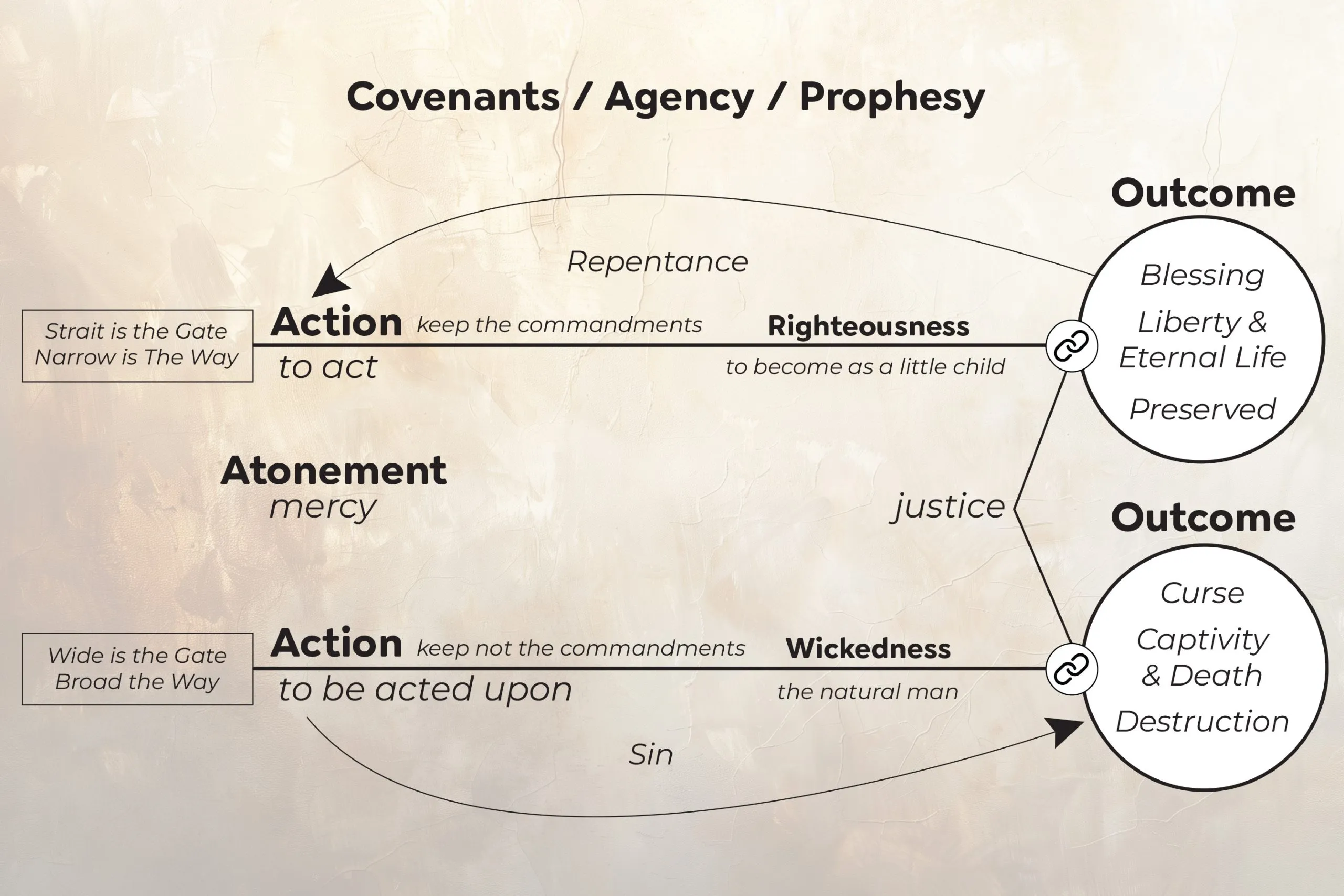
This is the way Babylon wants you to think. Basically what we have here is this is you, under law, everything has an action and an outcome, or a path and a destination. This represents the path, this represents the destination.
In this instance, this represents you. And when I say to you, you have choices, this is the way that most people think of that. I can choose between path one or path two, or destination one or destination two.
5:31 And freedom is the ability to pick which one of those that you want to follow. The problem with this is this doesn't match what the scriptures tell us about agency. This works okay for choice, but it doesn't work for agency.
And the reason for that, agency tells us that we have a path and a destination, and that we can only choose one or the other. So, if I want to be free, that's my destination, this is the outcome that I want. And we have to be morally righteous people.
The scriptures are very clear that law has fixed outcomes that are not subject to change at all. What we try to do with science, what we try to do with the Gospel, we try to map the path to the destination. For example, if you don't do your homework, you get bad grades.
If you only eat Krispy Kreme donuts, you gain weight. But let's say that you decide that you want to live healthy, so you would change your diet to match that. You don't have a choice in how these things are related to each other.
In the scriptures, there's a couple ways law is used. The one that I'm going to focus on today is what I call natural law. This is how I'm going to define this.
Natural law is a law which cannot be broken. Pretty simple definition. Natural law cannot be broken.
That's also God's law. Now this applies to spiritual law, but the reason I call it natural law is because we see, when we think of the laws of nature, we see really good examples of this. Sometimes it's difficult to understand the law.
It's not always the easiest thing in the world. But you can't break it. This nail is always subject to the laws of gravity.
7:58 Absolutely cannot break the laws of gravity. I mean even thinking, oh it's going to go break the law and then we'll have to throw it in jail and fine it or something. It doesn't make any sense.
Okay, that's natural law. But just because I hold it up with this magnet doesn't mean that it's not being subjected to the laws of gravity right now. It's not breaking the laws of gravity.
Nothing has changed. It's not falling to the earth, but nothing has changed. I put it on the table.
It's still not falling to the earth. It's still 100% subject to the laws of gravity, but there's something that's preventing it from going down. Now by the same token, this cup is not going to be held up by this magnet.
It's not subject to the laws that hold that nail with this magnet. The laws sometimes can be difficult to understand. Sometimes they can take so much time and there can be so many factors coming into it that we can't always see the law.
Which brings us to commandments. What are commandments? Well commandments are based on law every time. Commandments can be broken.
9:11 Plus they can change according to a situation. For example, you would not need to tell Noah to put seven years' supply of grain in silos. It wouldn't have done Noah any good.
It wouldn't have done Joseph any good to build an ark to get him through the famine. So commandments can change based on the situation. We do this all the time.
We do this with our children. The laws don't change. A child puts his hand on a hot stove, gets burned.
Handles sharp knives, gets cut. Opens the oven when it's hot. All these things are laws that can't be changed.
9:53 So we tell a little child, we give the little child the commandment, stay out of the kitchen. If they get a little bit older, we start to work with them and say, okay I'm going to teach you how to make macaroni and cheese and then later on we're going to make cookies. You know, you step it up.
By the time that child's 18, the commandment is no longer stay out of the kitchen. It's get in the kitchen, do the dishes, make dinner, clean up afterwards. But none of the laws have changed.
So when we think of God's commandments, oh why would it change here? Why would it be different here? It's because it's based on laws and those laws, God's looking at the path that is bound to the outcome and saying, I know that you want the outcome of eternal joy and happiness. And so I'm always going to command you to do those things that will result in that outcome. Always.
Agency: Two Outcomes
Always, always, always. So then people start thinking, oh okay this is a map of agency. You can choose the path, you can choose the outcome.
You can only choose one. Now it's true that you can only choose one. But for there to be agency, you have to be choosing a path or an outcome that is mapped differently.
So what you really need is two different outcomes. Now the way that we normally act is we either choose here or we choose here. And this demonstration, this we're going to call liberty and this one we're going to call bondage.
This comes from 2 Nephi 2. Liberty in 2 Nephi 2 is defined as the result of choices, not the process of making a choice. Agency is not just making a choice, although there must be choices for agency to exist. The difference between acting and being acted upon is that if you want liberty, you must bind yourself, must act, bind yourself to the action.
I want good grades so I'm going to study. The natural man, the reactive man, chooses the action and is acted upon or is bound to the outcome, which is called bondage. So in the scriptures, the word liberty actually means obedience to God's laws.
Now even in this case, the word obedience is a little misleading because again God's laws cannot be broken. If they can't be broken, well of course I'm obedient to them. I'm running around being subject to the law of gravity right now.
But if I give you the law that you didn't understand, you didn't know, it could be the law of sacrifice, the law of obedience, it could be the law of the gospel. As I give you these laws, you are able to implement those laws to achieve the result that you want. So even though you can't actually break these laws, you can now begin to use the laws to get where you want to go, to find the destination that you're looking for.
This is also called eternal life. This is the select kingdom. This is called death.
14:09 This is called bondage. And they're constantly used this way in the scriptures, constantly used this way. The natural man is a reactive man.
He comes into a situation and just wants to, without thinking of what is this going to achieve, he just wants to fix the problem. So what governments do, what spouses do, what we do with our children, we respond with the natural man, and then we are acted upon because we are forced to finish that path. We cannot break these connections.
It cannot be done. That's natural law. The main thing that occurs here is reactionary.
For example, let's say that you had a really rough day at work, you got fired, fined, kicked out, somebody ran you off the road on the way home, and everything was just horrible. And you get home and you open the door and your spouse is sitting there, has been sitting on the couch all day apparently because the kid's diapers haven't been changed and they're overflowing, they're still in their pajamas, spouse is sitting on the couch eating popcorn, watching TV, entire house is completely crashed, nothing's been done, and you begin to react. You begin to say, what am I doing all this for? That's, you are acting on the situation.
Now what's going to be the result of that? Well, if you were to switch that process out and say, okay, as you walk in the door, say, now what is the result that I want right now? The result that I want, the outcome that I want, is I really want to know what's going on. I want to know why this is occurring. Well, the only way you're going to find that out would probably be to ask.
So now, instead of reacting and being whatever the result is, the result that you get, you turn around and say, okay, I'm going to implement my agency and I'm going to try to get the result that I want. This is what science does as well. As we learn these laws, we actually come into compliance with it.
If you want to be an Olympic sharpshooter, you have to do everything that the gun tells you to do. It's not the other way around. Mastery is, in this instance, complete submission.
You think about in that in relationship with how Christ has turned the boat descending blowout thing. If you want to hit that target exactly where you are aiming for, you have to control your breathing, you have to pull the trigger in between heartbeats. Everything about how the gun ends dictates to you what you need to do to hit the target.
Let's say that you want to break the world's land speed record in a vehicle. You can't take a Model T and do it because the tires can't handle it. They're not balanced well enough.
As we learn more and more about these laws, we're able to tighten down and tighten down and become more and more in compliance with them. They've never changed. We're always subject to them.
But the more that we know and understand the law, the more free we are because the more we are capable of producing the outcome that we want. God the Father is able. He knows everything from the beginning to the end.
He's able to take any situation and say, this is the outcome I want. And he knows what he needs to do to get there, even if it's a very difficult process. For example, let's say that you wanted to take your children and bring them into exaltation.
To do that, they would need a body. But to do that, you would have to create worlds for them to do this in. But that would require a fall, and that would require an atonement.
So the path is already set out. And it's one of the things that the Atonement actually testifies to us about how deep this law goes. Because we know that if I'm a god and I can do absolutely anything that I want, and everything's just wide open, it's like I just make the rules.
Why make a rule that means I have to suffer more than man can possibly bear just to save it? And then he says pretty blatantly, I would rather not do this. If at all possible, take this cup from me. But there wasn't a way to achieve the outcome, so the path is set.
It's one of the great testifiers of that. Now, so what happens with us, and I'll just explain a little bit about the Atonement here, is you do an action here, and you're bound for death. You're bound for bondage.
You're bound to be kicked out of the presence of the Father forever. What the Atonement does is it picks you up off of this path, and it puts you back out here and lets you choose either here, I'm going to do this action, or here again. Again with this, we bind ourselves to this action.
19:51 And in this case, we bind ourselves to the outcome. It is possible to choose this action randomly and be bound to liberty. It doesn't happen very often.
And there are very evil people that say this is the action that I want, or the outcome that I want, and therefore knowingly I will perform these actions. But for the most part, for most people, the two places that agency comes into play is here and here. So the change in the definition is that God's law, or natural law, is law which cannot be broken.
The change in the term for agency is, it is a choice between the outcome or the action, with one leading to liberty, and the other leading to bondage. And the change in the terminology of liberty is, it is the choice, the result of the choice you make, not the process of choosing or the ability to choose. It's a very important distinction.
21:24 One of the things that makes this model is extremely simplified. It is only dealing with one use of agency, one choice, basically. But a lot of times, like I said, mapping these things out and saying what is the actual consequence is very difficult.
For example, if I don't rotate my crops, it's not the second year that I plant the same crop that my crops don't thrive. It's the third or second year that I rotate my crops at all that they don't thrive. And so it's the same with overgrazing a pasture.
The second that you put one too many cows in the pasture, it's not destroyed. It takes a couple months. But there's an exact ratio there that once you start overgrazing, it is just a matter of time before the field is destroyed.
22:29 Socialism is just a matter of time before the field is destroyed. How does freedom relate? Freedom is the ability to actually act on these choices. You can't actually, interesting thing is you actually cannot take a man's agency away from him at all.
You cannot rob a man of his agency. You can rob a man of his freedom, and you can severely limit his agency by limiting his knowledge. One of the elements of agency is knowledge.
You have to have knowledge of your choices, which is why God is the most free person is because he has the most knowledge to exercise his agency. But as long as I have the knowledge, I have the agency. Freedom is just the ability, like in this case, I know the outcome I'm looking for, and so I'm bound to this action.
Freedom is the ability to do that action, which is an excellent question because freedom is one of the words that's normally redefined here. Choice is the only one that kind of sticks with what we have. If you read 2 Nephi 2, I think it's 28 or 27, it says men are free to choose liberty.
So why would you use that terminology, free to choose liberty, if they all meant the same thing? If I said you're free to free to free, it doesn't make any sense. If I say you can choose to choose, it doesn't make any sense. So the words are not being used synonymously there.
Free, able to act, choose, having choices and a knowledge of them, liberty, what you choose. Again, what you choose, whole different thing. Do you want me to read that scripture? Sure.
Free to Choose (2 Nephi 2:27)
24:26 Wherefore, men are free according to the flesh, and all things are given them which are expedient unto man. And they are free to choose liberty and eternal life. You're the great mediator of all men, or to choose captivity and death according to the captivity and power of the devil.
24:46 For he seeketh that all men might be miserable like unto himself. This is captivity, death, bondage, this is eternal life, liberty, one choice versus the other choice. Just to make sure I'm kind of understanding the concept, in D&C 130, I want to make sure that maybe these verses kind of encapsulate the whole thing.
It's verses 20 and 21. There's a law irrevocably decreed in heaven for the foundations of this world upon which all blessings are predicated. And when we obtain any blessing from God, it is by obedience to that law upon which it is predicated.
Exactly. This is your blessing. So if you want this, you're forced to do this.
25:28 Exactly. People think that agency relieves them from that burden. You are bound to one or the other.
25:35 That is one of the most critical things to understand here. You are absolutely bound. It doesn't matter how much you like it, dislike it, or whatever.
You are absolutely bound that this action is the only thing that will result in this blessing. So true liberty is not licensed. No, there's absolutely no license to it whatsoever.
But again, you are able to act on versus being acted upon. You are choosing the outcome and then you are binding yourself to that action. And again, everything God tells us to do, this I do.
And everything he tells us to do will result in liberty, and it will result in exaltation, and it will result in joy, where this will result in misery. This is wickedness. And everything Satan's going to tell you to do, Satan's going to tell you that this doesn't exist.
That this absolutely doesn't exist. There's no correlation that you can do this and come up here all day long. You might be beaten with a few stripes to get there, but it's not a big deal, because you're going to go up here.
And the Atonement picks you up, takes you back here, and says, you ain't now. The Atonement doesn't put you here. It puts you, it gives you a chance to go here again.
If you choose this again, everything returns exactly the way it was. If you choose a different outcome, it puts you here. You're on the right path now to achieve exaltation.
But the Atonement doesn't give you exaltation. It is mercy. This is justice.
Justice is what binds these things together. It's law. And it cannot be robbed at all by mercy.
But what the Atonement can do is allow you to re-choose, which is the repentance process. I guess I'm lost here. I think what I'm understanding is that we don't understand what liberty is.
Yep. That's a big part of it. Because it's not freedom.
No, it isn't. Not in a scriptural sense. You know, if you look at the words of Thomas Jefferson, Thomas Jefferson used the word liberty in a lot of cases as being freedom.
But he also, when he wrote Life, Liberty, and the Pursuit of Happiness, liberty, in that case, is actually this. He's actually writing liberty as I'm defining it here. And each path eventually binds us to either Christ or Satan, too.
There can only be two masters. That's it. There are so many... When I first sat down with Brian and showed him this, we spent, I think, three hours going over it.
For about the next six months, about every three to four days, Brian would send me a conference talk or a link from LDS.org. Look, it's right here. Look, it's right here. Look, it's right here.
Here it is in the Scriptures. Here it is here. Here it is here.
You will find this everywhere because this is at the very top of everything that we understand is law. It is absolutely at the very top of it. And then agency, understanding agency.
Here's this unbelievably important term that we need to understand. It is the reason for the war in heaven. The three great gifts that we have is, number one, our life.
For which, if we're internally indebted. But our life would be worthless without agency. Absolutely worthless.
The second great gift was agency. Making us agents to ourselves. But you don't even know what the word agency means.
Even though it's the war in heaven and even though it is the thing which requires the atonement. Thomas Paine said, heaven knows how to put a price on things of great worth. The price of agency was the atonement and yet it is very rarely studied out.
It's the reason for the war in heaven. It's what we are here to learn. And yet we don't study out what it actually is.
And that's exactly what the adversary wants. And the third great gift is the atonement, which is what allows us to recover from the effects of agency. Because without the atonement, we could not recover from our own choices.
Freedom and Liberty
30:16 How do freedom and liberty differ? Freedom is the ability to act. So freedom is agency? No. Freedom is the ability to act.
Okay, so I can put you in a cage and that's preventing you from acting. But it isn't agency. Agency is the ability to choose between an outcome or an action.
30:43 And specifically ones that result in either liberty or bondage. Freedom is the ability to act on that. Okay, Abinadi in the courts of Noah, completely chained up, was more free than the people who chained him.
Because his freedom, or he had more agency I guess in this terminology, his agency was absolutely unaffected by the priests. And even though he was in chains, right now how free is he compared to King Noah? Okay, liberty is what you choose. It is synonymous with eternal life, with exaltation.
It is synonymous with happiness. It is what allows you to continue to choose. The more that you choose this path, the more bound you become.
Until you have less and less choices, until you have none left. The more you choose this path, the more choices you gain. You grow and you grow and you grow in knowledge.
And you are able to use those choices. Again, think about building a car. The more that you understand science, the more that we can refine our cars.
The cars of today have much greater understanding of the laws which allow us to produce a much better vehicle. Because we have more knowledge than they did in Henry Ford's time. By understanding the law, we have become more free because we can produce more results.
32:17 Liberty is understanding and adherence to those laws. Again, we call it eternal life, we call it happiness, we call it exaltation. All those are synonymous with it.
This is something that actually takes a while to incorporate and to really see. But if you can get these concepts into the way that you use your wording, to understand the language that's being used here, and then you can, these concepts, we're changing the symbols in the way that we think to match more closely what heaven wants us to think of these things. And the adversary doesn't want us to think like this at all.
This is anything he can do to make you think that agency is the same thing as freedom and it's the same thing as choice. He's going to muddle and confuse the issue over and over and over and over again. And if you start using these definitions as you read, you will see that these definitions match constantly.
The truth shall set you free. Absolutely applies. The reason that Satan's called the father of lies is because he wants only this to occur.
He will tell you that this action will result in this outcome. And the reason that father tells us what we need to do is because he actually wants us to achieve that outcome, which we can't do if we're performing these actions. So he tells us, whether you like it or not, this is what you got to do if you want to be happy.
It will result in these outcomes. He's telling us the truth, even though we don't always like it. And we don't want it to be that way.
Satan will tell us this always goes to here. Always. And he also tells us that this goes to here.
Think about that. You're just putting yourself in bondage because you're a Christian. You'd be more free if you drank.
You're not free. You're monogamous. You practice the law of chastity.
You're not free. I'm free because I don't practice it. I do whatever I want whenever I want.
I'm free. It's not the definitions that the scriptures use. That's what the father of lies uses.
That's what Babylon uses it. And you can walk out of this door and within two minutes you can find somebody that will spout that to you. Right there.
And it'll spout this to you right here. So you're saying by having a correct understanding of the definition of those words actually helps you, leads you to liberty. Absolutely.
Knowledge is critical to agency. And as you grow in your knowledge and in your liberty, in other words, how many times have you chosen correctly in conjunction with it? Your liberty grows, your knowledge grows, your freedom grows. But Satan wants to do the exact opposite.
And how many times, how many places in the scriptures does Satan want you to be miserable and in bondage like himself? Yeah. I imagine that's why the brass, the Lord told Nephi, well told Nephi to have his sons go get the brass plates so they can preserve knowledge and thus preserve agency. Right.
But if you're in bondage and you have a commandment to do something, like you're commanded to go get baptized, right? But you're in jail. So your freedom's taken away to be able to make the choice. So how do you still have the ability to do this? To obey the law to liberty because you have to obey certain commandments to get to liberty.
Right. And what you're getting into is you're getting into where it starts to get really complex, which is where laws stack upon each other. Like I said, I've tried to keep this really simple so that the basic concept comes through.
But let's take flight. Okay, flight requires that I understand, like just what we do right now, you have to have absolutely incredible mining techniques and refining techniques to get aluminum. You have to be able to produce massive amounts of energy because aluminum is the metal that's light enough to produce the aircraft.
You have to have an understanding of high and low pressure systems and thrust. You have to know turbine engines or internal combustion engines. All of these things start to come together.
And what happens is when you have enough thrust and your wing is shaped correctly, that you create a high pressure system on the bottom and a low pressure system on the top of the wing that you get lift. All of these laws coming together, the more knowledge you have, the more freedom you have. We can now create an aircraft that we couldn't do it without all the knowledge of the law.
The laws have never changed. They've existed forever that way. But as we learn them, and again, we didn't come into obedience to them.
The laws were there. We couldn't be disobedient to them. But as we applied the laws, we were able to get the results that we want.
In this case, there's a lot of laws that have to come into play. What you're asking is more in depth into this than I you're talking about that point, multiple laws that are playing each other. But I assure you that the Lord has set up a way so that even if you've lost your freedom, you cannot be robbed of your agency.
It was a gift he gave us, and he won't allow anybody to take it away from us except we can reduce it ourselves. The more that we misuse our agency, the less of it we have. And I would recommend, and the thing is with this is that I really, what I'd like to see is that if any of these concepts are beginning to make sense, you're beginning to see, wow, this is used consistently in the scriptures like this, over and over and over again, is to go ahead and read Elder Christofferson's talk on moral agency, to watch Brian's video on moral agency, and to read 2 Nephi 2 over and over and over again, the entire chapter, 2 Nephi 2. All of this is contained in there.
The elements of agency I talked about pretty extensively in Elder Christofferson's talk, and I think some of this you learn better if you actually take the basic part of the concept and go learn it for yourself, and make it a part of you. But you can only do that if you do it. I can't, this is so, I mean again, agency is what we're here for.
It's the reason for the war in heaven. It's an ongoing war. We're still in the middle of compulsion versus force, compulsion versus freedom.
Isn't there a accountability that has to come in here somewhere? If you take away somebody's freedom, you haven't taken away their agency. At the same time, you have now become accountable for what you have taken away from them. I mean it's just like if she's locked up, can't get baptized, etc.
But if they want to, they still have that agency. By choice, they would go down that path. Somebody has stepped in there and said, no you can't.
But the minute they step in on your agency, they become accountable for what they have denied you. Yeah, and that's, I think, well, it actually is very important because what you basically described there is the definition of sin, which is to take away people's agency. To take away their right to act.
40:51 And you do that to yourself when you sin. And you can do it to others as well. So when we do sins of omission and don't fulfill our responsibilities, we also are hurting other people.
Well, and a sin of omission is basically saying, if you want to reach here, you still have to do this. Now, maybe you didn't do this, but you didn't do this either, which requires you to, which is required to get here. Which is basically what a sin of omission is.
41:25 Which results in poverty. The non-action will still result in poverty. Um, I know you pretty much covered this, but I was, on that talk, Mr. Anderson, one of the quotes was, the more laws that you know, the more free, or the more free you can become.
Yes. Until when you know everything, you become ultimately free. God is the most free.
Can you just kind of explain that just a little bit? Sure. Um, again, if I, I'm sure you've probably covered it. I've got to talk with examples because there's, because there's not, we're redefining words.
42:08 So the example that applies in this situation is the one that I talked about with flight. The more that we understand the laws that govern flight, the more we're able to achieve with flight. Without understanding those laws, without having any knowledge of those laws, we can't achieve the result of flight.
So if I ask you, I want you to build me a helicopter. If you understood all the laws that, that manage that, the building of that helicopter, you're able to do it because you do the things necessary to achieve the results. And that result is a helicopter.
And you're talking massive amounts of laws coming into play here. Many, many, many, many different laws to get the result that you want. But without that knowledge, you can't do it.
I can't go to the Pharaoh of Egypt a thousand years ago and say, give me, build me a helicopter. But the knowledge is here today to do it. Again, the laws themselves actually never changed.
They've always been there. So in regards to that, so if you had started out with like a balloon that goes in there, you're still flying, but with the jet plane, you're going to have, there's more laws applying to that. Right.
And you're able to do more. To advance, right. Advance what you're able to achieve with it, which is what God the Father is able to do is with absolute knowledge of these relationships.
He's able to say, this is the outcome that I want. I don't want a hot air balloon. I don't want an airplane.
I don't want a glider. I want a helicopter. So he's able to apply all of those laws to produce a helicopter.
We do the exact same thing when we want to build a TV, we want to build a computer. And the thing is, people will tell you that this doesn't apply in the scriptures. When the Lord says that you need to obey the law of chastity, people all of a sudden think, oh, well, there's no relationship here.
Well, yes, there is. He's giving us, and it may, we, I mean, we may find out that that was the law of chastity was actually a commandment. It's supposed to result in our happiness.
All of it, everything he gives us will result in our happiness. But it's because we don't, we don't understand where we're at yet. We don't understand these links yet.
We can't understand them. Just like a child in the kitchen doesn't understand that they need to stay away from the stove because if they pull that pot down on their head full of boiling water, what it will do, the effects of the laws of physics dictate that that child will be burned if that water is poured on top of their head. Okay, so the commandment given is stay away.
When you have a child, the first thing you know, you start teaching them hot. They don't have any idea what hot is. What's hot? You have to experience hot to know what hot is.
Why are we here? We're here to experience hot. So that when the Lord says, hey, stay away from the hot, we're like, yeah, that burned last time. I'm going to stay away from it.
Now, now there's, you know, when we, when we start teaching a child about hot, you might put their little cup of hot cocoa down there and you say, careful, it's hot. And it's not too hot. It's not even close to too hot.
But because you're not going to give a little kid something that they're going to, it's going to actually burn them, you know, but they drink it and they, oh, that's hot. And their milk is cold. And they start to learn.
Then they start learning what really hot is, you know, and they're like, oh, okay, well, I told you it was hot. They're learning the laws. They're growing and developing.
They are learning the good from the evil. That's what we're doing. And the whole, the whole thing behind this and understanding these is so that we can begin to make, we can begin to understand that, you know what, it doesn't matter what my philosophies of men are mingled with scriptures.
It doesn't matter any of that. What matters is that I learned these things. And then if I want this result, this is what I have to do.
When we legislate, we ignore this relationship completely. When we raise our children, we don't think about this. How many times when you're raising your children, do you say, okay, I just caught Timmy lying.
46:52 Do you want to punish him for lying? Do you want to just react? No lying. Punishment. Or do you stop and you say, okay, wait a minute.
What's the outcome I want? I don't want him to lie. How do I achieve that? Now, it may be through punishment because Timmy, that might be what Timmy understands. But maybe it's explaining it.
You got to, you got to know Timmy. You got to have that knowledge and say, you know what, what's going to, what's going to achieve the outcome that I want here is not going to be to yell and scream and rant and rave. It's going to be to sit down and say, this is what's happened.
Sometimes when we legislate, we just look at what's happened with illegal immigration. We're where we're at on illegal immigration because all we do is constantly react over and over and over again. We react it.
It's just saying, what do we want to achieve? And to this day, you look at everything that's going on. I mean, there's stuff in the headlines right now on what's going on with illegal immigration. So they're saying, what is the result that we want and how do we achieve that? Instead we say, look, it's about obedience to the law.
Well, what law? No, it's about obedience to a commandment. You're only concerned about obedience to a commandment because most of the laws right now concerning immigrations would fall under that commandment, right? We're commanding you to do this and therefore you must do it. And if you break it, it's because you're not being obedient.
Start with the Outcome
48:19 If we actually reverse that process and said, what is the result that I want? And then said, then I don't have a choice what I'm going to do for it. I'm not going to offer up any solutions or anything right now. I'm saying that that is the process that we ignore.
48:38 There are facts about this too that we know that we constantly ignore. For example, this land, this land right now is reserved for a righteous people that will worship Christ. So if you want to be swept off, there are certain things that you could do.
And if you want to preserve the nation, there are certain things that you would do. But the law has been decreed that if we do not worship the God of this land, we will be swept off. And he's a pretty forgiving guy.
I mean, he lets the terminology worship be pretty broad. Let's take the promise that applies to this land. If we're a righteous and a moral people that worship the God of this land, we don't have to have tanks, armies, walls, crazy laws, any of that.
The Lord will protect and preserve us no matter what. If we are unrighteous, the greatest, biggest army, highest wall, best defense would do nothing to save us. Nothing.
Absolutely nothing because we'll be swept up. One's relying on the arm of the flesh. Okay, so what we do though is we think, yeah, all we need to do is build a wall.
A wall will solve the problem. Really? Really, where in this process do you think the wall comes into play? It won't achieve the result that you want. If it won't achieve the result that you want, why do it? If the result that you want is to keep out illegal immigration, will a wall work? No.
Okay, so don't do it. That's pretty basic, you know. It's a simple way of looking at things.
You can reverse engineer your entire life like this. What is the outcome that I want? What is the relationship I want with my spouse to be? Okay, and that's how I have to act. Have to act.
What I'm saying is learn the process. You're going to have to decide whether or not a wall would work. It's not me that's going to decide that for you.
I don't have any business deciding that for you. I mean, you know, again, the thing is just to look at it and say, will this achieve what I want it to achieve? If it doesn't achieve what I want it to achieve, then why am I doing it? Right, and to add with that is, you know, any nation, specifically this nation, it's just if we choose, you know, as a nation, as a people, we have the choice between these. It's exactly the same.
And if we choose to bind ourselves to the path, we will bring upon us the calamities that have been foretold. You know, we bring those things upon ourselves, just like that's what President Packer said. If we don't protect the family, we will bring upon us the calamities foretold by prophets before us.
51:45 Which is the proclamation. Right. And so, yeah, if we choose as a nation to bind ourselves to that other, we get the results of being, like he said, being swept off.
So it's, like he said, it's a law and we can choose one or the other. But understanding that that is actually how things work, whether you like it or not, and then applying this in your thought process and saying, okay, now, and then going to the scriptures, I'm looking for the, because the solutions are in the scripture. Absolutely flat out, I can testify to that.
I have no problem telling you if you want solutions that are in the scriptures. Everything is addressed that we need to know for what's occurring. It was written for us.
It's a handbook for us, specifically the book of Mormon. This is all in there, how to use this. And again, if you understand that this law simply cannot be broken.
52:48 So if you want a specific outcome, you must act and do the correct thing that results in it. Absolutely no other way around it. Now, some of those things are stuff that people don't like.
53:03 People read the scriptures and they don't like the solutions that are offered in there, because it doesn't say in there, double the size of your navy, increase your taxes. It gives you the principles to be a righteous nation. It tells you the consequences of being unrighteous.
So, you know, I mean, there's how many laws would we pass in the name of freedom and in the name of choice and in the name of liberty that actually will result in death and in bondage. And we'll do it in the name of liberty, because you know that that won't result in the outcome that you want. Zion cannot be built on Babylonian principles at all.
To act is to go this direction, but you still don't have a choice on what you're going to do to achieve that result. You do not have a choice on what the action is. It is bound by law.
54:17 The, exactly what Brian said, the blessing is bound to the action. The path is bound to the destination and you cannot ever do anything to break that bond. There's nothing that you can, that is the sum total key that if you can get that out of this lesson, lecture, whatever you want to call it, and learn that, that will take you further than anything else I could give you.
54:52 Understanding that agency, agency, you have to have, the reason that this is drawn with two of is agency requires two different results. You have to have, it's a choice, but it's a choice between two different results. But the way we think, the way that our brains work, we can only choose either between this is the outcome I want or this is the action that I'm going to react to.
55:20 We just don't think the other way, which is why it's written out like this. This is the way we think. It's only a choice between the outcome or the action.
55:43 We go back to the Garden of Eden before the fall. There are those that believe, I've been reading another, that believe that in the Garden of Eden that once they attempted amnesia and they fell, that that was not the worst plan for them to fall. In the Garden, they were granted agency.
So this kind of comes back to what Brian was saying. To be granted agency, they had to be given elements. The main elements here is going to be, they had choices.
In this case, you have a choice here and a choice here. One's going to result in that day you shall surely die. Death, always the same, always the same.
In this case, it's interesting that this was called a transgression, which could have been written as a trespass. A word is actually probably closer to being translated correctly as trespass. Meaning what? What would it mean to trespass? You went somewhere you weren't supposed to.
57:20 Would this help? It takes months, months and months to really begin to incorporate this. You said that if you choose liberty, you don't really have a choice on the actions. That's where you think that choice requires so much humility and submission to the will of the Father.
It's everywhere. You won't find anything in the scriptures this doesn't touch. You will find nothing.
This is the reason we're here. It's the reason for the atonement. This absolutely covers everything and more importantly than that, if you want to build Zion, it will be on this principle that it will be built.
You have to understand the laws that it is built on. Zion has been built before. It was done this way.
It cannot be done any other way. Straight is this path and very narrow that leads to this destination. Every other choice is on here.
It's everywhere. If you will take this and just start looking for it, it'll overwhelm you how many places you find it. A big thing is to seriously reading Moral Agency by Brother Christofferson.
It is a spectacular talk. Go home, watch Brian's video on this and read Second Nephi 2. It's rampant through there. Men are, they might have joy.
This is joy up here. Wickedness was never happiness. It's down here.
Can't be. This cannot be here. And so the thing is with this and what you can begin to do with it is you can begin to say, you know what, I had misconceptions here about what would actually work.
1:00:01 And when you start to look at this and you say, wow, okay, I can't, if this is what I want, I don't have a choice what happens here. This I have to do to get what I want. And again, you can apply it to everything in your life.
That's what you're here to do. As you learn to do this, as you learn to utilize your agency this way, you're becoming like Christ and the Father, redefining the words, the way that heaven uses it. So that as you read the scriptures, as it opens, as the doors open, the vision is revealed, that you can see what the symbols are that heaven wants you to understand and that the adversary will do anything he can to lie and manipulate and make sure that you don't understand your power against it.
Can you just talk a little bit more on the submission to God? That's actually something that I've always had a hard time with, and with understanding, the submission to the Father and how it brings one freedom. And this, because you're, by submitting to laws, it's not what it means, submitting to laws is the same as submitting to a Father. And that's what this is, a big thing I'm trying to explain here is that by submitting, you can't not submit to these laws.
You can't not do it. Just like you right now, you can't break the law of gravity. There's nothing you can do about it.
But you can understand, you can gain a knowledge that this is actually the way it works. And then you can understand that every commandment you've ever given is because it will put you on this path. You submit to it, not understanding yet.
The Law of Obedience
1:02:23 Then one of the amazing things here, absolutely incredible, is agency requires knowledge, but you can bypass the knowledge of the law by the law of obedience. The law of obedience covers you right here. And if you're obedient to the commandments, you won't get burned in the kitchen until you understand the law behind the commandment.
And then the commandment can go away. This is why God can be unchanging and give us different commandments. He hasn't changed in the least.
Just like as a parent, you haven't changed in the least to tell your child to stay out of the kitchen and later on to tell them to go in there and do the dishes as they get older. You have not changed in your goal as a parent one bit. Your goal as a parent is to raise a self-sufficient, honorable child that's not going to hurt themselves in the kitchen.
As soon as they can do that, you release them from the commandments. That commandment doesn't apply anymore. The laws have never changed.
Ever. You know, you think you're subjected to the laws, all of these laws, all the time because you're always subjected to the laws of gravity. Then you do find something like this.
But you don't realize that someday you might be changed into a different substance. You might grow. The laws do not change.
And submitting to the will of the Father is only understanding. I want to be happy, but I don't understand even how to be happy yet. But I learned to trust the Father enough to know that everything, everything He's ever told me is based on this model right here to get me right here.
Liberty is obedience to the laws and commandments of the gospel. It is nothing else. It cannot be anything else.
Liberty is a joint venture with law. I think the problem that arises in this every time is the fact that if you no longer are able to make that choice outside of that narrow line that leads to eternal life, you think something's been taken away. So you think you've lost your agency.
I can't choose anymore. But you have to make the big choice. Where do I want to go? See, and then once you've made that choice, then you should have the perception that I want to do just this thing.
I want to be on that path. I mean, it's like you say, Christ never did. He said, it's always my will be done, not mine.
1:05:36 And if you go into the Old Testament, it's when my will gets in there. I get in trouble. They always got in trouble.
Well, and that's what we're here to learn. And how do we learn this? Well, we learn it because we got burned in the kitchen. We want this to lead to this.
1:05:56 We want socialism to relieve us of our burden. We don't want to have to. It doesn't matter what this is.
We want it to lead to this. I want to be morally unclean. And I want it to lead to liberty.
I want to do heroin. And I want it to make me happy. I care what the sin is.
I want it to make me happy. I'm sorry. I cannot do that.
Mercy cannot break the bond of justice. This cannot be broken. I understand you want to be happy.
Therefore, I have provided a way for you to not pay that price and give you a chance to make the choice again. And this time, make the choice that will result in happiness. If you don't, all those things will come right back on your head, just like you did in your bed.
Put you right back on that path that's leading you to bondage. That's the atonement. Anything that we... natural law, physical law, is testifying to you in Christ.
Everything is testifying to you in Christ. And were it not for the atonement we would... one sin would eternally bind us too. Forever and ever we'd be bound to the outcome, which is death.
It's the absence of the Father. Any other questions? It takes time. It really takes time to understand this.
It takes months and months and months of just seeing it around you, seeing it in the scriptures. You know, if what you're saying, it all goes back to the Sinai covenant, where God said, this day you have choice. If you're righteous, you follow the commandments, here's what I will do for you.
I mean, it's like utopia. That's what he's like to say. You don't need walls, because the Lord would never let anybody come against you.
You'll never be hungry. You'll never... I mean, it's like, whoa, why would anybody violate that? But then on the other side of it, he gives you another look. He says, however, when you start breaking these commandments, then here's what you're going to get.
And if you'll read Leviticus 26, I noticed there, it's progressive. He starts off slapping your hands, and then he kicks you in the fanny, and then, boy, then he sells you off, and I mean, you're meat. So it's like, wow.
And that law is still in effect. See, that's what we don't get. And if you want the perfect example, look at the United States.
The Lord was bound to bless this nation as long as it was a righteous Christian nation. And boy, we just went up and up and up and up. And then look where we are now, because we have denied God.
We take him out of the schools, you take him out of the courts, you've taken him out of the laws, and look what's happening. I mean, you can't break that connection. Yeah, I'll go back and read what he said.
If you do this, this is what you'll have it. But the minute you cross over and you start doing this other stuff, here's where you're going. And we're on the path.
We just hit the roller coaster. We've gone over the hump. It's now throw part.
Absolutely. And that's very indicative of the example I gave of the overgrazing. It's not the moment that you put one too many cows in the pasture that the pasture is destroyed.
Okay, it's not the same year that you don't rotate your crops. But these laws, if you don't ever rotate your crops, this is what's going to happen to your crops. If you overgraze, this is what's going to happen.
It is, those results are bound to each other. It gets really, really complicated at that point. It's hard to see the difference, especially when nothing but lies are coming in all the time.
Lies, lies, lies. Trying to point you in different directions. And if you want to know the truth, there's really only one place to go looking for it.
Because there's only one source that I'm aware of that's never lied to me. Ever. Ever.
1:10:34 And if you go there looking for your solutions, what's really occurring here, you find, you know what, it doesn't matter how much I want to protect freedom and to protect agency and to protect liberty and to protect choice by allowing prostitution. Because it's two consenting adults, right? It doesn't matter how much I want those two things to go together, they cannot go together to preserve liberty. It does not preserve liberty.
1:11:09 Period. Liberty is only achieved by coming to a knowledge of the laws of God and bringing ourselves into compliance with them until that perfect day. Why is it called light knowledge? Why do we grow and grow and grow? Who's more free than God? Do you want to be free? Do you want to experience ultimate liberty? It's called exaltation.
1:11:39 Nothing is more free than that. And there is only one path to it. No matter what.
It's a change in a paradigm on how you think. It's everywhere. Absolutely everywhere.
1:12:01 Well, I just wanted to point out, like, because, and we were discussing an example of the Nephites when, like, when they came to Benjamin, when they had a really righteous society, their laws were actually exceedingly strict. And sometimes, you know, we think exceedingly strict laws actually cause us to lose our freedom. And there's just, there's a lot of examples in the Book of Mormon that show us the path to liberty.
And it's not always what we thought it might have been. This is exceedingly strict. There's no, there's no give.
There's absolutely no give. None whatsoever. But that doesn't make strict governments like Soviet Union or Nazi Germany good governments, because strictness does not make something good.
No, but, no, it doesn't. Strictness doesn't make it good. Because you can be strict in this all day long.
But you can be strict in this. You can be exceedingly strict in this. That's going to produce liberty.
Whether you're aware of the law or not. It doesn't matter. This law exists.
Period. If you comply with it, you'll get this result. If you don't, you'll get this result.
That's it. There's no, it doesn't matter. Everything else doesn't matter.
1:13:28 Now, is it always easy to see that? Each of you is going to have to find your, where you think that is. That's what we're here for, is to see how well you can do that. But this absolutely is non-negotiable.
Doesn't matter. You could say, well, I can't allow you to worship your god, because then, you know, if you're going to worship Alibaba, I can't worship my god. So what we'll do is we'll prevent you from passing laws that your god says is true, so that you can't pass laws from this other god.
Well, you know what? It doesn't matter. It doesn't matter. This cannot be separated from this.
No matter how you think of it, it cannot be separate. You can obey it or you cannot obey it. The result will be the result.
1:14:18 You cannot change the relationship between these two. I was thinking about, you know, we're talking about strictness a little bit. I think in the one where we have liberty, we're changing the natural man.
Where on the other one, maybe people might think that they're free because they have all these things they can do, but they end up in bondage. Where, when we change ourselves, in giving ourselves over to the lord. And by doing that, we gain more freedom, because it's not so hard.
And remember that this signal will tell you that this whole thing right here is bondage. He will tell you it's bondage. The world will tell you it's bondage.
The world will tell you you can't pass laws like that, because it's bondage and you're taking away my freedom. And you know what? The world gets to choose those things too. You know, it's one of the things that the way the lord has set it up, is that we get to choose which one of these we want to be in.
If the world chooses to do this one, that's okay. The world's going to choose it. You can choose to do this.
Your government may choose to do this. Your government can choose to do this. If we follow the constitution, you can have some places doing this.
You can have other places doing this. It doesn't really matter. And the main thing with this is you got to figure that out for yourself.
But if you understand that you cannot, you cannot break the relationship here. If you allow, period, if you allow prostitution into your community, you will have a community that is tainted with prostitution, period. You can't escape what the results of law says will happen when prostitution is in your community.
You cannot break that combination. You can't break that link. You have to also understand that communities are going to choose this for themselves.
That's part of, that's part, that's actually part of this, okay? One of the things is, you know, we've all been taught about governments. And if you have, if this was a line, you had complete anarchy here and you had total totalitarianism here, zero percent government over here, 100 percent government, put them in a circle. You kind of want to be in here somewhere, okay? The way that I like to describe this is, is how much, how much rain does your garden need? You have too many people that want to draw a line right there.
This is on this side of the line that said, you know what, it needs, it needs to be in here somewhere. That's what we said, which means you can't draw a line and say this is where it's good, this is where it's bad. It'll change.
It'll change under circumstances. And more than that, the people are going to choose for themselves bondage or liberty. The thing that's wonderful about the Constitution is the Constitution was set up to allow us to choose Zion or Babylon.
Now we have as a nation and as states individually chosen Babylon across the board. Individually, the states could have chosen exceedingly strict laws and built up Zion. You could have had Zion over here and Babylon over here, and under the Constitution it was allowed.
1:17:42 The Constitution was built to let us choose for ourselves if we wanted to build up one or the other. I'm just thinking about, like you mentioned Abinadi earlier, even if the nation we live in is choosing those things, we can still choose to live, choose Zion. Even if, you know, because of the blessing of agency.
And you can't be restrained from that. It's one of the things that God gave us is that if you choose to follow these paths individually, it doesn't matter what's going on around us. You can gain, I mean, just like, you know, I've called this exaltation, eternal life, liberty.
1:18:23 You can gain those. While everybody else around you gains death, you can gain exaltation. It's an individual path, but it can also be a group path.
Mormon and Mormonite. It's just, yeah, it's just that this, again, the main thing is to understand if you're trying to achieve this result by implementing this rule, it will never happen. Ever.
You need to find the real answers here, and the problem is, is that the world will tell you that you can't go to God for those answers because you can't prove it. And you can't. You can't logically put it down on paper.
It doesn't make them any less true. It doesn't matter if you go back in time 5,000 years and nobody has any idea what gravity is. Everybody's subjected to it.
Doesn't matter. Doesn't matter. Absolutely at all.
1:19:19 Nothing matters about that. What are you going to do? It's there. The law is that the laws that produce liberty are here.
You have, if you want liberty, this is what you've got to do. If a community wants liberty, it's what it has to do. You have to.
You can choose something else because you don't like what you're required to do, but it won't change what you're required to do. And don't look to me for those answers. Those answers are in the scripture.
Everybody chooses that for themselves. The one thing, I mean, you know, the way you define the line, it is absolutely strictness. However, we're going to make mistakes, and Christ did perform the atonement.
Repentance and Grace
So even though the strictness is there, if we make a mistake and then find out, oops, that didn't work, and you repent of that mistake, the Lord will take care of the variance from off of the line. He'll take care of that deviation. No, no.
What the Lord does is he allows you to get back on the line. Okay, you're on there, but you're not going to be held accountable for that. No.
See what happens, if you vary from that strict line, then you're automatically down here. And the atonement allows you to get back on that line. Okay, but you're denying the atonement if you say you are back there and out.
1:20:44 No, because the second that you repent, the atonement can put you back on this path. Okay, that's what I'm saying. He allows variation from that without destruction.
It's not voluntarily, because if you don't repent and change, yeah, you're in trouble. But don't think of it as a variation. Think of it as switching.
You switch to here, and then you repent, you switch to here, and then you blow it again, you switch to here. Second you blow it, you're bound to the outcome. Doesn't matter.
Sin cannot be looked upon with the least degree of allowance. There's zero allowance, none, not any allowance whatsoever. Apply the atonement, you're right back up here, and it's like it never happened.
Right. It is all-consuming. The atonement covers absolutely everything.
There is no variance it doesn't cover. Okay, but that's what I'm saying. You can't, it's just a way of thinking.
You can't pretend that that line is so strict that once you vary from it, you're done. See, I mean, that's why we have the sacrament every week. That brings you back, because you have repented, and you're back on there, and you've renewed your covenant.
1:21:54 Because if you lose hope, forget it. You know, Satan will come in there and say, okay, you blew it, here you are on that line, so therefore give up. You can blow it all day long, because you're going to repent all day long too.
Yeah, but you can't remember the same thing over and over and over and over, because he said, then you become like that dog that goes back to the vomit, and that's wrong. So you have to learn. You have to keep getting better and better and better and better.
I mean, that's what life is. It's a refining process. Right.
1:22:20 Well, we learn in the scriptures also that Christ grew from grace to grace. He stayed on the line the whole time, never left it, where mankind goes from grace to sin, grace to sin. That's why we keep on having to learn, okay, we messed up, better go back to this.
And where Christ is a strict, and the scriptures talk about, yeah, this. Real quick, if I could say, I mentioned earlier that one sin, and we become eternally bound to that without the atonement. And so, as I studied the atonement, it's like a role reversal.
1:23:15 Christ becomes an offering for sin. He becomes us, and we become Him. Even after all we can do, it is by His grace.
And essentially, we receive His perfection. He receives our sins. So we become perfect in Christ, as Moroni talks about.
So the perfection that we achieve is Christ's perfection in all actuality, only through the merits of Him, only His goodness. When we go to the judgment bar, He will plead for us because of His goodness. Mercy overpowers the demands of justice.
1:23:57 If He starts to plead the good things that we've done, justice will say, time out, what about these bad things? And so it is through Him. And I think that's where, you know, it can get confusing that we're on that fine line, when the reality, it's somewhere that it's His perfection, that His atonement allows us to come back to try again. And that's what can put us on the line.
And in the end, it is because of His perfection that we will be saved, not because of anything that we have done. That helps. I don't know if that helps answer that or kind of, I guess that helps me to look at it, is we just have to think of the role reversal.
Again, this is, it will take, even if you fully embrace everything that I've said here, it will take months and months and months to begin to even see how big this is. And how much you'll find it everywhere. So you'll have, I mean, you'll just, you'll consistently get more and more questions on that.
And just take your time and think it through. Apply the thought process. Where am I at on this line? What, you know, what is this action? What is this outcome? How are they bound to each other? Do I know if that's bound? Do I know if that's a commandment? Or is that a law? I mean, if you want to learn if something's a commandment or a law, you can pretty quickly check it to see if it can be broken.
1:25:26 Okay? The complexity then there comes when you realize, well, I may be able to break the law of chastity, but I can't break the law of chastity as far as what happens if I break the law of chastity. I'm still bound to that outcome. You know, thou shalt not kill is what, commandment or a law? Commandment.
Why is it that you could be commanded, thou shalt not kill, but you could also be commanded to strike off Laban's head? Because one's a law, one's a commandment. And they're all designed to bring us happiness. It was for happiness and within the laws of justice that Nephi was commanded to take Laban's life.
1:26:15 It goes back to that, the kitchen analogy and the matches, which I understand because God takes people's lives all day long. Right. We've actually covered a lot of the stuff that I would have done a follow-up, but I can do a follow-up meeting on this if you wanted to.
It would have to be, just from what we've already covered, I would say it would be worthwhile to extend it out quite a while, let you have a chance to see how this works. Because there will be tons of follow-up questions that we get. As you start trying to figure out when laws start stacking, it can get really confusing, like I said.
We have multiple laws that are affecting the outcome. Trying to figure out the difference between a law and a commandment can be confusing, that's what we're here for. We're going to make mistakes and be all over the place.
1:27:16 But just utilizing these terms and understanding what God's law is, what a commandment is, what freedom is, what agency is, help you understand why we're here, what we're doing with this, how this can make you more like our Father. But this is actually the purpose for this whole trip, is to learn how to become agents into ourself. The word agency is to agent the way that steward is to stewardship.
So I hope it's been helpful for you. That's what I come to this for. That's it.
Things Take Time
1:28:08 It's just that sometimes, one of the things is that things take time. For example, this is where it gets really hard to map stuff together. So let's say that you want to grow a tomato plant and produce some tomatoes.
How many laws come into effect there? You've got the ground, you've got the seed, you've got the water, the sun, all of these things that are going to affect whether or not at the end you're able to produce a tomato. Sometimes things take a long time to come to fruitation, and that's one of the reasons that all these things are testifying of Christ, that we're learning this, is that the law of the harvest, which is this by the way, the law of the harvest, is that sometimes these things take a long time. And the more time that they take, the harder it is to figure out which one's the law and which one's the commandment.
You can say, well, the law is the ground. Because that's all your experience was, is whether the ground was good or not. And somebody else is all, well, no, it's all about how much water you give them.
1:29:03 Somebody else is like, no, it's about how much sunshine. Well, it's a combination of those things. And the same thing works for nations.
It works for your household. It works how you manage your household. All these things come into play.
And you still have to figure this out, which is why I give this to you as a tool to figure things out, not giving you this as, here's the solutions to your problems. You've got to run that gambit yourself. So what socialism does is socialism says, look, it's working.
1:29:34 But it's not going to work. It can't work on long-term. You add enough time to it, and it absolutely can't work.
1:29:43 I have another question. And as I'm thinking of it, both sides of the question could apply this and say that the other side is on the side of Satan, and they're on the side of light. Actually, this occurs.
This is what happened in the war in heaven. This was presented to us, that this is what it's going to be like. And Satan immediately said, are you kidding me? There's going to be wars and famine, and people are going to abuse their children.
1:30:23 And he said, yeah. He goes, look at what Christ is doing to everybody. Wars, famine, abuse children, abuse spouses.
No security. People aren't going to make it back. Look at how horrible this is.
That's Christ. And they're pointing to this, and that's what they're saying. They're saying, I'm sorry, this is the law.
When you fall, these things will occur. But we will provide a savior for you. See, and then suddenly it's the most beautiful thing you've ever seen.
It goes from the most ugly thing in the world to the most beautiful thing. That you may return and partake of exaltation with us. You're going to have to partake of the tree of the knowledge of good and evil to be able to partake of the tree of life.
1:31:19 Yes, you're going to experience hatred. But it's better to pass through the sorrow. You may now live in evil, right? These principles show you that the more you come into compliance with God's laws, the more free you are.
You absolutely need to understand that principle. And if you watch the video that Brian made, you'll hear that quoted by Elder Christofferson on the Moral Agency Talk, and he explains it. He says, you know, the world would have you think that the more that we come into compliance with God's laws, the more we come into bondage because we're putting ourselves in bondage.
But again, this is to act versus to be acted upon. And so what's actually happening is we're becoming more free. He describes it as being rungs on the ladder.
The more laws that we understand, the more options we have available to us, and we become more like Christ by following those laws. We don't become more in bondage. We become more like the person that we know who is the most free.
Watch the video. Read the article. Read Second Nephi.
I have given you just the teeniest bit of this that I can give you. I'm trying to explain this. When I said this is the universe to scale, it is.
1:32:53 It is. I've given you just a teeny, teeny bit, and there is a ton more learning for you to do in this. If you start with those three things, you'll begin to be able to see it all over the place.
1:33:08 Brian could probably send you 50 articles that it's in. I mean, it's all over the place. And it's things that you say, I don't understand this.
I don't understand. It looks like these things to completely clash against each other. How could this possibly be that this is true and this is true? And it'll open those doors for you on the things that you think don't go together if you can begin to understand these concepts.
Comments