
Amulek’s Women
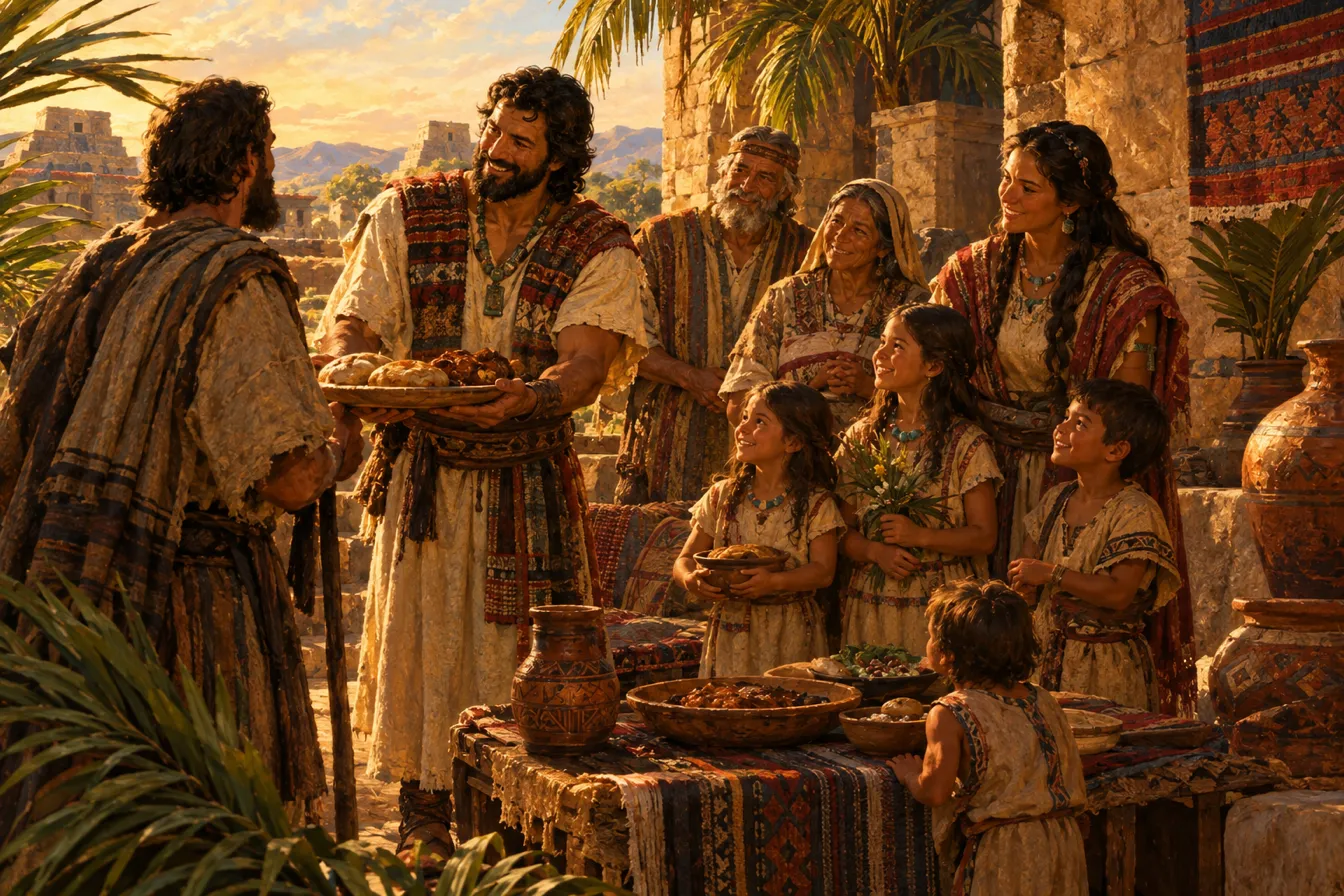
Some Latter-day Saint scholars have argued that righteous Nephite men, such as Amulek in Alma 10, practiced polygamy, and the argument is repeated today by some who teach that plural marriage is still God’s will. They point to Alma 10:11, “For behold, he hath blessed mine house, he hath blessed me, and my women, and my children, and my father and my kinsfolk; yea, even all my kindred hath he blessed, and the blessing of the Lord hath rested upon us according to the words which he spake,”1 and claim that “my women” refers to multiple wives and that God’s blessings condone this practice.2
The rest of the story says otherwise. Four things stand out:
- It is Alma’s household blessing. A few months earlier, on the same journey, Alma gave the same blessing, in the same words and the same order, to the whole city of Gideon.
- “My women” is how the Book of Mormon speaks of a household. Nephi speaks of “our women” in a company where every man had one wife. When the book means plural wives it says “wives and concubines,” and it condemns them every time.
- Amulek was not righteous until the angel came. By his own words he was “rebelling against God” until that very day. Even if his house held more than one wife, it can’t be an example of righteous polygamy.
- The blessing was not approval. Within months Amulek had lost nearly everyone it named.
The Story
Alma had just finished preaching in Gideon at the end of the ninth year of the judges. Early in the tenth year he taught in Melek and then traveled three days north to the city of Ammonihah.3 Ammonihah was a city gripped by apostasy and the order of Nehor: “Now Satan had gotten great hold upon the hearts of the people of the city of Ammonihah; therefore they would not hearken unto the words of Alma.”4 The people rejected Alma’s preaching, reviled him, and even spat on him.5 Dejected, Alma left, but an angel appeared and commanded him to return.6
The angel had already been to Amulek. On “the fourth day of this seventh month,” Amulek was on his way to see “a very near kindred” when the angel stopped him and sent him home to feed a prophet: “thou shalt receive him into thy house and feed him, and he shall bless thee and thy house; and the blessing of the Lord shall rest upon thee and thy house.”7 When Alma came back into the city hungry, Amulek was ready for him: “I know that thou wilt be a blessing unto me and my house.”8 Amulek fed him, and “Alma ate bread and was filled; and he blessed Amulek and his house.”9 Alma reiterated, “And now, Amulek, because thou hast fed me and taken me in, thou art blessed.”10
Alma tarried with Amulek for many days before preaching,11 during which time Amulek repented and became a servant of the Lord: “And the word came to Alma, saying: Go; and also say unto my servant Amulek, go forth and prophesy unto this people.”12 When the people tried to seize Alma, Amulek stood up beside him as a second witness.13 He told the city who he was: a descendant of Nephi, “a man of no small reputation among all those who know me,” with “many kindreds and friends” and “much riches.”14 He confessed that he had rebelled against God until the angel came. Then he told them what Alma had done for his house, and that is where Alma 10:11 comes from. When he finished, “the people began to be astonished, seeing there was more than one witness.”15
So Alma 10:11 is not a description of Amulek’s marriage. It is his testimony, to a city that knew him and his household, that the angel’s promise had come true. The blessings in Alma 10:11 fulfill the angel’s promise through Alma, not as divine approval of Amulek’s pre-repentance life.
The Same Blessing Alma Gave Gideon
Alma had given this blessing before, on the same journey. In Gideon, a righteous city where the people accepted his message (“because your faith is strong concerning that, yea, concerning the things which I have spoken, great is my joy”),16 Alma left a blessing: “And now, may the peace of God rest upon you, and upon your houses and lands, and upon your flocks and herds, and all that you possess, your women and your children, according to your faith and good works, from this time forth and forever.”17
| Gideon, a whole city (Alma 7:27) | Amulek’s house (Alma 10:7, 11) | |
|---|---|---|
| The blessing rests | “may the peace of God rest upon you” | “the blessing of the Lord shall rest upon thee” (10:7); “the blessing of the Lord hath rested upon us” (10:11) |
| The house | “and upon your houses” | “he hath blessed mine house” |
| The women and children | “your women and your children” | “my women, and my children” |
| Everyone and everything else | “your flocks and herds, and all that you possess” | “my father and my kinsfolk; yea, even all my kindred” |
| On what terms | “according to your faith and good works” | “according to the words which he spake” |
It’s the same blessing, in the same order, from the same prophet, a few months apart. The words are Alma’s own. In the whole Book of Mormon, a blessing that “rests upon” a household appears only in these two places, and so does a prophet who “blessed” a man’s house.18 No one reads “your women” in Gideon as a city of polygamists. “Women” is part of Alma’s household blessing, and Amulek repeats it when he tells the people what Alma did for his house.
What “My Women” Means
The text never uses “wives,” only “my women,” a broad term likely referring to female household members. The Book of Mormon speaks of households this way all the time. Nephi, writing of a company in which every man had taken one wife,19 says “our women did bear children in the wilderness.”20 Helaman writes that “our fathers and our women and our children are returning to their homes,”21 the same fathers, women and children Amulek names. The only other man in the book who says “my women” is the Lamanite king Ammoron, and he means the women of his people: “I will arm my women and my children.”22 Compare Captain Moroni’s “my men,”23 which denotes soldiers or followers, not implying polyandry.
Amulek’s own list shows how large his household was. Alma blessed “my women, and my children, and my father and my kinsfolk; yea, even all my kindred.” His father and his kin were counted in his house. A household like that would have more than one woman in it. As a man of “no small reputation” with “much riches,”24 Amulek likely cared for dependents, including a wife, daughters, widowed relatives, sisters, mother-in-law, or maidservants. Amulek names his father but not his mother, so his father may have been a widower. In Ammonihah’s social collapse, he may have sheltered displaced women, fitting Nephite patterns of protecting the vulnerable (echoing the law of Moses, which left the gleanings for the stranger, the fatherless and the widow).25
When the Book of Mormon means plural wives, it says so, and it condemns them. The word “concubines” appears eight times, and every time it is condemned.26 The Nephites under the second king were “desiring many wives and concubines.”27 King Noah “had many wives and concubines.”28 Riplakish “did have many wives and concubines.”29 If Amulek had plural wives, he would be the only righteous man in the book with more than one, and the text never calls his women wives.
Nephite writers could use “women” for wives. At the burning in Ammonihah, the “wives and children” of Alma 14:8 are “the women and children” of 14:10,30 and the book pairs “women” with “children” as often as it pairs “wives” with “children” (34 times each). But those were the wives of many believing men. That shows the word can mean wives; it doesn’t show that any one man had more than one.
Some argue that a man of Amulek’s wealth would have had several wives, since in the ancient world it was the rich who could.31 In the Book of Mormon, the rich men with many wives are King Noah and Riplakish, and Jacob tied the search for gold and silver to the desire for many wives as one sin.32 Amulek went the other way: he forsook “all his gold, and silver, and his precious things… for the word of God.”33
Even If “My Women” Meant Wives
Amulek openly admitted his rebellious past: “Nevertheless, I did harden my heart, for I was called many times and I would not hear; therefore I knew concerning these things, yet I would not know; therefore I went on rebelling against God, in the wickedness of my heart, even until the fourth day of this seventh month, which is in the tenth year of the reign of the judges.”34
He “went on rebelling against God, in the wickedness of [his] heart.” This mirrors Jacob’s condemnation of similar practices: “I must testify unto you concerning the wickedness of your hearts.”35 Jacob explicitly prohibited polygamy among Lehi’s descendants: “There shall not any man among you have save it be one wife; and concubines he shall have none.”36 As a descendant of Lehi,37 Amulek falls under this commandment, leaving no room for “righteous polygamy” among the Lehites.
So even if “my women” did mean more than one wife, the most the verse could show is a household Amulek formed while, by his own account, he was rebelling against God. That’s the opposite of the “righteous” polygamist the argument needs. And a man who repents doesn’t have to abandon the wives and children he already has. The Lord blessed Amulek’s whole house, as the angel promised. That is mercy toward a repentant man, not a pattern for the righteous to follow.
Alma knew this from his own family. His father had been one of King Noah’s priests,38 in a court where the priests kept “their wives and their concubines.”39 The record never says the elder Alma had more than one wife, and I’m not suggesting he did. It says only that he had been part of that court, and that years later he told his people, “remember the iniquity of king Noah and his priests; and I myself was caught in a snare, and did many things which were abominable in the sight of the Lord, which caused me sore repentance.”40 The Book of Mormon shows men coming out of that life by repentance. It never shows a man blessed for living it.
What Became of Amulek’s House
The blessing in Alma 10:11 rested on Amulek’s whole household, but it didn’t hold them. When the people of Ammonihah rejected the word, they “brought their wives and children together, and whosoever believed or had been taught to believe in the word of God they caused that they should be cast into the fire.”41 Alma had lived in Amulek’s house for many days, teaching. Alma and Amulek were carried out bound to watch,42 and Amulek cried out at “the pains of the women and children who were consuming in the fire.”43
The record doesn’t say whether his own women and children were among them. But when it later tells what Amulek lost, it names his riches, his friends, his father and his kindred, and not his women and children: Amulek had “forsaken all his gold, and silver, and his precious things, which were in the land of Ammonihah, for the word of God, he being rejected by those who were once his friends and also by his father and his kindred.”44
Everything in Amulek’s life had turned around. In Alma 10 he was “a man of no small reputation,” with “many kindreds and friends” and “much riches.” Now his riches were gone, and his friends, his father and his kindred had rejected him. He had taken Alma into his house; now Alma “took him to his own house, and did administer unto him in his tribulations, and strengthened him in the Lord.”45 Within months, “every living soul of the Ammonihahites was destroyed.”46
It’s a sad ending for Amulek’s father and kindred. They had been blessed in Amulek’s house by a prophet an angel sent there, and then they rejected Amulek for the word of God he preached. As far as the record tells, they stayed in Ammonihah. Not all who receive the message continue faithful. Alma blessed Gideon “according to your faith and good works,” and the blessing on Amulek’s house worked the same way: it was an invitation to each of them, not approval of the household as it stood.
What Amulek Received
Amulek’s story shows what following Christ can cost. Jesus promised that “every one that hath forsaken houses, or brethren, or sisters, or father, or mother, or wife, or children, or lands, for my name’s sake, shall receive an hundredfold, and shall inherit everlasting life.”47 Amulek forsook nearly everything on that list.
The Lord did not forget him. Years later, before the mission to the Zoramites, Alma prayed for his fellow laborers by name: “also Amulek and Zeezrom, and also my two sons—yea, even all these wilt thou comfort, O Lord. Yea, wilt thou comfort their souls in Christ.” When Alma laid his hands on them, “they were filled with the Holy Spirit.” The man who once fed a hungry prophet was now fed by the Lord: “the Lord provided for them that they should hunger not, neither should they thirst; yea, and he also gave them strength, that they should suffer no manner of afflictions, save it were swallowed up in the joy of Christ.”48
On that mission Amulek stood before the Zoramites and taught them to “cry unto him in your houses, yea, over all your household,” and not to “turn away the needy.”49 He knew what a household was worth.
Read this way, “my women” are the women of Amulek’s household, not plural wives. The rule the Book of Mormon gives Lehi’s descendants still stands: one wife, and concubines none. For more on that rule and the verse most often read as an exception to it, see A Deep Dive into Jacob 2:30.
Notes
- Alma 10:11 ↩
- John A. Tvedtnes, “The Hebrew Background of the Book of Mormon,” in Rediscovering the Book of Mormon, ed. John L. Sorenson and Melvin J. Thorne (Deseret Book and FARMS, 1991), 91, reads “my women” as wives, since the Hebrew word for women also means wives; “Why Is Amulek’s Household Significant?” KnoWhy #117 (Book of Mormon Central, May 24, 2017), builds on Tvedtnes and calls Amulek a likely polygamist. ↩
- Alma 8:1–6 ↩
- Alma 8:9; see also Alma 15:15, “they were of the profession of Nehor.” ↩
- Alma 8:11–13 ↩
- Alma 8:14–17 ↩
- Alma 10:6–7 ↩
- Alma 8:20 ↩
- Alma 8:22 ↩
- Alma 8:26 ↩
- Alma 8:27 ↩
- Alma 8:29 ↩
- Alma 9:32–34 ↩
- Alma 10:2–4 ↩
- Alma 10:12 ↩
- Alma 7:17 ↩
- Alma 7:27 ↩
- A blessing that rests upon a house: Alma 7:27; 10:7, 11. A man and his house blessed: Alma 8:22; 10:7, 11. The book’s other uses of “rest upon” are judgment (2 Nephi 1:10), Lehi’s first blessing passing to Nephi (2 Nephi 1:29) and the Spirit (2 Nephi 21:2). ↩
- “And it came to pass that I, Nephi, took one of the daughters of Ishmael to wife; and also, my brethren took of the daughters of Ishmael to wife; and also Zoram took the eldest daughter of Ishmael to wife.” – 1 Nephi 16:7 ↩
- 1 Nephi 17:1; see also 17:2, 20. ↩
- Alma 58:31 ↩
- Alma 54:12 ↩
- “I will command my men that they shall fall upon you, and inflict the wounds of death in your bodies, that ye may become extinct.” – Alma 44:7 ↩
- Alma 10:4 ↩
- Deuteronomy 24:19–21 ↩
- Jacob 1:15; 2:24, 27; 3:5; Mosiah 11:2, 4, 14; Ether 10:5. ↩
- Jacob 1:15 ↩
- Mosiah 11:2 ↩
- Ether 10:5 ↩
- Alma 14:8, 10. Moroni does the same with the Jaredites: “with their wives and their children—both men, women and children being armed with weapons of war.” – Ether 15:15 ↩
- KnoWhy #117, citing Ze’ev W. Falk, Hebrew Law in Biblical Times, 2nd ed. (2001). ↩
- Jacob 1:15–16 ↩
- Alma 15:16 ↩
- Alma 10:6 ↩
- Jacob 2:6 ↩
- Jacob 2:27 ↩
- Alma 10:2–3. Amulek traces his line to Nephi, the son of Lehi, and through Manasseh to Joseph of Egypt. ↩
- Mosiah 17:2 ↩
- Mosiah 11:4 ↩
- Mosiah 23:9 ↩
- Alma 14:8 ↩
- Alma 14:9 ↩
- Alma 14:10 ↩
- Alma 15:16 ↩
- Alma 15:18; compare Alma 8:21. ↩
- Alma 16:9. The city fell “on the fifth day of the second month” of the eleventh year (Alma 16:1), about seven months after the angel’s visit. ↩
- Matthew 19:29; see also 3 Nephi 12:10–12, “blessed are all they who are persecuted for my name’s sake, for theirs is the kingdom of heaven… for great shall be your reward in heaven.” ↩
- Alma 31:32, 36, 38; compare Alma 8:19–21, where Alma comes to Amulek hungry and is fed. ↩
- Alma 34:21, 28 ↩
Comments